

Most Muslim parents want their children to have a connection with the Quran. The difficult part is not usually the intention. It is making Quran learning a real part of a child’s life when mornings are rushed, school takes up most of the day, homework needs to be done and parents have their own work and responsibilities.
Sometimes parents start with good intentions, arrange Quran lessons and feel relieved that their child has finally started learning. Then, after a few weeks, the routine becomes difficult to maintain. The child loses interest, lessons are missed and everyone feels frustrated.
This is why Quran education is about more than simply finding someone to teach your child how to read. The way a child learns matters just as much as what they learn.
A Child’s First Experience With the Quran Matters
Think about a child who is learning something completely new.
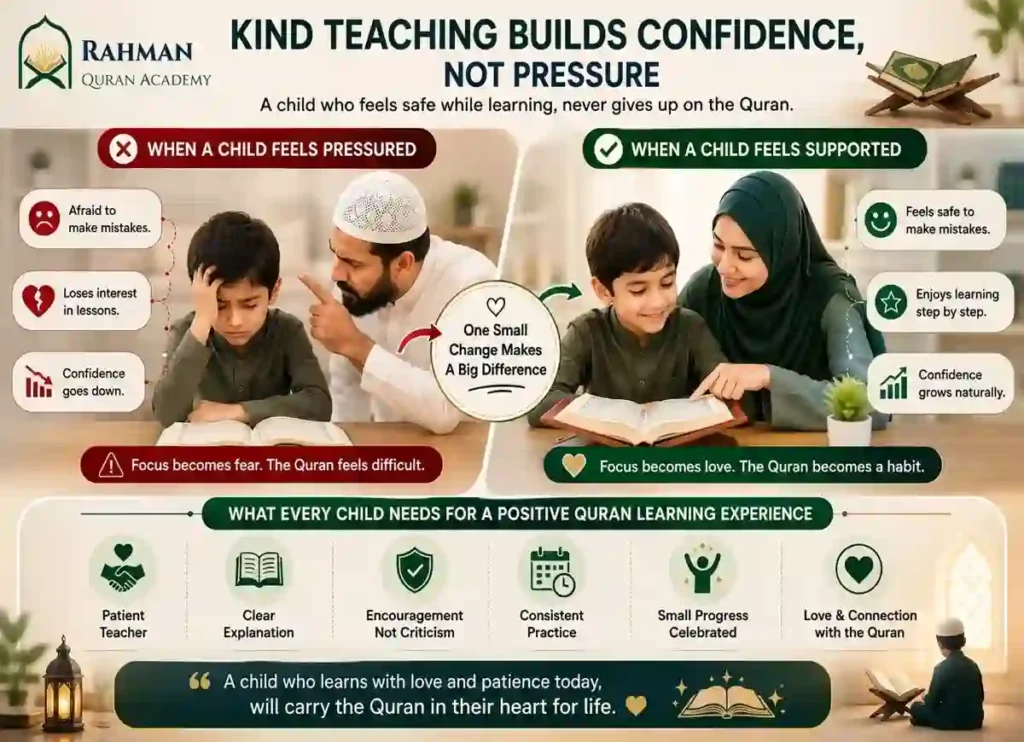
If every mistake is met with frustration, the child may become nervous about reading aloud. They start worrying about getting the next word wrong instead of actually enjoying the lesson.
Now imagine the opposite.
The teacher gives the child time, corrects the mistake kindly and celebrates a small improvement. The child finishes the lesson feeling, “I can do this.”
That difference may seem small, but it can shape how a child feels about Quran learning for years.
Children do not always remember every lesson they were taught. They often remember how the lesson made them feel.
That is why patience matters so much in Quran education.
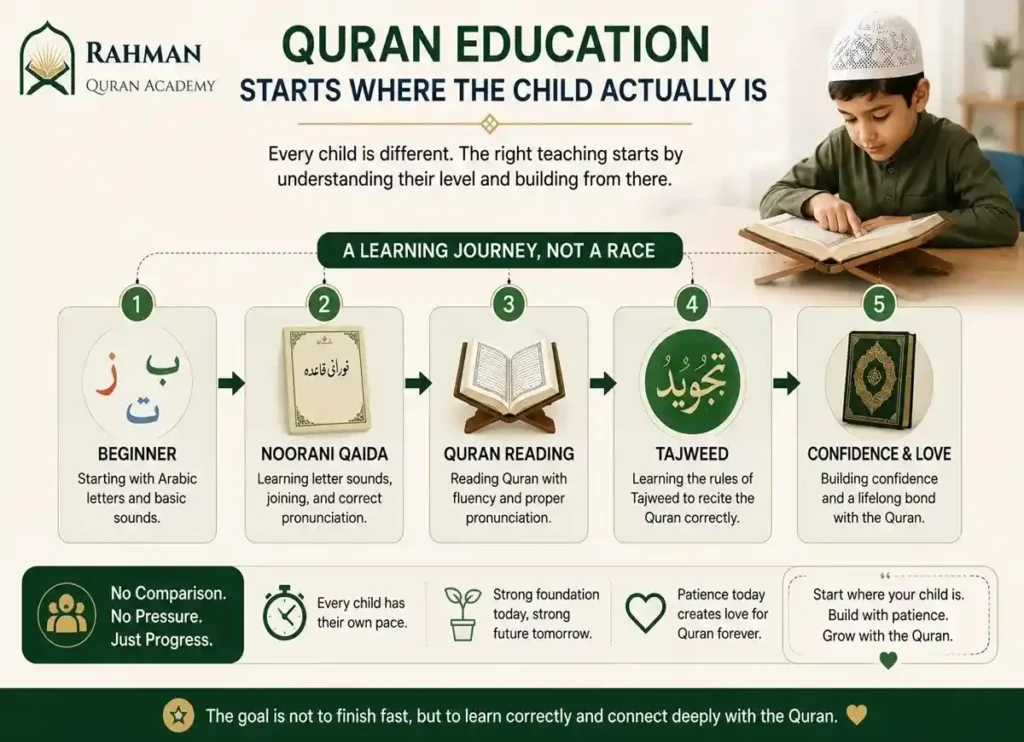
Quran Education Should Start Where the Child Actually Is
One of the biggest mistakes parents can make is comparing their child’s progress with another child’s.
Your neighbour’s child might already be reading the Quran fluently. Your child might still be struggling with Arabic letters. That does not mean your child is behind.
Children learn at different speeds.
A beginner may need to spend more time with Arabic letters and sounds before moving forward. Another child may already know the basics but struggle with fluency or pronunciation.
The teacher should first understand where the child is and then build from there.
For a beginner, that might mean starting with Noorani Qaida. For another child, it could mean improving Quran reading or working on Tajweed.
The important thing is that the child is learning correctly, not simply moving through pages as quickly as possible.
Noorani Qaida Is More Than a Book to Finish
Parents sometimes see Noorani Qaida as the stage a child needs to “get through” before starting the Quran.
That can lead to unnecessary pressure.
The real value of Qaida is the foundation it gives a beginner. Children learn how Arabic letters sound, how letters join together and how different sounds are produced.
If those basics are rushed, pronunciation problems can follow the child into Quran reading.
Taking a little longer at this stage is not wasted time.
In fact, it can save a lot of frustration later.
A child who learns the foundations properly is in a much better position when they begin reading Quranic verses.
Then Comes the Challenge of Tajweed
Once a child can read, another question usually comes up:
“Are they reading it correctly?”
This is where Tajweed becomes important.
A child may be able to read every word on the page but still make mistakes with pronunciation, elongation or other recitation rules. These mistakes are not unusual. They simply need to be identified and corrected.
The problem comes when children are encouraged to read faster before they have developed accurate habits.
A good teacher will sometimes stop the lesson for one small sound and practise it several times. To an adult, repeating the same sound may seem tedious. For a child, that repetition is often exactly what helps the correct pronunciation become natural.
Don’t Make Children Feel That They Are Failing
This deserves more attention than it usually gets.
A child who struggles with Quran reading does not necessarily need more pressure. They may need a different explanation, more practice or simply more time.
Imagine a child sitting in front of a teacher, knowing that they are going to be corrected every time they make a mistake. Eventually, they may become afraid to read.
That is the opposite of what parents want.
Correction is necessary. But there is a big difference between correcting a child and discouraging a child.
A patient teacher can say, “Let’s try that word again,” instead of making the child feel that they have done something terrible.
Over time, confidence makes a real difference. A child who is comfortable making mistakes is much more willing to keep trying.
Parents Don’t Have to Be Quran Teachers
Some parents feel guilty because they cannot personally teach their children.
They should not.
Parents can play an important role without being the person conducting every lesson.
You can make sure the child attends regularly. You can listen to them read. You can ask what they learned that day. You can encourage them when a difficult Surah finally becomes easier.
Even something as simple as asking, “What did you learn in your Quran lesson today?” shows the child that their learning matters to you.
Children notice these things.
When Quran education is treated as an important part of family life rather than another task on a timetable, they are more likely to take it seriously themselves.
Finding Time Is Often the Hardest Part
For many families, the problem is not willingness. It is the schedule.
A child comes home from school tired. There is homework to finish. Dinner needs to be prepared. Parents may still be working. By the time everything is done, the child has little energy left.
This is one reason many families consider online Quran education.
Learning from home removes the need to travel to another location and can make it easier to fit lessons around school and family life.
For parents exploring this option, Rahman Quran Academy is one online Quran education provider serving Muslim families in the UK.
Of course, convenience alone does not make an online class good. The teacher still needs to know how to work with children, correct their recitation and keep them involved during the lesson.
What Should Parents Look For in Quran Classes?
Before choosing a Quran class, it is worth asking a few straightforward questions.
Can the teacher work with children?
Teaching Quran requires knowledge, but teaching a child requires patience as well. These are not necessarily the same skill.
Will my child receive enough individual attention?
A child who is struggling with pronunciation can easily get overlooked in a large group.
Does the teacher correct mistakes properly?
A child should not simply be told to “read again.” They should understand what went wrong and how to improve it.
Can the lessons fit our family’s routine?
A perfect programme that your child cannot attend regularly is not much use.
Will I know how my child is progressing?
Parents should not have to guess whether their child is improving.
For families specifically looking for online quran classes for kids, these are the kinds of questions worth asking before committing to a programme.
Categories: PRAYER ,ALMS , SAWN & The Holy Quran, Quran Jaz 1- 114
Don’t Judge Progress Only by How Many Pages a Child Reads
This is another trap parents can fall into.
It feels good when a child moves quickly through the Quran. But finishing more pages does not necessarily mean they are learning better.
A child who reads slowly but pronounces the words correctly may be making better progress than a child who rushes through several pages while repeating the same mistakes.
Look for smaller signs.
Maybe your child used to hesitate before reading and now starts confidently. Maybe a particular pronunciation that was difficult a month ago has improved. Maybe they have started reminding you that it is time for their lesson.
Those changes matter.
Sometimes progress is not obvious until you look back and realise how far the child has come.
Make Practice Small Enough to Actually Happen
Parents often think practice needs to be a long session.
It doesn’t.
For a young child, ten focused minutes can be more useful than thirty minutes of distracted reading.
The exact amount will depend on the child’s age and level, but the principle is simple: regular practice beats occasional pressure.
A child can revise a few difficult words, read a recently learned passage or repeat a Tajweed rule.
The aim is to keep the Quran familiar without turning every evening into a struggle.
The Teacher-Parent Relationship Matters Too
Parents and teachers should not work separately.
If a child keeps making the same mistake, the teacher should be able to tell the parent. If the child seems unusually tired, frustrated or distracted, the parent should be able to mention it to the teacher.
This communication helps everyone understand what the child actually needs.
It also prevents parents from judging progress based on one lesson or one difficult day.
Some days a child will read beautifully.
Other days they may be distracted, tired or simply not in the mood.
That is normal.
What matters is what happens over the weeks and months.
Give Your Child Time
Perhaps the most useful advice for parents is also the simplest:
Don’t rush your child.
You want your child to read the Quran correctly. You want them to learn Tajweed. You may hope they will memorise Surahs and eventually complete the Quran.
Those are all worthwhile goals.
But children need time to reach them.
If the foundations are strong, progress can build naturally. If the foundations are rushed, parents may eventually have to go back and correct problems that could have been avoided in the first place.
Quran education is not a race between children.
It is about helping one child take the next right step.
Final Thoughts
Every parent wants their child to grow up with the Quran close to their heart.
But that relationship cannot be forced into existence through pressure or a race to finish lessons.
Children need good teaching, patient correction and plenty of encouragement. They need parents who care about their progress without making every mistake feel like a failure.
Whether a child is learning Noorani Qaida for the first time, improving Quran reading or beginning Tajweed, the same principle applies: give them the right support and give them time.
A child who learns to read the Quran with confidence and affection has gained something far more valuable than simply completing a course. They have started building a relationship with the Quran that can continue long after childhood.
Recommended For You
- Quran Juz 1 to 30 List Free PDF Download
- Tracing Quran Juz 1-10 by Bil-Thikr Productions
- Tracing Quran Juz 11-20 by Bil-Thikr Productions
- Tracing Quran Juz 21-30 by Bil-Thikr Productions
- Tracing The Quran Juz By Juz: Download All 30 Parts