
Dua for visiting graveyard is a short greeting and prayer the Prophet ﷺ taught for anyone who steps among the graves. It gives peace to those who have passed and quietly reminds the visitor of his own return to Allah. Many Muslims go to a graveyard and stand there unsure what to say.
If you want to understand death and the afterlife with a calm heart, Al-Ghazali’s Remembrance of Death and the Afterlife is a thoughtful read.
Why Visiting Graves Matters
A cemetery is a place of burial, but in Islam it is also a place of reflection. Britannica’s note on cemeteries shows how nearly every culture treats these grounds with respect.
A visit softens the heart. It pulls attention away from daily noise and toward the Hereafter.
Also Read: As Alullah Al Azim Dua in Arabic (أسألُ اللهَ العَظِيمَ ربَّ العَرْشِ العَظيمِ أنْ يَشْفِيَكَ)
Dua for visiting graveyard
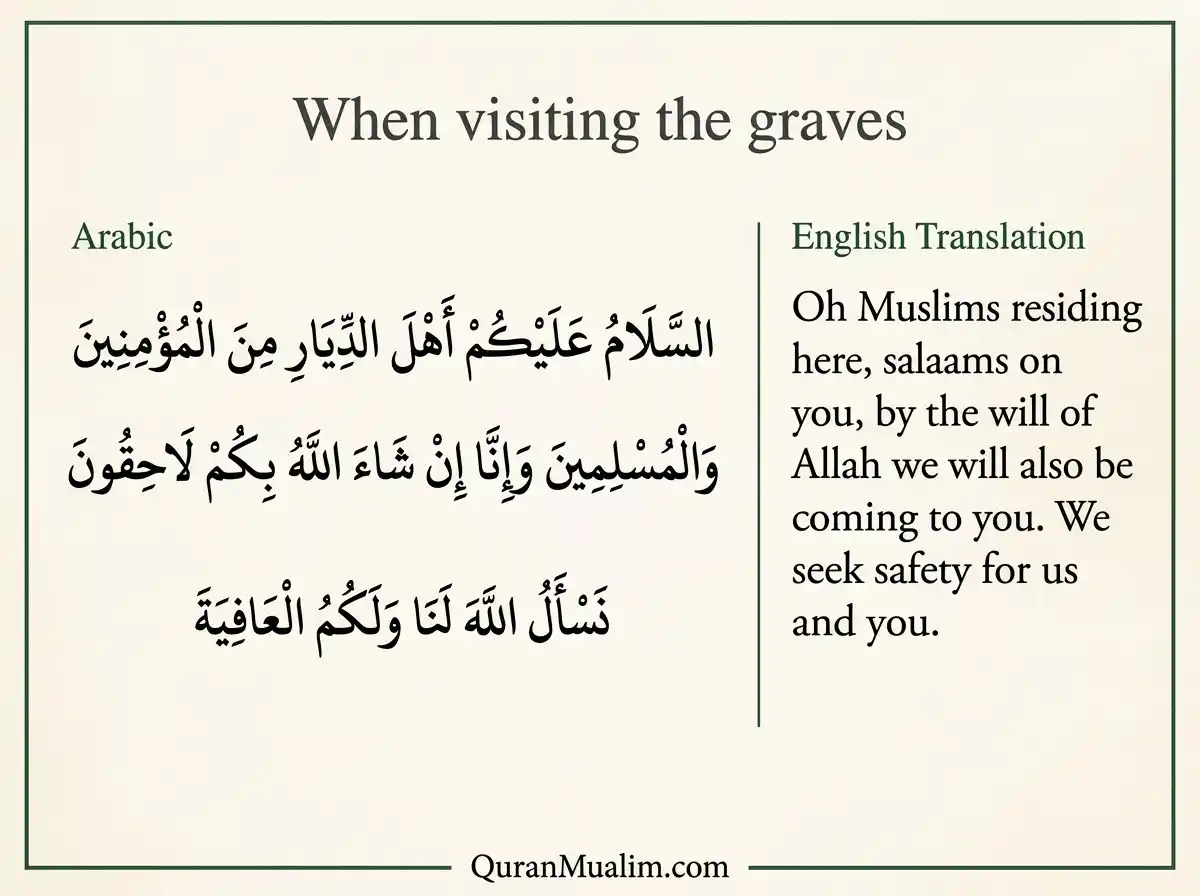
This is the dua taught by the Prophet ﷺ when entering the graveyard.
Arabic: السَّلَامُ عَلَيْكُمْ أَهْلَ الدِّيَارِ مِنَ الْمُؤْمِنِينَ وَالْمُسْلِمِينَ، وَإِنَّا إِنْ شَاءَ اللَّهُ بِكُمْ لَاحِقُونَ، نَسْأَلُ اللَّهَ لَنَا وَلَكُمُ الْعَافِيَةَ
Transliteration: As-salamu ‘alaykum ahlad-diyari minal-mu’minina wal-muslimin, wa inna in sha’Allahu bikum lahiqun, nas’alullaha lana wa lakumul-‘afiyah.
English Translation: Peace be upon you, people of this abode, among the believers and the Muslims. We will join you, if Allah wills. We ask Allah for well-being for us and for you.
Urdu Translation: اے مومنوں اور مسلمانوں کے گھر والو! تم پر سلامتی ہو۔ ان شاء اللہ ہم بھی تم سے ملنے والے ہیں۔ ہم اللہ سے اپنے لیے اور تمہارے لیے عافیت مانگتے ہیں۔
After this greeting, you may make a personal dua for forgiveness and mercy for the deceased.
A Simple Fiqh Rule
Hanafi scholars teach that visiting graves is recommended, especially for men, and a mark of remembering death. The dua is always made to Allah, never to the dead. Avoid wailing, sitting or walking on graves, and asking the deceased for help.
For further reading, look for these classical Hanafi titles in libraries: Imdad al-Ahkam and Fatawa Darul Uloom Deoband.
Your Graveyard Visit Checklist
- Make your intention for Allah’s sake.
- Greet the people of the graves with the Sunnah dua.
- Stand quietly and pray for forgiveness for them.
- Keep your voice low and your behavior respectful.
- Leave with a promise to improve your own deeds.
Also Read: Complete Guide To The Dua Allahummaghfirli Zambi
Where to Keep Learning
| Trusted Site | What You Will Find |
| IslamQA | Clear answers on funerals, graves, and etiquette |
| Islamic Teachings Forum | Community discussion and guidance |
| Sunnah.com | Hadith with chapters and grading |
| Quran.com | Qur’an text with translations |
Also Read: Namaz Dua (Masnoon Duain) PDF Download

Alasad online Quran Tutor
Want to recite these words with confidence? Our teachers guide beginners in Arabic pronunciation, one step at a time. Message us on WhatsApp at +923017363500 or email [email protected] to book your free trial class.
Categories: PRAYER ,ALMS , SAWN & The Holy Quran, Quran Jaz 1- 114
Frequently Asked Questions
Can women visit the graveyard?
Scholars differ. Many allow it with conditions: no loud crying, no neglecting duties, and no unsafe situations. Ask a trusted scholar about your circumstances.
Do I have to say the dua in Arabic?
Arabic is best because it is the authentic wording. If you cannot recite it yet, say it in your own language while you learn.
Can I recite Qur’an at the graves?
Scholars hold different views here. The clearly proven Sunnah is the greeting and dua, so sticking to that is the safest path.
Is it allowed to cry at a grave?
Quiet tears from sadness are natural. Loud wailing and screaming are not allowed. Patience, as the Prophet ﷺ taught, is the goal.
Can I visit on any day?
Yes. There is no fixed day. Visit whenever you can, and avoid treating one day as a special requirement.
Conclusion
A graveyard is a quiet teacher. One short greeting, one sincere dua, and a few minutes of reflection can change how you spend the rest of your day. Make this Sunnah part of your life, pray for those who went ahead of us, and remember that every soul is walking the same road. Start with your next visit.
Related Posts For You
- Allahumma Ajirni Minan Naar
- Allahummaghfirli Zambi Dua
- Astaghfirullah Meaning in Urdu
- Allahumma Rahmataka Arju: A Dua For Hope
- la ilaha illa anta subhanaka inni kuntu arabic
- Powerful Dua For Repentance and Forgiveness
- Prayer For Forgiveness of Others – Islamic Guide
- Prayer For Forgiveness of Others – Islamic Guide
- Allahumma Ajirni Minan Naar in Arabic & English
- Subhanallahi wa bihamdihi subhanallahil azeem astaghfirullah meaning