
Hajj and Umrah constitute paramount acts of devotion within Islam, drawing believers from across the globe to Makkah to prostrate before Allah, meditate upon His majesty, and perform the rituals ordained for the Sacred House.The Holy Quran elucidates these sacred obligations through revelations regarding the sincere completion of pilgrimage, the profound significance of Safa and Marwah, the sanctity of the Kaaba, the divine summons issued by Prophet Ibrahim (AS), and the prescribed conduct expected of all pilgrims.
Should you seek Quranic verses pertaining to Hajj and Umrah, this compilation assembles the most pertinent passages alongside their original Arabic, English translations, and contextual exegesis.
Furthermore, it meticulously delineates those revelations that explicitly reference Umrah from those that address Hajj within the wider framework of the pilgrimage.
Please note that English translations may exhibit minor variations in phrasing.
The Arabic text of the Quran constitutes the original source, while the English renderings provided herein adhere to the meaning of the cited translations.
1. Surah Al-Baqarah (2:196) – Complete Hajj and Umrah for Allah
Surah Al-Baqarah, verse 196, stands as one of the most explicit Quranic allusions to the rites of Hajj and Umrah.
It mandates that believers fulfill these devotional obligations for the sake of Allah while delineating specific regulations pertaining to Ihram, sacrificial offerings, and the contingencies that might hinder a pilgrim from concluding the prescribed rituals.
Arabic:
وَاَتِمُّوا الۡحَجَّ وَالۡعُمۡرَةَ لِلّٰهِؕ فَاِنۡ اُحۡصِرۡتُمۡ فَمَا اسۡتَيۡسَرَ مِنَ الۡهَدۡىِۚ وَلَا تَحۡلِقُوۡا رُءُوۡسَكُمۡ حَتّٰى يَبۡلُغَ الۡهَدۡىُ مَحِلَّهٗ ؕ فَمَنۡ كَانَ مِنۡكُمۡ مَّرِيۡضًا اَوۡ بِهٖۤ اَذًى مِّنۡ رَّاۡسِهٖ فَفِدۡيَةٌ مِّنۡ صِيَامٍ اَوۡ صَدَقَةٍ اَوۡ نُسُكٍۚ فَاِذَآ اَمِنۡتُمۡ فَمَنۡ تَمَتَّعَ بِالۡعُمۡرَةِ اِلَى الۡحَجِّ فَمَا اسۡتَيۡسَرَ مِنَ الۡهَدۡىِۚ فَمَنۡ لَّمۡ يَجِدۡ فَصِيَامُ ثَلٰثَةِ اَيَّامٍ فِى الۡحَجِّ وَسَبۡعَةٍ اِذَا رَجَعۡتُمۡؕ تِلۡكَ عَشَرَةٌ كَامِلَةٌ ؕ ذٰ لِكَ لِمَنۡ لَّمۡ يَكُنۡ اَهۡلُهٗ حَاضِرِىۡ الۡمَسۡجِدِ الۡحَـرَامِؕ وَاتَّقُوا اللّٰهَ وَاعۡلَمُوۡٓا اَنَّ اللّٰهَ شَدِيۡدُ الۡعِقَابِ
English meaning:
Undertake the Great Pilgrimage or the Minor Pilgrimage in obedience to Allah; however, if circumstances render the journey impossible, then provide the sacrificial offering within your means.
Furthermore, refrain from shaving your heads until the sacrificial animal has successfully reached its designated destination.
However, should any individual fall ill or suffer from a scalp condition necessitating a shave, they must expiate this by observing a fast, offering charity, or presenting a sacrificial animal.
Furthermore, during times of tranquility, those who conjoin the minor pilgrimage with the major one are obligated to provide the sacrificial offering within their means.
Those unable to afford the full sacrifice during the pilgrimage are instructed to fast for three days while in Mecca and seven upon their return to their homes, thereby completing the requisite ten days.
This stipulation applies specifically to individuals whose families reside outside the immediate vicinity of the Sacred Mosque.Furthermore, one should maintain a profound consciousness of the Divine, bearing in mind that Allah is severe in His retribution.
-Al-Baqarah 2:196 (translation of meaning)
Explanation:
The opening declaration, “Complete the Hajj and Umrah for Allah,” underscores the imperative to undertake these devotional rites with genuine sincerity dedicated solely to the Divine.
Furthermore, the verse delineates specific procedural guidelines pertinent to the pilgrimage journey, addressing scenarios where travelers may be obstructed from their intended path, outlining regulations regarding the shaving of the head, stipulating compensation in particular instances, and clarifying the sacrificial obligations arising from the confluence of Umrah and Hajj.
This verse holds particular significance for its explicit designation of both Hajj and Umrah, serving as a reminder to pilgrims that these rites constitute acts of worship which must be executed in full conformity with their prescribed religious obligations.
2.Surah Al-Baqarah (2:158) – Safa and Marwah Are Among the Signs of Allah
Safa and Marwah are two elevated sites situated within the precincts of the Sacred Mosque in Makkah.
The act of traversing the path that connects these hills, an observance termed Sa’i, constitutes a pivotal ritual integral to both the Hajj and Umrah pilgrimages.
Arabic:
إِنَّ ٱلصَّفَا وَٱلْمَرْوَةَ مِن شَعَآئِرِ ٱللَّهِ ۖ فَمَنْ حَجَّ ٱلْبَيْتَ أَوِ ٱعْتَمَرَ فَلَا جُنَاحَ عَلَيْهِ أَن يَطَّوَّفَ بِهِمَا ۚ وَمَن تَطَوَّعَ خَيْرًا فَإِنَّ ٱللَّهَ شَاكِرٌ عَلِيمٌ
English meaning:
The hills of Safa and Marwah stand as distinguished symbols of the Divine.
Consequently, every pilgrim undertaking the major or minor Hajj to the Sacred House is commanded to traverse the path between these two elevations.Furthermore, Allah, who is undeniably Grateful and Omniscient, wills to accept any act of benevolence performed with sincere intention.
-Al-Baqarah 2:158 (translation of meaning)
Explanation:
This sacred passage designates Safa and Marwah as manifestations of the Divine, explicitly encompassing both the rites of Hajj and Umrah.
The ritual circumambulation performed between these elevated landmarks is known as Sa’i.
The ritual is intrinsically linked to the narrative of Hajar (AS), who endeavored to secure water for her son, Ismail (AS).
During the performance of Sa’i, Muslims commemorate her unwavering perseverance and profound reliance upon Allah.
The verse further elucidates that acts of worship must be undertaken with profound devotion and an earnest commitment to obedience toward Allah.
3.Surah Aal-e-Imran (3:96-97) – The Sacred House in Makkah and the Obligation of Hajj
These two verses delineate the unique sanctity of the Kaaba in Bakkah (Makkah) and simultaneously mandate the performance of Hajj for those Muslims who possess the requisite capacity to embark upon this journey.
Surah Aal-e-Imran (3:96)
Arabic:
إِنَّ أَوَّلَ بَيْتٍ وُضِعَ لِلنَّاسِ لَلَّذِى بِبَكَّةَ مُبَارَكًا وَهُدًى لِّلْعَـٰلَمِينَ
English meaning:
Undoubtedly, the inaugural house of worship ordained for mankind is that located at Bakkah, a sanctuary endowed with blessings and serving as a guiding light for all humanity.
-Aal-e-Imran 3:96 (translation of meaning)
Surah Aal-e-Imran (3:97)
Arabic:
فِيهِ ءَايَـٰتٌۢ بَيِّنَـٰتٌۭ مَّقَامُ إِبْرَٰهِيمَ ۖ وَمَن دَخَلَهُۥ كَانَ ءَامِنًۭا ۗ وَلِلَّهِ عَلَى ٱلنَّاسِ حِجُّ ٱلْبَيْتِ مَنِ ٱسْتَطَاعَ إِلَيْهِ سَبِيلًۭا ۚ وَمَن كَفَرَ فَإِنَّ ٱللَّهَ غَنِىٌّ عَنِ ٱلْعَـٰلَمِينَ
English meaning:
The sanctuary bears unmistakable markers, most notably the site where Abraham once stood.
Those who enter may find complete security.Undertaking a pilgrimage to this sacred edifice constitutes a mandatory obligation incumbent upon all who possess the means to undertake such a journey.Yet, for those who decline, Allah remains entirely self-sufficient, requiring nothing from His creation.
-Aal-e-Imran 3:97 (translation of meaning)
Explanation:
These passages underscore the sanctity of the Kaaba as a preeminent site of devotion and spiritual direction.
Specifically, verse 97 delineates Hajj as a mandatory duty incumbent upon those who possess the requisite capacity to undertake the pilgrimage.
The requisite capacity is a pivotal consideration in Islamic jurisprudence, where it is examined in contexts ranging from financial solvency and physical well-being to the secure feasibility of travel.
While certain verses unequivocally mandate the performance of Hajj, they must not be construed as a definitive pronouncement regarding the legal standing of Umrah.
4.Surah Al-Hajj (22:26-27) – Prophet Ibrahim’s Call to Pilgrimage
In the Quran, it is recounted that Allah directed Prophet Ibrahim (AS) concerning the Sacred House and exhorted him to summon humanity to undertake the pilgrimage.
Surah Al-Hajj (22:26)
Arabic:
وَإِذْ بَوَّأْنَا لِإِبْرَٰهِيمَ مَكَانَ ٱلْبَيْتِ أَن لَّا تُشْرِكْ بِى شَيْـًۭٔا وَطَهِّرْ بَيْتِىَ لِلطَّآئِفِينَ وَٱلْقَآئِمِينَ وَٱلرُّكَّعِ ٱلسُّجُودِ
English meaning:
Recall the occasion when We designated for Abraham the sacred precinct of the House, commanding him, ‘Reject no form of partnership in My worship and sanctify My sanctuary for those who circumambulate the Kaaba, engage in standing prayer, and perform the bowing and prostration.’
-Al-Hajj 22:26 (translation of meaning)
Surah Al-Hajj (22:27)
Arabic:
وَأَذِّن فِى ٱلنَّاسِ بِٱلْحَجِّ يَأْتُوكَ رِجَالًۭا وَعَلَىٰ كُلِّ ضَامِرٍۢ يَأْتِينَ مِن كُلِّ فَجٍّ عَمِيقٍۢ
English meaning:
Announce the sanctity of the pilgrimage to the masses; they shall arrive upon you, traversing arduous and remote routes, some on foot and others upon the most destitute camels.
-Al-Hajj 22:27 (translation of meaning)
Explanation:
These passages forge an intrinsic link between the pilgrimage to the Prophet Ibrahim (AS) and the consecration of the Sacred House.
Verse 26 underscores the imperative of worshipping Allah exclusively while ensuring the sanctity of His House remains untainted for all who engage in acts of devotion.Furthermore, Verse 27 delineates the summons to Hajj, highlighting the convergence of pilgrims who traverse vast distances to reach this holy sanctuary.
The depiction of pilgrims journeying from distant lands underscores the global scope of the Hajj.
Muslims hailing from diverse nations, linguistic backgrounds, and cultural heritages converge in Makkah, united by a singular objective: the worship of Allah.
5.Surah Al-Baqarah (2:197) – Good Conduct and Taqwa During Hajj
The Hajj extends far beyond the mere fulfillment of physical rituals; the Quran further instructs pilgrims to uphold exemplary conduct, refrain from discord, and maintain a constant awareness of Allah throughout the journey.
Arabic:
ٱلْحَجُّ أَشْهُرٌۭ مَّعْلُومَـٰتٌۭ ۚ فَمَن فَرَضَ فِيهِنَّ ٱلْحَجَّ فَلَا رَفَثَ وَلَا فُسُوقَ وَلَا جِدَالَ فِى ٱلْحَجِّ ۗ وَمَا تَفْعَلُوا۟ مِنْ خَيْرٍۢ يَعْلَمْهُ ٱللَّهُ ۗ وَتَزَوَّدُوا۟ فَإِنَّ خَيْرَ ٱلزَّادِ ٱلتَّقْوَىٰ ۚ وَٱتَّقُونِ يَـٰٓأُو۟لِى ٱلْأَلْبَـٰبِ
English meaning:
The pilgrimage of Hajj unfolds within specific, universally recognized months.
Any individual who undertakes this sacred journey during this period is required to abstain from intimate relations, sin, and contention.Whatever virtuous deeds one performs are invariably known by Allah.Furthermore, travelers are exhorted to procure provisions, yet the most valuable sustenance is undoubtedly righteousness.Therefore, O people of insight, remain ever mindful of Me.
-Al-Baqarah 2:197 (translation of meaning)
Explanation:
This verse offers profound instruction regarding the conduct of a pilgrim, urging the abstention from indecent behavior, transgression, and discord throughout the Hajj.
It further emphasizes that *Taqwa*—the conscious reverence of Allah—constitutes the most superior sustenance for the journey.
Pilgrims frequently endure congested environments, extended treks, and significant physical exertion, thereby rendering patience, benevolence, and profound respect for fellow travelers indispensable virtues throughout the Hajj.
Although this verse explicitly delineates the rites of Hajj, the imperatives regarding moral conduct it elucidates possess enduring relevance, extending their application to the daily lives of all Muslims.
6. Surah Al-Baqarah (2:198) – Remembering Allah at Mash’ar al-Haram
The Quran further delineates the observance of remembrance for Allah subsequent to the pilgrims’ departure from Arafat in the Hajj.
Arabic:
لَيْسَ عَلَيْكُمْ جُنَاحٌ أَن تَبْتَغُوا۟ فَضْلًۭا مِّن رَّبِّكُمْ ۚ فَإِذَآ أَفَضْتُم مِّنْ عَرَفَـٰتٍۢ فَٱذْكُرُوا۟ ٱللَّهَ عِندَ ٱلْمَشْعَرِ ٱلْحَرَامِ ۖ وَٱذْكُرُوهُ كَمَا هَدَىٰكُمْ وَإِن كُنتُم مِّن قَبْلِهِۦ لَمِنَ ٱلضَّآلِّينَ
English meaning:
You incur no reproach in pursuing the blessings bestowed by your Sustainer; yet, as you conclude your sojourn at Arafat, it is incumbent upon you to invoke the Name of Allah at Al-Mash’ar al-Haram.
Reflect upon the guidance He has granted you, acknowledging that prior to this, you were indeed among those who had strayed.
-Al-Baqarah 2:198 (translation of meaning)
Explanation:
This verse delineates a distinct phase of the Hajj, urging pilgrims to maintain remembrance of Allah as they traverse from Arafat to Mash’ar al-Haram, while unequivocally establishing that soliciting Allah’s sustenance during the pilgrimage carries no stigma.
The verse elucidates that the remembrance of Allah constitutes the very essence of the pilgrimage.
Far from being a mere excursion to sacred sites, this journey represents an act of worship demanding profound gratitude, humility, and unwavering devotion.
7. Surah Al-Hajj (22:32) – Respecting the Symbols of Allah
The Qur’an instructs the faithful to reverence the sanctified emblems instituted by Allah, a directive that holds profound significance regarding the rituals and holy sites integral to the pilgrimage.
Arabic:
ذَٰلِكَ وَمَن يُعَظِّمْ شَعَـٰٓئِرَ ٱللَّهِ فَإِنَّهَا مِن تَقْوَى ٱلْقُلُوبِ
English meaning:
Indeed, and whoever reveres the symbols of Allah does so undoubtedly out of profound piety inherent within their heart.
-Al-Hajj 22:32 (translation of meaning)
Explanation:
This verse establishes a profound linkage between the veneration of Allah’s sacred emblems and the cultivation of *Taqwa*.
The essence of pilgrimage is comprised of hallowed rituals and sanctified locales, which are to be approached by the faithful with unwavering reverence and humility.
This serves as a poignant reminder to the faithful that external acts of worship must invariably be underpinned by genuine conviction and a heart attuned to the consciousness of Allah.
One must never allow reverence for sacred rites to devolve into a mere performance of appearance; rather, such observances must be firmly rooted in authentic devotion and unwavering righteousness.
8. Surah Al-Baqarah (2:125) – The Kaaba as a Place of Worship
Furthermore, a significant segment delineates the Sacred House as a sanctuary of refuge and a destination for reintegration, while specifically invoking the Station of Ibrahim.
Arabic:
وَإِذْ جَعَلْنَا ٱلْبَيْتَ مَثَابَةًۭ لِّلنَّاسِ وَأَمْنًۭا وَٱتَّخِذُوا۟ مِن مَّقَامِ إِبْرَٰهِيمَ مُصَلًّۭى ۖ وَعَهِدْنَآ إِلَىٰٓ إِبْرَٰهِيمَ وَإِسْمَـٰعِيلَ أَن طَهِّرَا بَيْتِىَ لِلطَّآئِفِينَ وَٱلْعَـٰكِفِينَ وَٱلرُّكَّعِ ٱلسُّجُودِ
English meaning:
Recall that We have ordained the Sanctuary as a haven of security and a destination for return, while designating the Station of Abraham as a designated locus for prayer.
Furthermore, We charged both Abraham and Ishmael with the solemn duty to sanctify Our House, thereby ensuring its suitability for those who circumambulate it, for those who dwell within it in devout contemplation, and for those who engage in acts of prostration and bowing.
-Al-Baqarah 2:125 (translation of meaning)
Explanation:
This verse underscores the profound spiritual significance of the Kaaba, portraying it as a sanctuary to which all devotees return and a bastion of security.
Furthermore, it delineates the sacred mandate entrusted to Prophet Ibrahim (AS) and Prophet Ismail (AS) to consecrate the House for the benefit of worshippers.
This verse furnishes crucial context for comprehending the Kaaba’s preeminent status within Islamic devotional practice and elucidates the profound reverence with which pilgrims approach the sacred structure.
Which Quranic Verses Explicitly Mention Umrah?
It proves advantageous to differentiate between verses that explicitly designate the Umrah and those which address the Hajj or the Sacred House in a more comprehensive manner.
| Quranic reference | Main subject | Explicitly mentions Umrah? |
| Al-Baqarah 2:196 | Completing Hajj and Umrah | Yes |
| Al-Baqarah 2:158 | Safa and Marwah; Hajj and Umrah | Yes |
| Aal-e-Imran 3:96–97 | The Kaaba and obligation of Hajj | No |
| Al-Hajj 22:26–27 | The Sacred House and call to Hajj | No |
| Al-Baqarah 2:197–198 | Hajj months, conduct and remembrance | No |
| Al-Hajj 22:32 | Honouring Allah’s symbols | No |
| Al-Baqarah 2:125 | The Kaaba and its role in worship | No |
While the term Umrah is explicitly invoked only in Surah Al-Baqarah, verses 2:158 and 2:196, other passages remain pertinent as they elucidate the broader Qur’anic framework surrounding pilgrimage, the Kaaba, and the devotion to Allah.
What Is the Difference Between Quranic Guidance About Hajj and Umrah?
While both Hajj and Umrah entail a journey to Makkah for worship within the Sacred House, they are not synonymous practices.
The Quran mandates the Hajj pilgrimage as a religious duty incumbent upon those possessing the requisite capability, a directive explicitly articulated in Surah Aal-e-Imran, verse 97.
The prescribed rituals are conducted over designated days within the Islamic lunar month of Dhul Hijjah.
The Quran explicitly delineates Umrah in tandem with Hajj within Surah Al-Baqarah, verses 196 and 158, while stipulating that its rites may be undertaken at any time, distinct from the prescribed periods for Hajj.
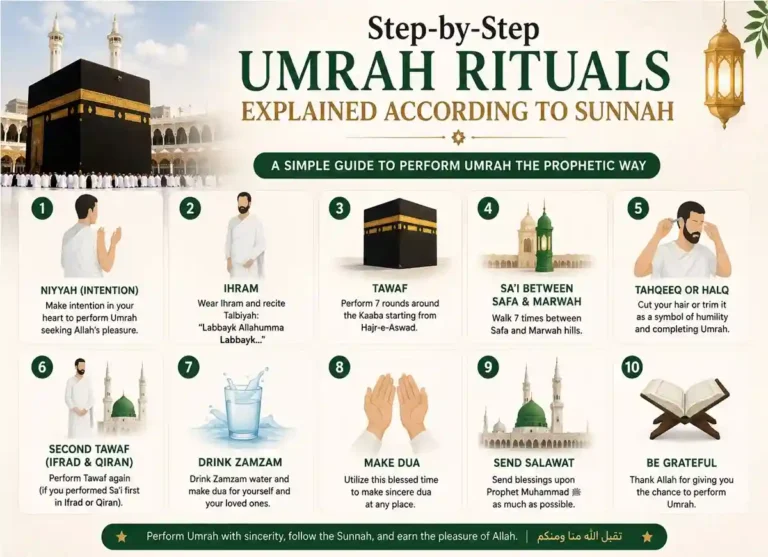
Shared worship is evident in their association with the Sacred House, as both practices entail specific acts of devotion, namely Tawaf and Sa’i.
The intricate protocols and jurisprudential determinations governing Hajj and Umrah are elucidated through the Sunnah and the extensive corpus of Islamic scholarship.
While Quranic verses establish the foundational basis for these pilgrimages, Hadith literature and subsequent exegetical works provide the necessary elaboration.Given that jurists hold divergent opinions regarding the precise legal classification of Umrah, it is prudent to avoid portraying any single madhhab’s position as universally consensual.
Preparing for an Umrah Journey
Gaining a profound comprehension of the Quranic exegesis serves as a cornerstone in the spiritual preparation for Umrah.
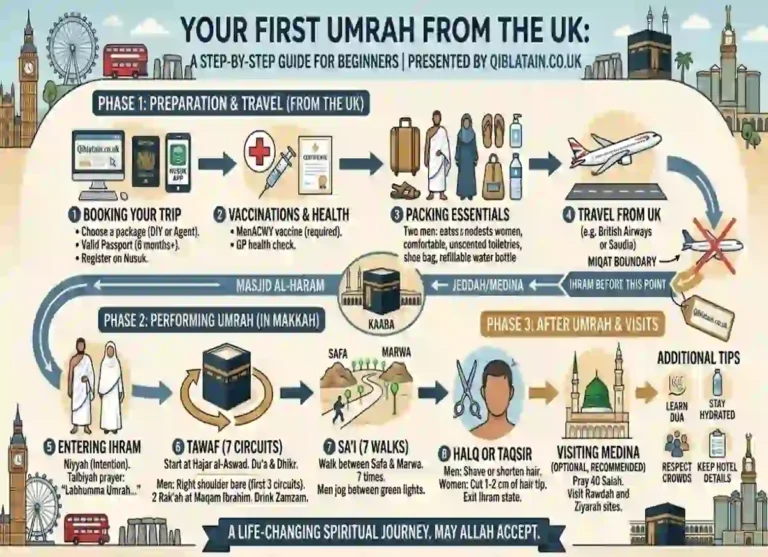
Concurrently, pilgrims must attend to practical logistical arrangements prior to their departure, which entails mastering the ritual obligations, securing all requisite documentation, familiarizing themselves with the stipulations regarding the Miqat, and orchestrating the necessary transportation networks between urban centers.
Securing a dependable Umrah taxi service well in advance is highly advisable for pilgrims navigating the Saudi Arabian landscape, whether traversing the sacred cities of Makkah and Madinah, the coastal gateway of Jeddah, or reaching other regional destinations.
Such foresight significantly enhances the logistical coherence and overall comfort of the pilgrimage.This preparatory measure proves especially invaluable for families, senior travelers, and parties managing substantial luggage.
Practical preparations must align with the intended objective of the journey, which is to perform the rites with serene composure, enduring patience, and unwavering devotion.
Frequently Asked Questions
1. Which Quranic verse mentions both Hajj and Umrah?
Surah Al-Baqarah, verse 196, explicitly delineates both the major pilgrimage and the lesser pilgrimage, directing believers to fulfill the obligations of Hajj and Umrah solely for the sake of Allah.
The verse’s initial directive commands the faithful to complete these rites.
2. How many times is Umrah mentioned in the Quran?
The Arabic term “Umrah” (عُمْرَة) is explicitly referenced three times within two specific verses: Al-Baqarah 2:158 and Al-Baqarah 2:196.
3. Which Quranic verse mentions Safa and Marwah?
Verse Al-Baqarah 2:158 delineates the significance of Safa and Marwah, explicitly designating them as symbols of Allah, and references the rites performed by individuals undertaking Hajj or Umrah as they traverse the path between these two hills.
4. Which verse establishes Hajj as an obligation?
Surah Āl-i-ʿImrān, verse 97, stipulates that undertaking the pilgrimage to the Sacred House constitutes a religious obligation incumbent upon those who possess the requisite capacity to embark upon such a journey.
5. Does the Quran explain all the steps of Umrah?
While the Quran addresses the essence of Umrah and offers profound guidance regarding pilgrimage, it does not delineate a comprehensive, sequential protocol for every ritual associated with the act.
Instead, the precise methodology is derived from the Sunnah of Prophet Muhammad (peace be upon him) and further elucidated through the interpretations of Islamic scholars.
6. Does the Quran mention the call of Prophet Ibrahim for Hajj?
Affirmative.
Surah Al-Hajj, verse 22:27, recounts the divine injunction addressed to Prophet Ibrahim (AS) to publicly announce the pilgrimage, thereby summoning believers from every distant route, whether arriving on foot or mounted upon beasts of burden.
7. Are the Quranic verses about Hajj also relevant to Umrah?
Certain scriptural passages explicitly delineate both Hajj and Umrah, whereas others focus on the Kaaba, sacred emblems, the remembrance of the Divine, or rites intrinsic solely to Hajj.
Consequently, the applicability of each verse must be discerned in accordance with its specific thematic focus, avoiding the conflation of all references to Hajj as direct mandates for Umrah.
Final Words
The Quran offers essential directives regarding Hajj and Umrah, emphasizing the necessity of performing these pilgrimages with sincere devotion to Allah, while also underscoring the imperative to honor sacred symbols, engage in remembrance of the Divine, and uphold exemplary conduct.
Verses 158 and 196 of Surah Al-Baqarah hold particular significance as they explicitly reference Umrah; meanwhile, other passages elucidate the profound importance of the Kaaba and the overarching objectives inherent in the pilgrimage.
The contemplation of these verses enables Muslims to comprehend the spiritual bedrock underpinning their sacred journey.
Complementing their acquisition of practical rituals through authentic Sunnah and rigorous scholarly tradition, pilgrims are thereby equipped to undertake Hajj or Umrah with profound knowledge, unwavering sincerity, steadfast patience, and devoted intention.
Related Posts:
- Pilgrimage To Mecca PDF Download
- What is Ihram Haji? | Hajj and Umrah
- What is The Hajj Definition – Learn Islam
- 3 Types of Hajj | Tamattu | Ifrad | Hajj Qiran
- What is The Importance of Safa Marwa History?
- Umrah Guide Book | Important point in The Mecca
- The Great Mosque of Mecca | Al-Masjid an-Nabawi
- Importance of The Days of Zil Hajj | The Day of Arafah
- Define menses During Hajj and Umrah | Mina in Makkah
- Essential Duas to Recite on Your Hajj and Umrah Journey
- Holy Pilgrimage | The Journey Pilgrimage To The Holy land
- The Holy Pilgrimage of The Messenger | The Rituals of Hajj
- A Woman’s Guide to Umrah Pilgrimage | Pilgrimage Definition