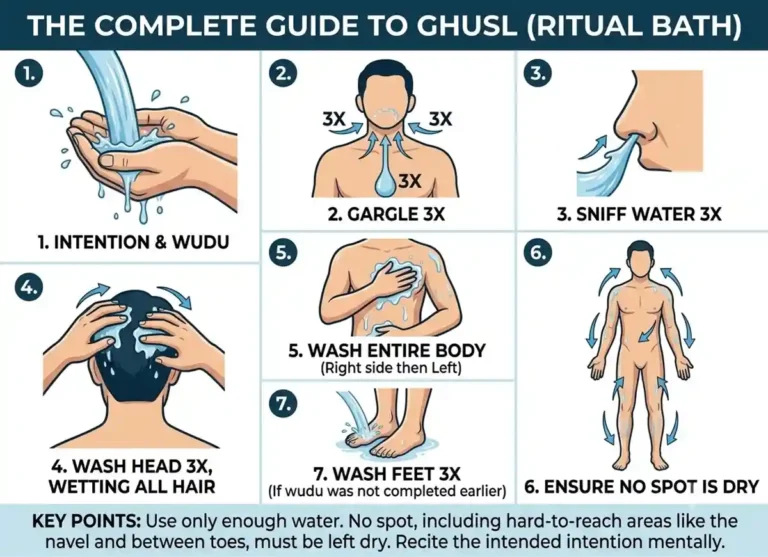

Ghusl steps confuse many Muslims, especially converts and young women learning purification rules for the first time. Missing even one step can leave a person unsure whether their prayer counts, which creates real anxiety around something meant to bring peace.
Recommended: Fiqh of Purification – A Woman’s Guide to Taharah
The Quran and authentic Hadith outline this process clearly. Once you learn the correct order, ghusl becomes routine rather than a source of stress before every prayer.
Must Read: Wudu (Step-by-Step)
Why Getting the Steps Right Matters
Skipping a step during ghusl can invalidate the entire purification. Since valid Salat depends on being pure, understanding the exact steps for ghusl protects your worship from being rejected due to a simple oversight.
The Standard Steps for Ghusl
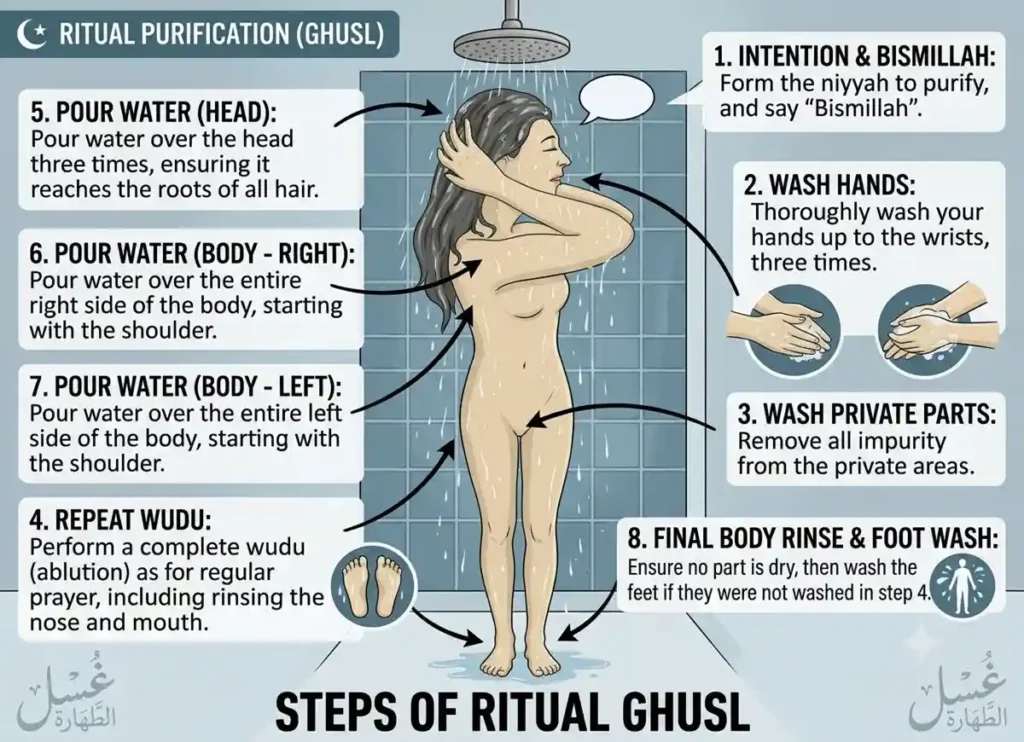
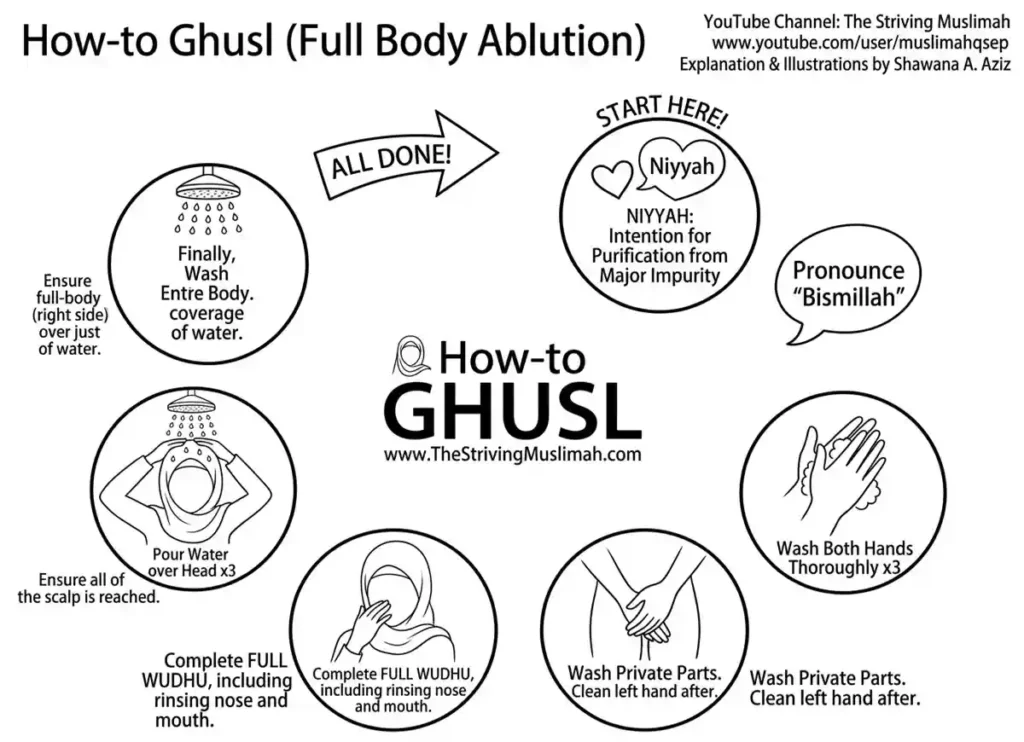
Here is the correct order followed by the majority of scholars, applicable to both men and women:
- Make the intention (niyyah) silently in your heart
- Say Bismillah before starting
- Wash both hands up to the wrist, three times
- Wash the private parts thoroughly, removing any impurity
- Perform a complete wudu, just as you would before prayer
- Pour water over the head three times, working it to the scalp
- Pour water over the right shoulder and side, then the left
- Rub the body gently to ensure water reaches every area
Also Read: The Key To Purity: Dua For Ghusl After Menstruation
Ghusl Steps for Ladies: What’s Different
Ghusl steps for ladies follow the same core sequence, with a few extra points of care. Hair does not need to be fully undone, but water must reach the scalp. Braided hair should be loosened enough for water to soak through to the roots.
How to Do Ghusl After Period Steps
Many women ask specifically about how to do ghusl after period steps, since this ghusl marks the return to prayer and fasting. The method is the same as regular ghusl, but scholars recommend using a small amount of musk or perfumed soap on the area affected by blood, following the Prophet’s ﷺ guidance to a woman asking this exact question.
Also Read: Blessings Dua For Ghusl After Periods
Ghusl Steps for Women:
Use this simplified checklist for ghusl steps for women during busy mornings:
- Make intention first
- Wash hands, then private area
- Complete wudu fully
- Pour water on head three times
- Cover the whole body, right side then left
- Loosen tight braids so water reaches the scalp
Quran Verses on Purification
Allah says regarding cleanliness before worship:
Surah Al-Baqarah (2:222) — “…and He loves those who purify themselves.” This verse establishes that Allah loves those who take purification seriously. Read on Alim.org
Surah An-Nisa (4:43) — “…until you have washed [your whole body]…” This verse directly commands full ghusl after major impurity before prayer. Read on Alim.org
Hadith References on Ghusl Steps
Sunan Abu Dawood 251 — A woman asked the Prophet ﷺ how to purify herself after menstruation, and he explained using a musk-scented cloth on the area of blood. Read on Sunnah.com
Jami` at-Tirmidhi 105 — This hadith describes how Aisha (RA) and the Prophet ﷺ would sometimes perform ghusl together from a single vessel of water. Read on Sunnah.com
Also Read: Can I Fast If I Make Ghusl After Fajr?
Ghusl for Janabah vs Ghusl After Period
| Feature | Ghusl for Janabah | Ghusl After Period |
| Trigger | Sexual intimacy, wet dream | End of menstrual bleeding |
| Extra step | None specific | Musk/perfumed soap recommended |
| Applies to | Men and women | Women only |
| Core steps | Same 8-step method | Same 8-step method |
A Common Mistake Women Make
Rushing during ghusl often means missing the scalp under thick or braided hair. Take an extra moment here — a dry patch on the scalp can invalidate the entire ghusl, requiring you to start again.
Hanafi Fiqh References
For deeper reading, these classical Hanafi texts are commonly found in Islamic libraries and archives:
- Bahishti Zewar by Maulana Ashraf Ali Thanvi
- Radd al-Muhtar by Ibn Abidin
- Al-Hidayah by Imam Marghinani
Trusted Islamic Resources
For scholarly rulings, visit IslamQA and the Islamic Teachings Forum. For general background, see Wikipedia’s entry on Ghusl and Britannica’s overview of ritual purity in Islam. You can also explore more purification guides on quranmualim.com.
Categories: Namaz ,Zakat , Roza , Prayer , Hadith & Supplications
Frequently Asked Questions
When is ghusl fard for a woman?
Ghusl becomes fard for a woman after sexual intimacy, the end of menstruation, the end of postnatal bleeding, and after a wet dream with discharge.
How do you perform ghusl nifas in Islam?
Ghusl after nifas (postnatal bleeding) follows the same steps as regular ghusl, marking the return to prayer, fasting, and other acts of worship once bleeding stops.
How do you do ghusl after periods in Islam?
Perform the full ghusl sequence: intention, washing hands and private area, wudu, then pouring water over the head and body three times, covering every part.
How do you perform ghusl after your period?
Follow the standard eight steps, paying extra attention to the scalp and any braided hair, ensuring water reaches every part of the body and head.
Is it necessary to make ghusl if you forgot to wash your private parts?
Yes, if the private parts were not properly washed, the ghusl is considered incomplete, and it should be repeated correctly to ensure valid purification.
Final Thoughts
Learning the correct ghusl steps removes doubt and builds confidence in your worship. With a little practice, this simple routine becomes second nature, keeping your prayers valid and your heart at peace.
Alasad Online Quran Tutor | Learn Quran, Tajweed & Islamic Studies Online
🌐 quranmualim.com | 📺 YouTube | 📱 WhatsApp Available
Related Posts For You:
- How to Perform Ghusl? PDF Download
- Ghusl Dua | Dua for Ghusl – Learn Islam
- How To Do Ghusl After Period: Step-by-Step Guide
- Ghusl: A Complete Guide To Islamic Ritual Purification
- Dua After Ghusl – The Secret to Spiritual Cleanliness!
- How To Clean Private Parts After Urination? Learn Islam
- Ramadan Fasting Rules: Intimacy, Ghusl, Music/TV, Vitamins, Pregnancy