

Ghusl is the full-body ritual bath every Muslim needs to know how to perform correctly. It’s one of the most essential acts of purification in Islam, required before prayer, fasting, and several other acts of worship. Understanding ghusl properly removes confusion and builds confidence in daily worship.
Many Muslims, especially converts or younger practitioners, feel unsure about the exact steps of ghusl. This uncertainty often leads to skipped prayers or nagging doubts about whether worship was accepted. Thankfully, Islam provides clear, practical guidance on this exact topic.
For readers wanting deeper study on Islamic purification rules, this guide to Taharah and ritual purity in Islam is a helpful companion resource.
The Importance of Ghusl in Islam
Ghusl isn’t just physical cleanliness. It represents spiritual renewal, allowing a Muslim to enter a state of purity before standing in prayer or performing sacred acts. Without proper ghusl, several essential forms of worship simply cannot be validly performed.
Also Read: The Key To Purity: Dua For Ghusl After Menstruation
The Islamic Perspective
Qur’an References
1. Surah Al-Ma’idah (5:6)
Allah instructs believers to purify themselves fully if in a state of major impurity, establishing the foundation for ghusl as a religious obligation.
Read on Quran.com
2. Surah An-Nisa (4:43)
This verse discusses states requiring purification before prayer, reinforcing that cleanliness of the body reflects readiness of the heart for worship.
Read on Quran.com
Hadith References
1. Sahih al-Bukhari
The Prophet ﷺ described pouring water over the head three times, then washing the entire body, demonstrating the practical method of ghusl.
Sunnah.com – Sahih al-Bukhari
2. Sahih Muslim
The Prophet ﷺ emphasized that water must reach every part of the body, including the roots of the hair, for ghusl to be valid.
Sunnah.com – Sahih Muslim
Must Read: Wudu (Step-by-Step)
When Is Ghusl Required?
- After sexual intimacy between spouses (Janaba)
- After menstruation ends (Hayd)
- After postnatal bleeding ends (Nifas)
- Before Friday prayer, as a recommended practice
- Before entering the state of Ihram for Hajj or Umrah
- Upon embracing Islam as a new Muslim
Also Read: Blessings Dua For Ghusl After Periods
Ghusl Kay Fara’iz (Obligatory Elements)
Every valid ghusl must include these essential elements:
- Niyyah (Intention) – Intending in the heart to perform ghusl for purification
- Rinsing the mouth – Water must reach the entire mouth
- Rinsing the nose – Water must reach the nasal passages
- Washing the entire body – Every part of the skin and hair roots must be reached by water
Ghusl Kay Sunnat (Recommended Practices)
- Washing both hands before beginning
- Washing private parts first
- Performing wudu before starting ghusl
- Pouring water over the head three times
- Washing the right side of the body before the left
Also Read: Islamic Studies Books Grades 1-12 PDF Download
How to Perform Ghusl Step-by-Step
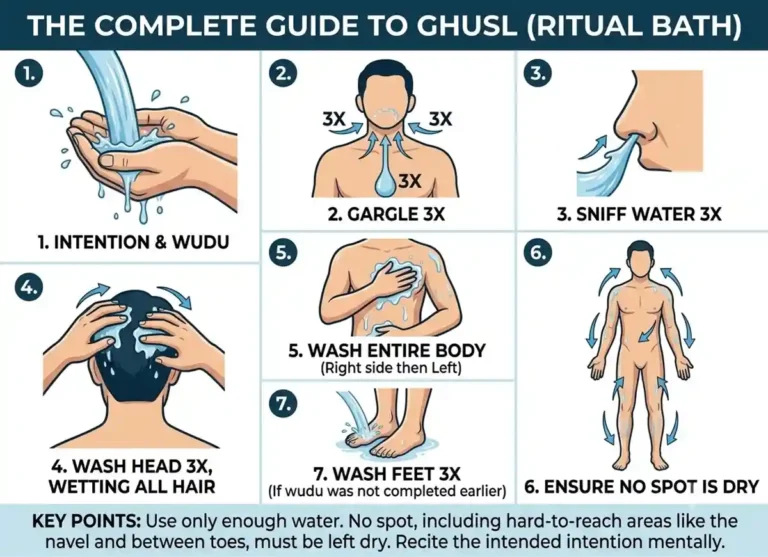
- Make the intention (niyyah) for purification in your heart
- Say Bismillah and wash both hands up to the wrists
- Wash the private parts thoroughly, removing any impurity
- Perform wudu as you would before prayer
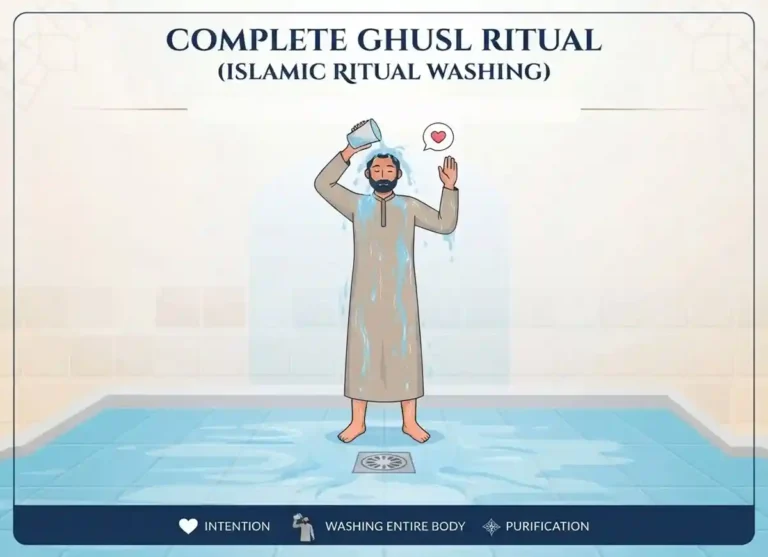
- Pour water over your head three times, ensuring it reaches the scalp
- Wash the right side of your body completely, then the left
- Ensure water reaches every part of the body, including skin folds
Ghusl for Women: Special Considerations
Women should pay extra attention to ensuring water reaches through braided or thick hair, though undoing hair completely isn’t required unless water genuinely cannot reach the scalp. After menstruation or postnatal bleeding ends, ghusl becomes obligatory before resuming prayer and fasting.
Quick Reference Table
| Element | Requirement |
| Intention (Niyyah) | Obligatory |
| Rinsing mouth and nose | Obligatory |
| Washing entire body | Obligatory |
| Pouring water on head 3 times | Recommended (Sunnah) |
| Performing wudu first | Recommended (Sunnah) |
Hanafi Fiqh Books
- Al-Hidayah by Burhan al-Din al-Marghinani
- Nur al-Idah by Hasan ibn Ammar al-Shurunbulali
- Bidayat al-Mubtadi by al-Marghinani
- Kanz al-Daqaiq by Abu al-Barakat al-Nasafi
These texts are available in Islamic library archives and offer deeper insight into the fiqh of purification.
Learning More From Trusted Sources
For general background on ritual purification, Wikipedia’s overview of ghusl offers useful context, while Britannica’s entry on Islamic ritual practices explains the broader religious framework.
For detailed fiqh rulings, the community forum at IslamicTeachings.org and the scholarly Q&A archive at IslamQA remain reliable, trusted resources.
For more structured lessons on Islamic purification topics like this one, www.quranmualim.com offers simple, well-organized articles for everyday questions.
Categories: Namaz ,Zakat , Roza , Prayer , Hadith & Supplications

Frequently Asked Questions
How many times should water be poured over the head during ghusl?
Pouring water three times over the head is a recommended Sunnah practice, though the obligatory requirement is simply that water reaches the scalp.
Can I perform ghusl while fasting?
Yes, performing ghusl does not break or invalidate your fast in any way, regardless of when during the day it’s performed.
What should I do if I doubt whether my ghusl was correct?
If you generally remember completing it properly, ignore the doubt. If you clearly missed a spot, wash only that area again.
Is undoing braided hair necessary for women during ghusl?
No, undoing hair isn’t required unless water genuinely cannot reach the scalp through the braids or styling.
Does ghusl need to be repeated for every prayer?
No, ghusl remains valid until something that breaks purity occurs again, unlike wudu, which is needed before each prayer.
Final Thoughts
Ghusl is more than a physical routine. It’s a meaningful act of spiritual renewal that prepares the heart and body for worship. With clear steps and consistent practice, every Muslim can approach ghusl with confidence, ensuring their prayers and acts of worship are built on a foundation of true purity.
Must Read:
- Can I Fast If I Make Ghusl After Fajr?
- Is Abortion Haram Islam? Learn Islam
- Heavenly Blessings Dua For Ghusl After Periods
- My period stopped then started again 4 days later
- Can I Read The Quran on My Period – Is It Allowed?
- Can You Have Menses and Be Pregnant? Learn Islam
- Define Menses During Hajj and Umrah | Mina in Makkah
- Dark Brown Menses Blood: What It Means For Your Prayers
Recommended For You
- Do Muslims Masturbate? Learn Islam
- Is Abortion Haram Islam? Learn Islam
- What Does The Quran Say About Killing?
- Do Cats Bring Angels in The House in Islam?
- Al-Aqsa Mosque: Why It’s Islam’s First Qibla
- Clear Sticky Discharge Male After Urination?
- Is Abortion Haram? What Islamic Teachings Say
- Can You Read Quran on Your Period? Learn Islam
- Is It Permissible To Use Condom in Islam? Learn Islam
- How To Clean Private Parts After Urination? Learn Islam
- Bone Marrow Donation in Islam: Overview, Process & Side Effects
Related Blogs:
- Is Being Gay Haram – Learn Islam
- Is It Haram To Be Gay? – Learn Islam
- Can You Be Gay in Islam? learn Islam
- Is It Haram to Masturbate? Learn Islam
- Do Gay People Go To Heaven? Learn Islam
- Can Gay People Go To Heaven? Learn Islam
- What Islam Says About Gay People in Islam?
- What Does The Quran Say About Gay People?
- How Many Calories Does Masturbating Burn?
- Is Homosexuality in Islam Allowed? Learn Islam
- Can I Kiss My Wife Private Parts in Christianity?
- What Does The Quran Say About Homosexuality?
- What Does Islam Say About Homosexual Marriage?
- The Crucial Role of The Qur’an in Enlightened Living
- Religion and Sexuality – A Journey of A Gay Muslim
- Is Sodomy A Sin? Perspectives on Its Moral Standing