
In this article we will learn about why we celebrate Shab-e-Barat in Islam. Shab-e-Barat, also known as the “Night of Forgiveness” or “Night of Freedom,” is an important night in the Islamic calendar that falls on the 15th of Sha’ban (the eighth month). On this night, Muslims pray for mercy, ask Allah to pardon their misdeeds, and believe that the year’s fate has already been decided. It is a time for repentance, asking for blessings for the living and the dead, and concentrating on worship prior to Ramadan.
It is observed with special prayers (Namaz), devotion, and occasionally fasting. Some scholars consider some rites, which emphasize individual worship and obedience to fundamental Islamic doctrines, as innovations (Bid’ah), despite the fact that they are extensively observed, particularly in South and Southeast Asia.
Scholarly Opinions Shab E Barat in Islam
The Prophet (peace be upon him) himself established the virtue of the night of mid-Shaban. It has been transmitted through a number of channels, including Abdullah bin Amr, Muadh, Abu Hurairah, Abu Thulabah, Awf bin Malik, Abu Bakr, Abu Musa, and Aishah (may Allah be pleased with all of them), with each narration supporting the others.
Also Read: Third Kalima Tamjeed Arabic English Translation
Imam Shafi’i writes:
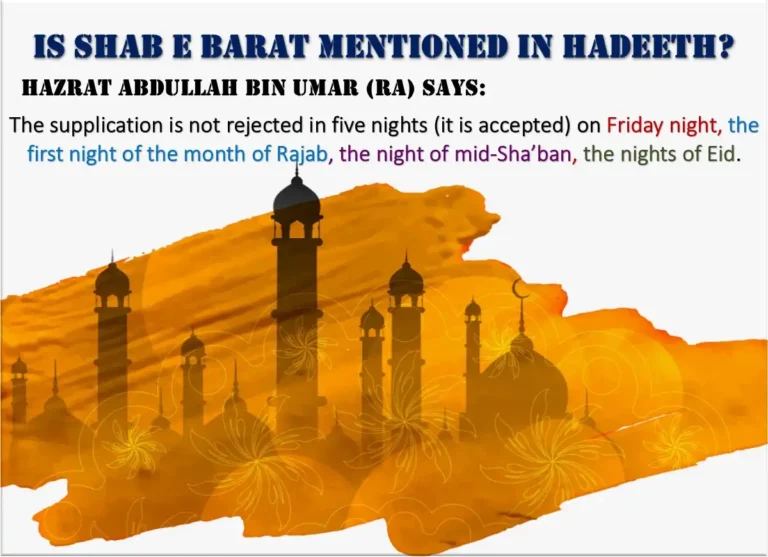
“Truly, the night of Juma, the night of Eid Al-Adha, the night of Eid Al-Fitr, the first night of Rajab, and the fifteenth night of Shabaan are the five nights on which dua is accepted.” [Page No. 231, Al-Umm
Imam Shurunbulali Hanafi writes:
The final 10 nights of Ramadan, two nights of Eidain (Eid ul-Fitr and Eid ul-Adha), ten nights of Zil Hijjah, and the fifteenth night of Sha`ban should all be resurrected.” [Noorul Eidhah Page No. 63]
Shaikh Abu-Ishaq Ibrahim Al-Hanbali writes:
Because of the Ahadith, it is preferable to resurrect the period (with Salat and Ibadah) between the two E’shas (Maghrib and E’sha). Many scholars say, “Similarly with the night of Ashura, the first night of Rajab, and the 15th night of Sha`ban ”. [Al-Mubdi Volume 002, Page No. 27]
Sheikh Mansoor Bahoti Hanbali writes:
“The fifteenth night of Sha`ban is a night of goodness. While instituting congregational prayers (on this night) is a beneficial idea, some Salaf prayed all night. Additionally, the prize for Ibadah on “the 15th night of Sha`ban” is identical to the award for Ibadah on the night of E’id. [Kash-shaful Qina , Volume 001: Page No. 444]
Sheikh Mubarakpuri (Salafi scholar) writes:
You should be aware that enough Ahadith have been recounted to attest to “the virtues of the 15th night of Sha`ban.” These Ahadith all demonstrate its foundation.
After relating many Ahadith about the importance of this night, he says:
“Those who “believe there is no proof” of the virtue of the 15th night of Sha`ban are strongly refuted by the sum of all these Ahadith, and Allah is the ultimate judge.” [Pages 365-367 of Tuhfat ul Ahwadhi, Volume 003]
Ibn-Taimiyyah when asked about the 15th night of Sha’ban replied:
There are numerous accounts and Athar (quotes from the Sahabah) about the excellence of the 15th night of Shabaan. According to reports, the Salaf prayed this evening. Consequently, praying by yourself on this particular night, which has priority in the Salaf, is adequate proof, and something of this nature is undeniable.
When asked the same issue again, Ibn-Taimiyyah said, “If one prays on this night alone or in a select company of people as many groups among the Salaf did, then it is good.” [Fatawa Ibn Taimiyyah Volume 23, Page 131-132]
In summary, Shab E Barat in Islam is referred to as the “night of forgiveness.” Doubts about its customs and special voluntary prayers are common on this night. The celebration of Shab e Barat is seen by some academics as an innovation in Islam.
Scholars advised us to fast on Shaban night because it is one of the White Days, notwithstanding the uncertainty surrounding particular devotion on this night. which are Shaban’s 13th, 14th, and 15th.
The Prophet (PBUH) often fasted throughout this month, calling it a “neglected month.” This classification emphasizes the importance of fasting during this period in order to get ready for Ramadan.
Recommended For You (Shabe Barat)
- What Should We Pray for on Shab e Barat?
- Best Shab e Barat Dua To Change Destiny
- Common Dua in Taraweeh Prayer To Recite
- So Kar Uthne Ki Dua | Dua After Waking Up
- Allahumma Rahmataka Arju: A Dua For Hope
- Arabic Prayer With Transliteration and Meaning
- Shab e Barat Ibadat and Prayers—Night of Forgiveness
Salatul Tasbih
- How To Perform Salatul Tasbih?
- Definition of Subhanallah and Its Meaning
- la ilaha illa anta subhanaka Inni Kuntu Minaz Zalimin