


Surah Hashr stands out as one of Islam’s most powerful chapters on divine protection and spiritual vigilance. This surah reveals how Allah deals decisively with those who betray His believers, while simultaneously showing how believers can strengthen their connection with Allah through reflection and remembrance. Whether you’re seeking spiritual growth or looking to understand Islamic history more deeply, Surah Al-Hashr offers timeless lessons that protect your faith and clarify your purpose.
Amazon Book Recommendation: The Message of the Qur’an by Muhammad Asad – A contemporary tafsir offering clear English meanings with cultural and historical context for modern Muslim understanding.
The Problem: Spiritual Weakness and Heedlessness
Many believers struggle with spiritual consistency. You pray regularly, yet feel disconnected. You know Islamic principles intellectually, yet struggle to apply them emotionally. You want to deepen your faith, but distractions constantly pull you away. This isn’t unusual. This is the human condition that Surah Hashr addresses directly.
The Divine Insight: Reflection as Spiritual Protection
Surah Hashr demonstrates how Allah protects believers through decisive action against traitors. The historical context shows Allah didn’t abandon His community when it faced betrayal. He actively helped believers overcome injustice. This reflects a profound truth: Allah actively protects those who trust Him.
Why Surah Hashr Matters for Your Faith
Protection Against Internal and External Threats
Life attacks your faith from multiple angles. External forces oppose Islam. Internal distractions—worldly desires, doubts, arrogance—slowly erode your spiritual foundation. Surah Al-Hashr teaches both external resilience and internal fortification through faith and reflection.
Understanding Divine Justice
The surah depicts Allah’s justice in action. Betrayers faced consequences. Yet believers who were harmed weren’t left abandoned. This teaches a critical lesson: Allah’s justice operates in ways we might not immediately understand, but it ultimately protects the faithful and holds wrongdoers accountable.
The Transformative Power of Remembrance
The famous last three verses of Surah Al Hashr aren’t just beautiful. They’re pharmacies for the spiritual soul. Reciting them with understanding rewires your brain, calms anxiety, and reconnects you with Allah’s majesty. This is why the Prophet loved them so deeply.
Also Read: Read Quran Online For Free: Access Sacred Text
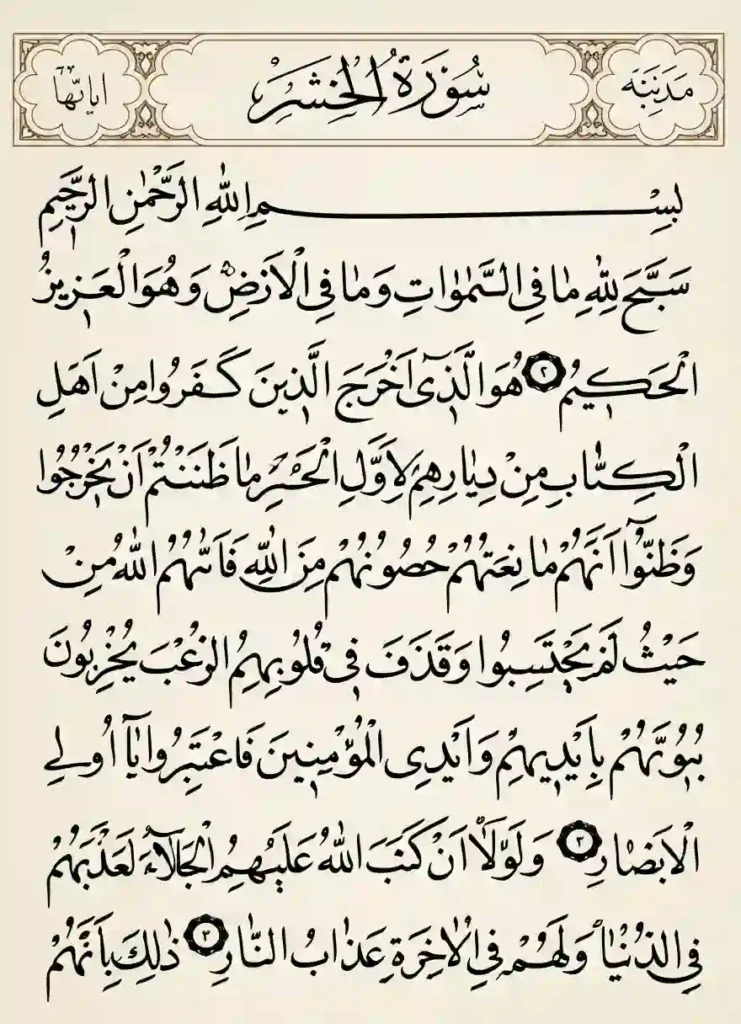
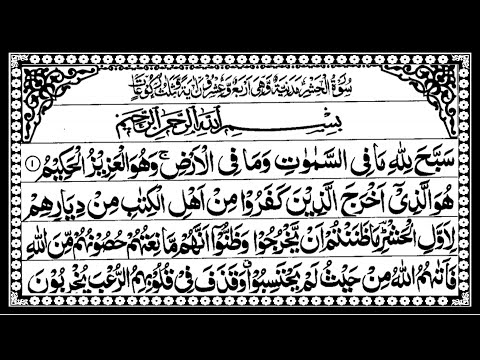
Surah Hashr (Chapter 59) – Complete Text
All 24 Verses: Arabic, Transliteration & English Translation
| Verse | Arabic Text | Transliteration | English Translation |
| 59:1 | سَبَّحَ لِلَّهِ مَا فِي السَّمَاوَاتِ وَمَا فِي الْأَرْضِ ۖ وَهُوَ الْعَزِيزُ الْحَكِيمُ | Sabbaha lillaahi maa fee as-samaawaati wa maa fil-ardi wa huwal-azizul-hakeem | All that is in the heavens and on earth glorifies Allah; and He is the Exalted in Might, the Wise. |
| 59:2 | هُوَ الَّذِي أَخْرَجَ الَّذِينَ كَفَرُوا مِن أَهْلِ الْكِتَابِ مِن دِيَارِهِمْ لِأَوَّلِ الْحَشْرِ ۚ مَا ظَنَنتُمْ أَن يَخْرُجُوا ۖ وَظَنُّوا أَنَّهُمْ مَّانِعَتُهُمْ حُصُونُهُمْ مِّنَ اللَّهِ فَأَتَاهُمُ اللَّهُ مِنْ حَيْثُ لَمْ يَحْتَسِبُوا ۖ وَقَذَفَ فِي قُلُوبِهِمُ الرُّعْبَ ۚ يُخْرِبُونَ بُيُوتَهُم بِأَيْدِيهِمْ وَأَيْدِي الْمُؤْمِنِينَ ۚ فَاعْتَبِرُوا يَا أُولِي الْأَبْصَارِ | Huwal-lazee akhraj allazeena kafaroo min ahlis-kitaab min diyaaihim li-awwalil-hashr maa zanantum an yakhrujoowa wa zannoo annahum maani’atuhum husooneuhum minal-laah fa-atahum allaahu min haythu lam yahtasiboo wa qadhafa fee quloobihim ar-ru’b yukhriboona buyoota hum bi-aydeeihim wa aydil-mu’mineen, fa’tabiroo yaa oolit-absaar | He is the One Who expelled those who disbelieved among the People of the Book from their homes at the first gathering. You did not think they would leave, and they thought their fortresses would protect them from Allah. But Allah came to them from where they had not expected, and cast terror into their hearts, [so] they destroyed their houses by their own hands and the hands of the believers. So take warning, O people of vision. |
| 59:3 | وَلَوْلَا أَن كَتَبَ اللَّهُ عَلَيْهِمُ الْجَلَاءَ لَعَذَّبَهُمْ فِي الدُّنْيَا ۖ وَلَهُمْ فِي الْآخِرَةِ عَذَابُ النَّارِ | Wa law laa an kataba allaahu ‘alayhim al-jalaa’a la’azzabahum fil-dunyaa wa lahum fil-aakhirah ‘azaabun-naar | And if Allah had not decreed for them exile, He would have punished them in this world, and for them in the Hereafter is the punishment of the Fire. |
| 59:4 | ذَٰلِكَ بِأَنَّهُمْ شَاقُّوا اللَّهَ وَرَسُولَهُ ۖ وَمَن يُشَاقِّ اللَّهَ فَإِنَّ اللَّهَ شَدِيدُ الْعِقَابِ | Zaalikah bi-annahum shaqqul-laaha wa rasoolahu wa man yushaaqqil-laaha fa-innal-laaha shadeed al-‘iqaab | That is because they opposed Allah and His Messenger. And whoever opposes Allah—indeed, Allah is severe in penalty. |
| 59:5 | مَا قَطَعْتُم مِّن لِينَةٍ أَوْ تَرَكْتُمُوهَا قَائِمَةً عَلَىٰ أُصُولِهَا فَبِإِذْنِ اللَّهِ وَلِيُخْزِيَ الْفَاسِقِينَ | Maa qata’tum min leenatun aw taraktumooha qaa-imatan ‘alaa usoolihaa fa bi-iznillaahi wa liyukhzi al-faasiqeen | And whatever palm trees you cut down or left standing on their roots—it was by permission of Allah, so that He might disgrace the defiantly disobedient. |
| 59:6 | مَّا أَفَاءَ اللَّهُ عَلَىٰ رَسُولِهِ مِنْ أَهْلِ الْقُرَىٰ فَلِلَّهِ وَلِلرَّسُولِ وَلِذِي الْقُرْبَىٰ وَالْيَتَامَىٰ وَالْمَسَاكِينِ وَابْنِ السَّبِيلِ ۚ كَيْ لَا يَكُونَ دُولَةً بَيْنَ الْأَغْنِيَاءِ مِنكُمْ ۚ وَمَا آتَاكُمُ الرَّسُولُ فَخُذُوهُ وَمَا نَهَاكُمْ عَنْهُ فَانتَهُوا ۚ وَاتَّقُوا اللَّهَ ۚ إِنَّ اللَّهَ شَدِيدُ الْعِقَابِ | Maa afaa-al-laahu ‘alaa rasoolih min ahl al-quraa fa lillaahi wa lir-rasool wa li-zil-qurbaa wal-yataama wal-masaakeen wa ibnis-sabeel kay la yakoon dolatan bainal-aghniyaa’i minkum wa maa atakum ar-rasool fa khuzoohu wa maa nahaakum ‘anhu fantahoo wa-ttaqul-laah, innal-laaha shadeed al-‘iqaab | Whatever Allah restored to His Messenger from the people of the towns—it is for Allah and the Messenger and for the relatives and orphans and the poor and the traveler, so that it may not circulate only among the rich from among you. And whatever the Messenger has given you—take it; and what he has forbidden you—refrain from it. And fear Allah; indeed, Allah is severe in penalty. |
| 59:7 | لِلْفُقَرَاءِ الْمُهَاجِرِينَ الَّذِينَ أُخْرِجُوا مِن دِيَارِهِمْ وَأَمْوَالِهِمْ يَبْتَغُونَ فَضْلًا مِّنَ اللَّهِ وَرِضْوَانًا وَيَنصُرُونَ اللَّهَ وَرَسُولَهُ ۚ أُولَٰئِكَ هُمُ الصَّادِقُونَ | Lil-fuqaraa’il-muhajireena allazeena oukhriju min diyaarihim wa amwaalihim yabtghoon fadhlan minal-laahi wa ridwaan wa yansuroonal-laaha wa rasoolahu, ula-ika humuc-saadiqoon | [Especially] for the poor emigrants who were expelled from their homes and their properties, seeking bounty from Allah and [His] approval and supporting Allah and His Messenger. Those are the truthful ones. |
| 59:8 | وَالَّذِينَ تَبَوَّؤُوا الدَّارَ وَالْإِيمَانَ مِن قَبْلِهِمْ يُحِبُّونَ مَن هَاجَرَ إِلَيْهِمْ وَلَا يَجِدُونَ فِي صُدُورِهِمْ حَاجَةً مِّمَّا أُوتُوا وَيُؤْثِرُونَ عَلَىٰ أَنفُسِهِمْ وَلَوْ كَانَ بِهِمْ خَصَاصَةٌ ۚ وَمَن يُوقَ شُحَّ نَفْسِهِ فَأُولَٰئِكَ هُمُ الْمُفْلِحُونَ | Wallazeena tabawwa’ud-dara wal-eeman min qabalhim yuhibboona man hajara ilayhim wa laa yajidoona fee sudoorihim haajatan mimma ootoo wa yu’thiroona ‘alaa anfusihim wa law kana bihim khasaasa, wa man yuwaqi shuhha nafsih fa-ola-ika humul-muflihoon | And those who, before them, had homes [in Madinah] and [adopted] the faith, love those who emigrated to them and find not any want in their hearts of what the emigrants were given but give [them] preference over themselves, even though they are in privation. And whoever is protected from the stinginess of his soul—it is those who will be the successful. |
| 59:9 | وَالَّذِينَ جَاءُوا مِن بَعْدِهِمْ يَقُولُونَ رَبَّنَا اغْفِرْ لَنَا وَلِإِخْوَانِنَا الَّذِينَ سَبَقُونَا بِالْإِيمَانِ وَلَا تَجْعَلْ فِي قُلُوبِنَا غِلًّا لِّلَّذِينَ آمَنُوا رَبَّنَا إِنَّكَ رَءُوفٌ رَّحِيمٌ | Wallazeena jaa’oo min ba’dihim yaqooloona rabbana-ghfir lana wa li-ikhwanina allazeena sabaqoona bil-eeman wa laa taj’al fee quloobina ghlal lil-lazeena aamanu rabbana innaka raoofun raheem | And those who came after them say, “Our Lord, forgive us and our brothers who preceded us in faith and put not in our hearts [any] resentment toward those who believe. Our Lord, indeed You are Kind and Merciful.” |
| 59:10 | أَلَمْ تَرَ إِلَى الَّذِينَ نَافَقُوا يَقُولُونَ لِإِخْوَانِهِمُ الَّذِينَ كَفَرُوا مِن أَهْلِ الْكِتَابِ لَئِن أُخْرِجْتُمْ لَنَخْرُجَنَّ مَعَكُمْ وَلَا نُطِيعُ فِيكُمْ أَحَدًا أَبَدًا ۖ وَإِن قُوتِلْتُمْ لَنَنصُرَنَّكُمْ ۚ وَاللَّهُ يَشْهَدُ إِنَّهُمْ لَكَاذِبُونَ | Alam tara ilal-lazeena nafaqoo yaqooloona li-ikhwanihimul-lazeena kafaroo min ahlis-kitaab la-in okhrjitum lakhrujanah ma’akum wa laa nutee’ feekum ahada abada wa in qootiltum la-nansurannakum wallaahu yashhadu innahum lakaadhboon | Have you not seen those who practice hypocrisy, saying to their brothers who have disbelieved among the People of the Book, “If you are expelled, we will surely leave with you, and we will never obey anyone over you, and if you are fought, we will surely help you.” But Allah testifies that they are liars. |
| 59:11 | لَئِن أُخْرِجُوا لَا يَخْرُجُونَ مَعَهُمْ ۖ وَلَئِن قُوتِلُوا لَا يَنصُرُونَهُمْ ۖ وَلَئِن نَصَرُوهُمْ لَيُوَلُّنَّ الْأَدْبَارَ ثُمَّ لَا يُنصَرُونَ | La-in okhriju la yakhrujoona ma’ahum wa la-in qootilo la yansuroonahum wa la-in nasaroouhum la-yuwallun-il-adbaar tumma laa yunsaroon | If they are expelled, they will not leave with them. And if they are fought, they will not help them. And if they should help them, they will surely turn their backs; then they will not be aided. |
| 59:12 | لَأَنتُمْ أَشَدُّ رَهْبَةً فِي صُدُورِهِم مِّنَ اللَّهِ ۚ ذَٰلِكَ بِأَنَّهُمْ قَوْمٌ لَّا يَفْقَهُونَ | La-antum ayaddu rahbatan fee sudoorihim minal-laah zaalik bi-annahum qawmun laa yafqahoon | You are more fearful in their hearts than Allah. That is because they are a people who do not understand. |
| 59:13 | لَا يُقَاتِلُونَكُمْ جَمِيعًا إِلَّا فِي قُرًى مُّحَصَّنَةٍ أَوْ مِن وَرَاءِ جُدُرٍ ۚ بَأْسُهُمْ بَيْنَهُمْ شَدِيدٌ ۚ تَحْسَبُهُمْ جَمِيعًا وَقُلُوبُهُمْ شَتَّىٰ ۚ ذَٰلِكَ بِأَنَّهُمْ قَوْمٌ لَّا يَعْقِلُونَ | Laa yuqatiloonakum jamee’an illa fee quran muhassana aw min waraa’i judur, ba’suhum baynuhum shadeed tashabuhum jamee’an wa quloobuhum shatta zaalik bi-annahum qawmun laa ya’qiloon | They will not fight you altogether except within fortified cities or from behind walls. Their violence among themselves is severe. You think they are together, but their hearts are divided. That is because they are a people who do not reason. |
| 59:14 | مِثْلُ الَّذِينَ مِن قَبْلِهِمْ قَرِيبًا ۖ ذَاقُوا وَبَالَ أَمْرِهِمْ ۖ وَلَهُمْ عَذَابٌ أَلِيمٌ | Misthul-lazeena min qablihim qarib zaaqu wa bala amrihim wa lahum ‘azaabun aleem | The example of those before them is like the state of those just now. They tasted the consequence of their affair, and for them is a painful punishment. |
| 59:15 | مَّثَلُ الشَّيْطَانِ إِذْ قَالَ لِلْإِنسَانِ اكْفُرْ فَلَمَّا كَفَرَ قَالَ إِنِّي بَرِيءٌ مِّنكَ إِنِّي أَخَافُ اللَّهَ رَبَّ الْعَالَمِينَ | Mathul-shaytaan iz qaala lil-insaan ikfur fa-lamma kafara qaala innee baree-un minka innee akhafulla rabb al-‘aalameen | The example of Satan is like the state when he says to man, “Disbelieve,” but when he disbelieves, Satan says, “Indeed, I am disassociated from you. Indeed, I fear Allah, Lord of the worlds.” |
| 59:16 | فَكَانَ عَاقِبَتُهُمَا أَنَّهُمَا فِي النَّارِ خَالِدَيْنِ فِيهَا ۚ وَذَٰلِكَ جَزَاءُ الظَّالِمِينَ | Fa-kaana ‘aaqibatuhuma annahuma fin-nari khalidayn fiha wa zaalik jazaa-u az-zaalimeen | So the outcome for both of them is that they will be in the Fire, abiding eternally therein. And that is the recompense of the wrongdoers. |
| 59:17 | يَا أَيُّهَا الَّذِينَ آمَنُوا اتَّقُوا اللَّهَ وَلْتَنظُرْ نَفْسٌ مَّا قَدَّمَتْ لِغَدٍ ۖ وَاتَّقُوا اللَّهَ ۚ إِنَّ اللَّهَ خَبِيرٌ بِمَا تَعْمَلُونَ | Yaa ayyuhal-lazeena aamanoo-ttaqul-laaha wa ltat-nzur nafsum maa qaddamat li-ghad wa-ttaqul-laah, innal-laaha khabeer bimaa ta’maloon | O you who have believed, fear Allah. And let every soul look to what it has put forward for [the day of] tomorrow, and fear Allah. Indeed, Allah is acquainted with what you do. |
| 59:18 | وَلَا تَكُونُوا كَالَّذِينَ نَسُوا اللَّهَ فَأَنسَاهُمْ أَنفُسَهُمْ ۚ أُولَٰئِكَ هُمُ الْفَاسِقُونَ | Wa laa takoonoo kallazeena nasul-laaha fa-ansaahum anfusahum ula-ika humul-faasiqoon | And do not be like those who forgot Allah, so He made them forget themselves. Those are the defiantly disobedient. |
| 59:19 | لَا يَسْتَوِي أَصْحَابُ النَّارِ وَأَصْحَابُ الْجَنَّةِ ۚ أَصْحَابُ الْجَنَّةِ هُمُ الْفَائِزُونَ | Laa yastawee ashaabun-nari wa ashaabul-jannah, ashaabul-jannah humul-fa-izoon | Not equal are the companions of the Fire and the companions of Paradise. The companions of Paradise—they are the successful ones. |
| 59:20 | لَوْ أَنزَلْنَا هَٰذَا الْقُرْآنَ عَلَىٰ جَبَلٍ لَّرَأَيْتَهُ خَاشِعًا مُّتَصَدِّعًا مِّن خَشْيَةِ اللَّهِ ۚ وَتِلْكَ الْأَمْثَالُ نَضْرِبُهَا لِلنَّاسِ لَعَلَّهُمْ يَتَفَكَّرُونَ | Low anzalna haaza al-qur-ana ‘alaa jabal la-raa-itahu khashi’an muttasaddi’an min khashyatil-laah wa tilka al-amsaal nadribuhaa lil-naas la’allahum yatafakkaroon | If We had sent down this Qur’an upon a mountain, you would have seen it humbled and split open out of fear of Allah. And these examples—We present them to the people so that perhaps they will give thought. |
| 59:21 | هُوَ اللَّهُ الَّذِي لَا إِلَٰهَ إِلَّا هُوَ ۖ عَالِمُ الْغَيْبِ وَالشَّهَادَةِ ۖ هُوَ الرَّحْمَٰنُ الرَّحِيمُ | Huwal-laahul-lazee laa ilaaha illaa huwa ‘aalimul-ghaybi wa ash-shahadah huwa ar-rahmaan ar-raheem | He is Allah, other than whom there is no deity, Knower of the unseen and the witnessed. He is the Entirely Merciful, the Especially Merciful. |
| 59:22 | هُوَ اللَّهُ الَّذِي لَا إِلَٰهَ إِلَّا هُوَ الْمَلِكُ الْقُدُّوسُ السَّلَامُ الْمُؤْمِنُ الْمُهَيْمِنُ الْعَزِيزُ الْجَبَّارُ الْمُتَكَبِّرُ ۚ سُبْحَانَ اللَّهِ عَمَّا يُشْرِكُونَ | Huwal-laahul-lazee laa ilaaha illaa huwa al-malik al-quddoos as-salaam al-mu-min al-muhaymin al-‘aziz al-jabbar al-mutakabbir subhaanallahi ‘amma yushrikoon | He is Allah, other than whom there is no deity, the Sovereign, the Pure, the Perfection, the Bestower of Faith, the Overseer, the Exalted in Might, the Compeller, the Superior. Exalted is Allah above whatever they associate with Him. |
| 59:23 | هُوَ اللَّهُ الْخَالِقُ الْبَارِئُ الْمُصَوِّرُ لَهُ الْأَسْمَاءُ الْحُسْنَىٰ ۚ يُسَبِّحُ لَهُ مَا فِي السَّمَاوَاتِ وَالْأَرْضِ ۖ وَهُوَ الْعَزِيزُ الْحَكِيمُ | Huwal-laahul-khaliqu al-baari-u al-musawwir lahul-asma-ul-husna yusabbih lahu maa fees-samaawaati wal-ardi wa huwal-azizul-hakeem | He is Allah the Creator, the Inventor, the Fashioner; to Him belong the best names. All that is in the heavens and earth exalts Him; and He is the Exalted in Might, the Wise. |
| 59:24 | سَبِيحٌ عَمَّا يُشْرِكُونَ | Tasbih ‘amma yushrikoon | Exalted is He above whatever they associate with Him, and [He is] the Most Great. |
Also Read: The Holy Quran PDF Free Downloads
Understanding Surah Hashr’s Structure
Verses 1-4: The Expulsion and Justice
The opening verses recount the historical event and establish that divine justice manifested through the expulsion of those who betrayed the believers.
Verses 5-12: Distribution and Hypocrisy
These verses address how spoils should be distributed and reveal the hearts of hypocrites who made false promises to the expelled tribe.
Verses 13-19: Lessons and Warnings
The middle section provides lessons from the past and warnings about the nature of those who reject faith.
Verses 20-24: The Divine Names and Reflection
The final section—especially verses 22-24—describes Allah’s ninety-nine names and attributes, inviting believers to profound reflection.
The Famous Last Verses: Verses 22-24
These three verses are treasured by believers for their comprehensive description of Allah’s attributes. They’re structured to mirror all the divine names and characteristics, serving as a spiritual mirror that helps believers understand divine reality.
Reciting these verses:
- Clears the mind of worldly distractions
- Strengthens faith in divine attributes
- Brings peace to anxious hearts
- Provides spiritual protection throughout the day
- Deepens understanding of Islamic monotheism
Also Read: Which Surahs Should Be Read Every Day and why?
Surah Hashr: Quick Reference
| Aspect | Details |
| Surah Number | 59th Chapter of the Qur’an |
| Total Verses | 24 Verses |
| Revelation | Madinah (revealed during Prophet’s time in Madinah) |
| Juz | 28th Juz |
| Named After | “The Gathering” or “The Expulsion” |
| Primary Themes | Divine justice, expulsion of Banu Nadir, spiritual reflection |
| Historical Event | Banishment of Banu Nadir tribe in 4 AH |
| Famous Verses | Last three verses (22-24) – Allah’s divine attributes |
| Key Message | Reflection on divine attributes brings spiritual strength |
Verses by Thematic Group
| Group | Verses | Theme | Primary Lesson |
| Justice in Action | 1-4 | Expulsion & divine justice | Allah protects believers |
| Spoils & Distribution | 5-7 | Social justice | Resources serve the community |
| The Helper Community | 8-9 | Ansars’ sacrifice | Self-sacrifice purifies the soul |
| Hypocrisy Exposed | 10-16 | False promises | Truth is revealed eventually |
| Accountability | 17-19 | Reflection & consciousness | Remember your accountability to Allah |
| Divine Reality | 20-24 | Allah’s attributes | Reflection on names brings peace |
Also Read: Root word of Quran
Practical Reflection Guide
For Daily Practice:
- Morning Recitation: Verses 22-24 upon waking (for spiritual protection)
- Midday Reflection: Contemplate one divine attribute from verses 22-24
- Evening Study: Read verses 17-19 to assess your daily actions
- Bedtime: Recite verses 20-24 for peaceful sleep
Weekly Deeper Study:
- Monday: Study verses 1-4 (Understanding divine justice)
- Tuesday: Study verses 5-7 (Social responsibility)
- Wednesday: Study verses 8-9 (Self-sacrifice and community)
- Thursday: Study verses 10-16 (Hypocrisy and truth)
- Friday: Study verses 17-19 (Accountability and consciousness)
- Saturday-Sunday: Repeat verses 22-24 and contemplate divine attributes
Learn More About Surah Hashr
For comprehensive understanding and guided learning:
📱 WhatsApp: +923017363500
📧 Email: [email protected]
Explore these trusted Islamic platforms:
Also Read: Tajweed Quran Online: Perfecting Your Quranic Recitation
Key Qur’anic Verses from Surah Hashr
Verse 1: The Banishment and Divine Justice
Surah Hashr 59:1-2
Read on Quran.com – “Whatever is in the heavens and earth glorifies Allah, and He is the Exalted in Might, the Wise. He is the One Who expelled those who disbelieved among the People of the Book from their homes at the first gathering.”
This opening establishes a profound truth: all creation glorifies Allah. When believers align themselves with this universal reality, they become invulnerable. Betrayal becomes irrelevant when you’re grounded in something infinitely larger.
Verse 2: The Invitation to Reflection
Surah Hashr 59:21
Read on Quran.com – “If We had sent down this Qur’an upon a mountain, you would have seen it humbled and torn apart out of fear of Allah. And these examples We present to the people that perhaps they will give thought.”
This verse reveals the Qur’an’s transformative power. It can humble mountains; what should it do to your heart? The key word is “thought.” Superficial reading misses the point. Thoughtful, deep reflection activates the Qur’an’s spiritual medicine.
The Last Three Verses: A Spiritual Fortress
The final verses of Surah Hashr (59:22-24) describe Allah’s ninety-nine names and attributes. They’re structured as a mirror—reflecting back to you who Allah truly is, which helps you understand who you should become. Regular recitation of these verses does more than remind you of theology. It rewires your consciousness.
These verses address common spiritual crises:
- Anxiety? Remember Allah’s power and wisdom.
- Loneliness? Allah is ever-present.
- Doubt? Contemplate His perfect attributes.
- Arrogance? Know your smallness before His majesty.
Also Read: 20 Short Surahs of Quran in English PDF Free Download
Benefits of Surah Hashr for Modern Believers
1. Spiritual Immunity
Constant reflection on Allah’s attributes builds psychological resilience. You don’t panic when the world seems chaotic because you’ve anchored yourself in eternal realities.
2. Clarity on Justice
Life isn’t always fair immediately. Surah Al-Hashr teaches that Allah’s justice operates beyond our timeline. This brings peace to hearts troubled by worldly injustice.
3. Mental and Emotional Health
The final verses work like meditation prescribed by the Divine. Anxiety decreases. Peace increases. Sleep improves. This isn’t psychology alone—it’s spiritual medicine.
4. Better Decision-Making
When you’re regularly reflecting on divine attributes, your priorities naturally align with Islamic values. Decisions become clearer because your conscience is well-trained.
5. Community Strength
Understanding divine justice teaches you to trust Allah’s plan for your community. This prevents despair and cultivates hope during collective challenges.
Hadith References: The Prophet’s Own Teaching
Hadith 1: The Virtue of Reflection
Sunan an-Nasa’i 3/267
Read on Sunnah.com – The Prophet emphasized that even brief moments of sincere reflection are more valuable than extensive worship performed without presence of heart.
This hadith explains why Surah Al-Hashr focuses on reflection. Quality of engagement matters far more than quantity. Ten minutes of deep thinking beats hours of mechanical repetition.
Hadith 2: The Protection of the Last Three Verses
Sunan Ibn Majah, Book 9, Hadith 2941
Read on Sunnah.com – The Prophet taught that reciting the last three verses of Surah Hashr provides protection and blessing throughout the day.
This is why countless Muslims make these verses part of their daily routine. The practice isn’t superstition. It’s prophetic guidance supported by generations of spiritual experience.
Practical Application: The Reflection Framework
| Challenge | What Surah Hashr Teaches | Action Step | Expected Benefit |
| Spiritual emptiness | Consistent reflection reconnects you | Daily Qur’an reflection (15 min) | Renewed sense of purpose |
| Anxiety about the future | Allah’s power and wisdom are infinite | Recite verses 22-24 daily | Peace and trust |
| Feeling betrayed or hurt | Allah sees injustice and responds | Study Surah’s historical context | Healing through divine justice |
| Wavering faith | Deep thinking strengthens conviction | Contemplate one divine attribute daily | Rock-solid confidence |
| Moral confusion | Alignment with divine attributes clarifies ethics | Regular Qur’an study | Clear moral compass |
Hanafi Jurisprudence on Remembrance and Protection
For deeper fiqh understanding of remembrance practices, consult:
- Reliance of the Traveller (Umdat as-Salik) by Imam Ahmad ibn Naqib al-Misri – Addresses spiritual practices and their legal foundations
- Al-Ashbah wa an-Nazair by Jalal ad-Din as-Suyuti – Explores Islamic principles and their practical applications
These texts ground spiritual practices in sound jurisprudence, showing that remembrance isn’t emotional indulgence but a commandment with legal weight.
For understanding Islamic history and the Madinah period, explore Islamic jurisprudence and its methodology, and historical Islamic communities.
Categories: PRAYER ,ALMS , SAWN HAJJ & DUA , Hadith and Tafseer, The Holy Quran, Quran Jaz 1- 114
The Science Behind Spiritual Reflection
Modern neuroscience confirms what mystics knew for centuries. Repeated reflection on meaningful concepts rewires neural pathways. When you regularly contemplate Allah’s attributes, your brain literally changes. Anxiety decreases. Resilience increases. Purpose becomes clear.
This isn’t mysticism divorced from reality. This is how God designed human consciousness to work. Surah Hashr leverages this design intentionally.
Creating Your Daily Reflection Practice
- Week 1: Focus on the opening verses about divine justice. Contemplate how Allah protects believers.
- Week 2: Study verses 22-24 carefully. Learn one new divine attribute daily.
- Week 3: Recite the final verses morning and evening. Notice shifts in your mental state.
- Week 4: Combine all three practices. Experience the compounding benefit.
Learn Quran for Free – Quranmualim
Deepen your understanding of Surah Hashr and other chapters with expert guidance:
📱 WhatsApp: +923017363500
📧 Email: [email protected]
Explore these trusted Islamic learning platforms:
- Islamic Community Forum – Connect with learners worldwide
- Comprehensive Islamic Q&A – Answers grounded in Qur’an and Sunnah
Those who want Taweez, Naqash of Surah Hashr Benefits , please send contact by email- [email protected]
Download Surah Hashr
Free Download Surah Hashr Google Drive Link – ( Download)
Conclusion: The Gift of Divine Protection
Surah Hashr isn’t just a historical narrative. It’s a prescription for spiritual health. It teaches that you’re protected when you ground yourself in Allah’s reality. It shows that betrayal and injustice don’t have the final word. It reveals that consistent reflection is more powerful than you imagine.
The last three verses sit like jewels at the surah’s end, waiting for you to polish them through recitation and contemplation. Every time you recite them with presence, you strengthen your spiritual fortress. Every time you reflect on divine attributes, you align yourself with universal truth.
Start today. Choose one verse. Spend ten minutes thinking deeply about it. Notice how your heart responds. This is what Surah Hashr invites you toward—not complicated theology, but simple, powerful connection with your Creator. That connection is available right now. It’s waiting for your conscious engagement.
Frequently Asked Questions
What does “Surah Hashr” mean exactly?
Surah Hashr means “the gathering” or “the expulsion,” referring to the historical banishment of the Banu Nadir tribe. However, the surah’s message extends to all believers about protection, justice, and divine care.
Why are the last three verses of Surah Al Hashr so special?
The final verses beautifully describe Allah’s ninety-nine names and attributes. The Prophet loved these verses deeply, and they serve as spiritual medicine for anxiety, doubt, and disconnection from divine reality.
How often should I recite Surah Hashr?
There’s no mandatory frequency. Many Muslims recite the last three verses daily for spiritual protection. Some study the entire surah weekly. Consistency matters more than intensity.
Can non-Arabic speakers benefit from Surah Hashr?
Absolutely. Understanding the translation and meaning is what matters. The Qur’an’s wisdom transcends language. Reflect on the meanings deeply, and you’ll experience the spiritual benefit regardless of language.
What if I don’t see immediate changes after recitation?
Spiritual growth isn’t always dramatic or immediate. Think of reflection as exercise—consistent practice over weeks and months creates noticeable transformation. Trust the process and stay consistent.
Recommended For You:
- Quran Filetype PDF Free PDF Download
- A Quick Guide To Quran Tajweed Rules
- What is A Juz in Quran? Basic Information
- Quran PDF Arabic Only – Clear Arabic Script
- Quran Word By Word English Translation PDF
- Download Quran PDF With Urdu, Arabic & English
- Qur’an Juz by Juz PDF: A Journey Through The Holy Book
- Complete Quran Juz : Juz 1 To Juz 30 Free PDF Downloads