
what is shab e barat in islam is usually asked on a calm Sha‘ban evening, when the moon looks brighter and the house feels quieter. Someone mentions forgiveness. Someone else forwards a poster. You smile, but inside you want the real story—what Islam actually teaches, and what’s simply tradition.
This night often feels like a startup relaunch for the soul. The “problem” is messy: guilt, mixed messages, and fear of missing out. The “solution” is clean: return to Allah with repentance, pray what you can, and keep your heart soft.
The simple meaning of Shab-e-Barat
Shab e barat is a name used in many communities—especially in South Asia—for the middle night of Sha‘ban. People call it the Night of Forgiveness or the Night of Freedom from sin. The main idea is not complicated: it’s a night to pause, seek Allah’s mercy, and fix what you can.
Different Muslims treat the night differently. Some focus on quiet worship. Others add cultural customs, food, or family gatherings. The safest path is to keep worship sincere and avoid turning any one routine into a “must.”
When the night falls and why dates can differ
Because the Islamic calendar is lunar, the date depends on moon sighting. Many people observe it on the night leading into the 15th of Sha‘ban, while some describe it as the “14th-to-15th night” based on local calendars.
Instead of stressing over exact labels, plan for the core actions: pray Maghrib and ‘Isha on time, make du‘a, and protect Fajr. That’s how the night stays meaningful anywhere in the world.
The Qur’an foundation behind the night
Even if people debate details about this night, the Qur’an gives a clear message: don’t lose hope, and return to Allah with sincerity.
Surah Az-Zumar (39:53) says:
لَا تَقْنَطُوا مِن رَّحْمَةِ ٱللَّهِ
Translation: “Do not despair of the mercy of Allah.” Reference: quran.com/az-zumar/53
This verse is the emotional center of the night. It tells you that Allah’s door is open, even if you feel ashamed.
A verse that turns emotion into action
Hope is beautiful, but it needs direction. Surah At-Tahrim (66:8) gives that direction:
تُوبُوا۟ إِلَى ٱللَّهِ تَوْبَةًۭ نَّصُوحًا
Translation: “Turn to Allah in sincere repentance.” Reference: quran.com/66:8
Sincere repentance is not just regret. It’s regret plus change. It’s dropping what harms you and choosing a better path with Allah’s help.
A promise that makes du‘a feel real
If your heart wonders, “Will Allah listen to me tonight?” the Qur’an answers in Surah Ghafir (40:60):
ٱدْعُونِىٓ أَسْتَجِبْ لَكُمْ
Translation: “Call upon Me; I will respond to you.” Reference: https://quran.com/40:60
That promise turns du‘a into confidence. You’re not speaking into silence. You’re calling the One who hears.
Categories: PRAYER , The Holy Quran, Quran Jaz 1- 114
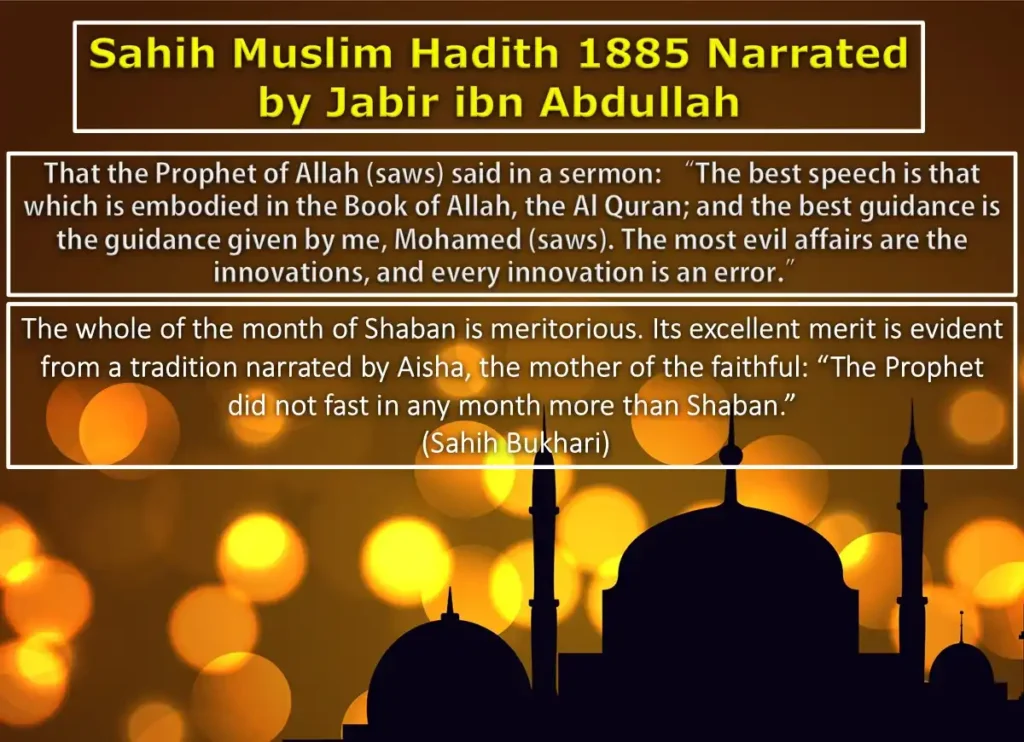
The hadith reports people connect with mid-Sha‘ban
Many Muslims mention narrations about the middle night of Sha‘ban, including reports about worship and forgiveness. Scholars discuss strength and grading, so it’s wise not to build “mandatory rituals.” But these narrations still teach powerful lessons about repentance, pure faith, and clean hearts.
One report describes Sayyidah ‘Aishah (RA) finding the Prophet ﷺ at Al-Baqi‘ cemetery. In Sunan Ibn Majah (Hadith 1389):
فَإِذَا هُوَ بِالْبَقِيعِ رَافِعٌ رَأْسَهُ إِلَى السَّمَاءِ
Translation (meaning): “I found him at Al-Baqi‘, raising his head toward the sky…” Reference: sunnah.com/ibnmajah:1389
Another widely quoted report is Sunan Ibn Majah (Hadith 1390), about forgiveness for many people, with exceptions:
يَغْفِرُ لِجَمِيعِ خَلْقِهِ إِلَّا لِمُشْرِكٍ أَوْ مُشَاحِنٍ
Translation (meaning): “…except an idolater or one who harbors hostility.” Reference: sunnah.com/ibnmajah:1390
A crystal-clear hadith about repentance at night
For repentance, one of the strongest and clearest hadith is in Sahih Muslim (Hadith 2759a):
إِنَّ اللَّهَ يَبْسُطُ يَدَهُ بِاللَّيْلِ لِيَتُوبَ مُسِيءُ النَّهَارِ
Translation: “Allah stretches out His Hand at night so that the one who sinned by day may repent…”
Reference: https://sunnah.com/muslim:2759a
This captures the heart of the night without needing any complicated claims.
How to worship without getting lost in “numbers”
If you want to pray extra at night, keep it simple. The Prophet ﷺ gave a clear method for night prayer in Sahih al-Bukhari (Hadith 990):
صَلَاةُ اللَّيْلِ مَثْنَى مَثْنَى
Translation: “The night prayer is offered two rak‘ahs at a time…”
Reference: sunnah.com/bukhari:990
So you can pray 2 rak‘ahs, pause, pray 2 more, and stop when your focus drops. No pressure. Just presence.
What Muslims commonly do on Shab-e-Barat
Across many cultures, people spend the night in a few simple acts. These are always safe and always beneficial:
- Voluntary prayer (nafl)
- Qur’an recitation and reflection
- Dhikr and istighfar (seeking forgiveness)
- Du‘a for yourself, family, and the Ummah
- Forgiving people and repairing relationships
The strongest worship is the one that changes your character after the night.
A beginner-friendly plan you can actually follow
Try this simple flow:
- Pray Maghrib and ‘Isha on time
- Sit for five minutes of quiet tawbah
- Pray 2 rak‘ahs nafl slowly
- Read a page of Qur’an
- Make du‘a for forgiveness and guidance
- Sleep in time to pray Fajr properly
This plan is small, but it’s real—and real worship is what lasts.
A Qur’anic du‘a to end the night
If you want one du‘a that covers dunya and akhirah, use Surah Al-Baqarah (2:201):
رَبَّنَآ ءَاتِنَا فِى ٱلدُّنْيَا حَسَنَةًۭ… وَقِنَا عَذَابَ ٱلنَّارِ
Translation: “Our Lord, grant us good in this world and good in the Hereafter…”
Reference: https://quran.com/2:201
It’s short, balanced, and deeply human.
Culture vs. religion: staying respectful and steady
Some customs—like special foods or community gatherings—are cultural ways families mark the night. If they bring people closer to kindness and worship, they can be harmless. But don’t let culture become a courtroom where everyone judges everyone else.
A good rule: keep worship private, avoid arguments, and never skip obligations while chasing “extras.” The night is meant to soften you, not harden you.
A better way to answer the big question
So, what is shab e barat in islam when you strip away noise? It’s a night many Muslims use to return to Allah—through repentance, prayer, and du‘a—while staying careful about rigid claims. You don’t need a perfect routine. You need a sincere heart and a clear next step.
And here’s the best part: the night can be a beginning. If you leave it with one sin dropped, one grudge forgiven, and one prayer protected, you’ve won something real.
A confident close that stays with you
What matters is not how late you stayed awake, or how many posts you shared. What matters is what changes after sunrise. Make your du‘a. Pray what you can. Forgive someone. Fix one habit. Then walk into tomorrow like someone who restarted with purpose.
what is shab e barat in islam becomes a living answer when your life reflects it—calmer prayer, cleaner heart, and steadier steps toward Allah.
FAQs
1) Is Shab-e-Barat mentioned by name in the Qur’an?
The name is cultural. The Qur’an strongly teaches repentance and hope in Allah’s mercy, which is why the night focuses on forgiveness. See quran.com/az-zumar/53.
2) Which Qur’an verse is best for forgiveness?
Az-Zumar 39:53 is widely quoted: “Do not despair of Allah’s mercy.” Reference: quran.com/az-zumar/53
3) What hadith mentions the Prophet ﷺ at Al-Baqi‘?
Sunan Ibn Majah 1389 describes ‘Aishah (RA) finding the Prophet ﷺ at Al-Baqi‘ making supplication.
Reference: sunnah.com/ibnmajah:1389
4) How should I pray extra nafl at night?
Pray in pairs of two rak‘ahs, based on Sahih al-Bukhari 990.
Reference: https://sunnah.com/bukhari:990
5) What is the best simple du‘a to read?
Al-Baqarah 2:201 is a complete, short du‘a for good in both worlds. Reference: quran.com/2:201
Recommended For You (Shabe Barat)
- Shab e Barat Mubarak (Lailatul Barat)
- What Should We Prayers of Shab e Barat?
- Best Shab e Barat Dua To Change Destiny
- The Night of Mid-Sha’ban (Shab e Barat)
- What Does Islam Say About Shab Barat?
- Common Dua in Taraweeh Prayer To Recite
- So Kar Uthne Ki Dua | Dua After Waking Up
- Shab-e-Barat Ki Dua – Duas For Mid Sha’ban
- Read Shab-e-Barat Quotes From The Quran
- Allahumma Rahmataka Arju: A Dua For Hope
- Why Do We Celebrate Shab-e-Barat in Islam?
- Shab e Barat Ki ibadat Ka Tarika (step-by-step)
- Berat Kandili – Holy Night of Forgiveness 2026
- Arabic Prayer With Transliteration and Meaning
- Berat Kandili Ne Zaman? Night of Forgiveness
- Sobe Barat- Historical & Scholarly Perspectives
- What To Recite in Shab e Barat Nawafil Namaz?
- Shab e Barat Ki Fazilat: Toba, Aur Maghfirat Ki Raat
- Shab e Barat Kya Hai? FaziLat, Ibaadat Aur Ehmiyat
- Shab e Barat Namaz Ka Tarika (Prayers For 15 Shaban)
- Shab e Barat Ibadat And Prayers – Night of Forgiveness
- Shab e Barat Ki Namaz Ka Tarika: A Simple Way To Pray
- Shab e Barat Prayers: A Guide to Prayers & Significance
- What Happened on Shab e Barat? Night of Mid Shaban
- What Is Shab e Barat? Night for Repentance & Barakah
- What is The Shab e Barat meaning? Night of Forgiveness
- Shab e Barat Namaz Rakats: How To Pray Namaz Rakats?
Salatul Tasbih
- How To Perform Salatul Tasbih?
- Definition of Subhanallah and Its Meaning
- la ilaha illa anta subhanaka Inni Kuntu Minaz Zalimin