
How to do istikhara is one of the first questions new Muslims and even long-time practicing Muslims ask when a big decision shows up — marriage, a job offer, a move, or anything where the right path isn’t obvious. It’s a common source of confusion, mostly because people know the prayer exists but were never walked through it clearly.
Before we get into the steps, here’s a resource many people keep on hand when studying dua and voluntary prayer: Riyad as-Saliheen by Imam Nawawi (Amazon). It’s a solid companion for understanding prophetic etiquette around prayer and supplication.
What Is Istikhara Prayer
Istikhara is a short voluntary prayer where a Muslim asks Allah to guide them toward whichever choice carries real good, when they themselves can’t see the outcome. The insight is simple and comforting: Allah knows what’s hidden from us, so instead of guessing or overthinking, a believer hands the unknown parts of a decision over to Him.
This isn’t a replacement for thinking things through. You still gather facts, weigh your options, and ask people you trust for advice. Istikhara sits on top of that groundwork — it doesn’t skip it. The Prophet ﷺ used to teach his companions istikhara the way he taught them surahs of the Qur’an, which shows how much weight it carried in everyday life.
How to Do Istikhara Prayer — Step by Step
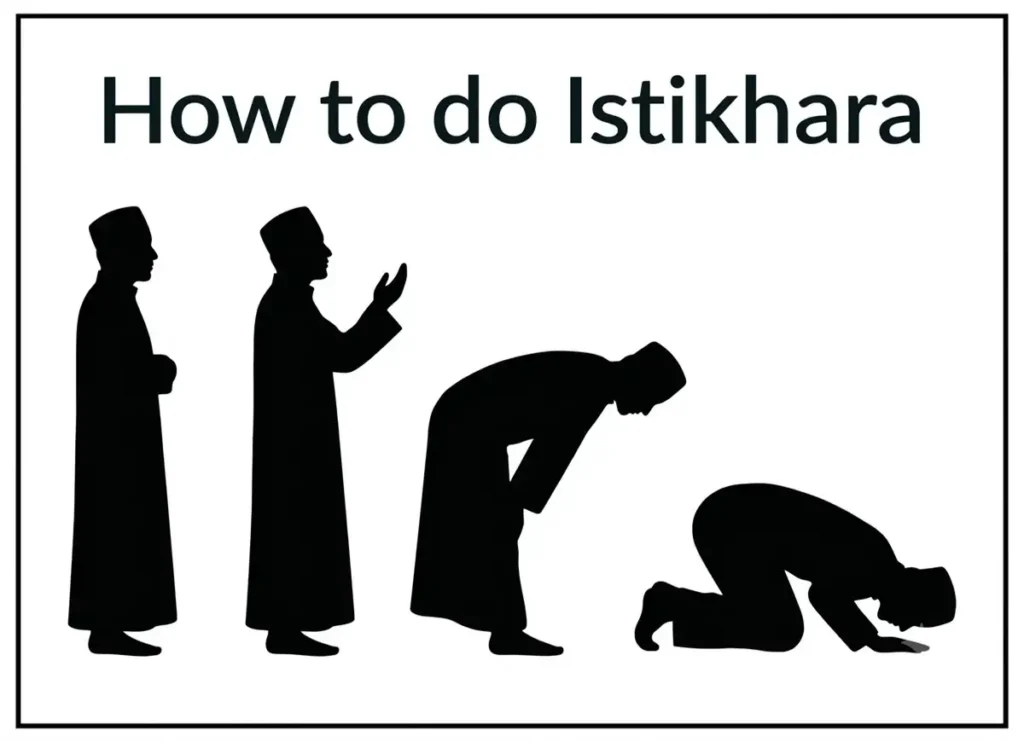
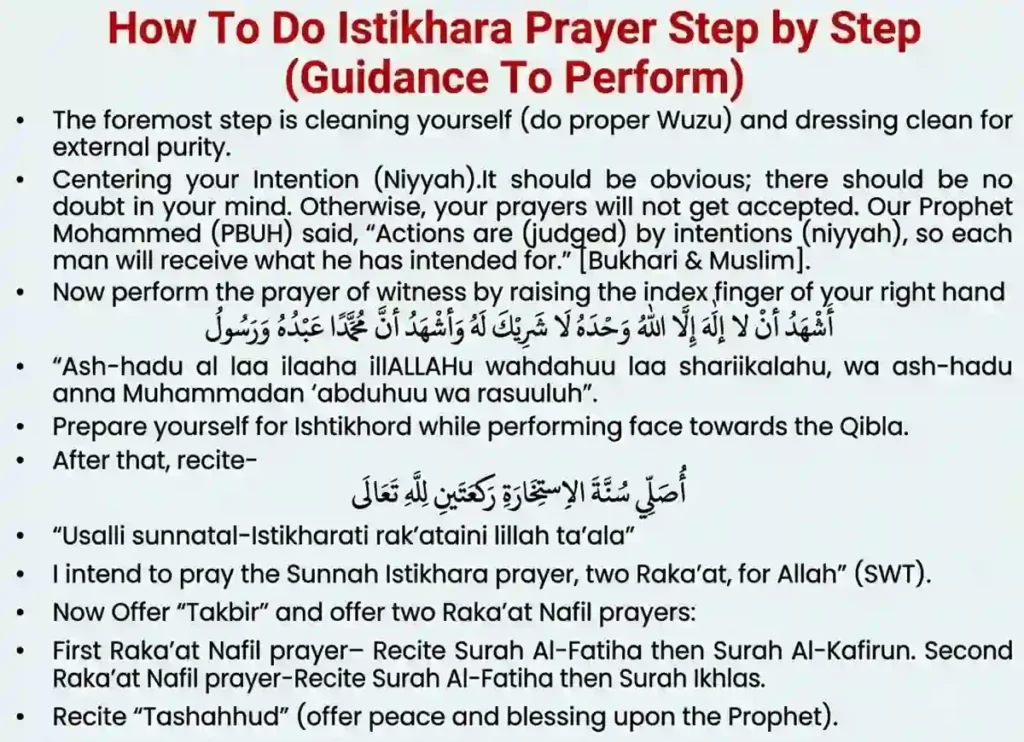
If you’re wondering how to do istikhara prayer the correct way, here’s the sequence:
- Make Wudu — begin in a state of purity.
- Set your niyyah (intention) — be clear in your heart about the specific matter you’re seeking guidance on.
- Pray two rak’ahs of Nafl, separate from your obligatory prayers. Many recite Al-Fatihah followed by Surah Al-Kafirun in the first rak’ah, and Al-Fatihah followed by Surah Al-Ikhlas in the second — though this isn’t required.
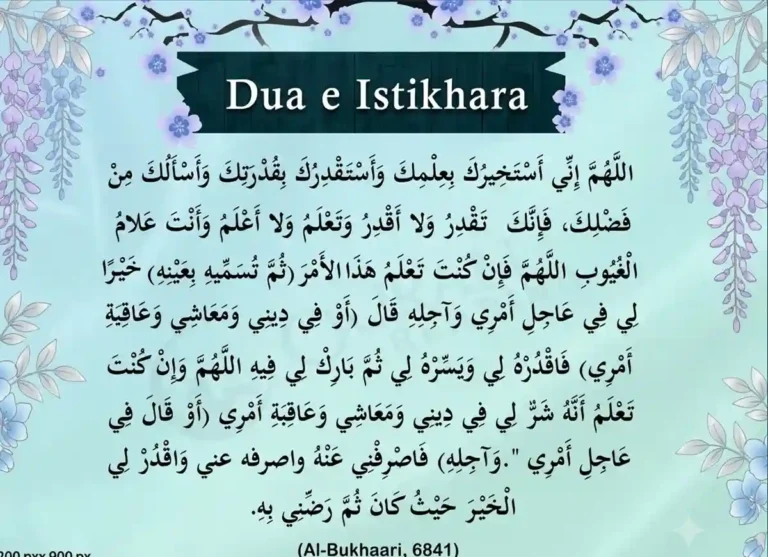
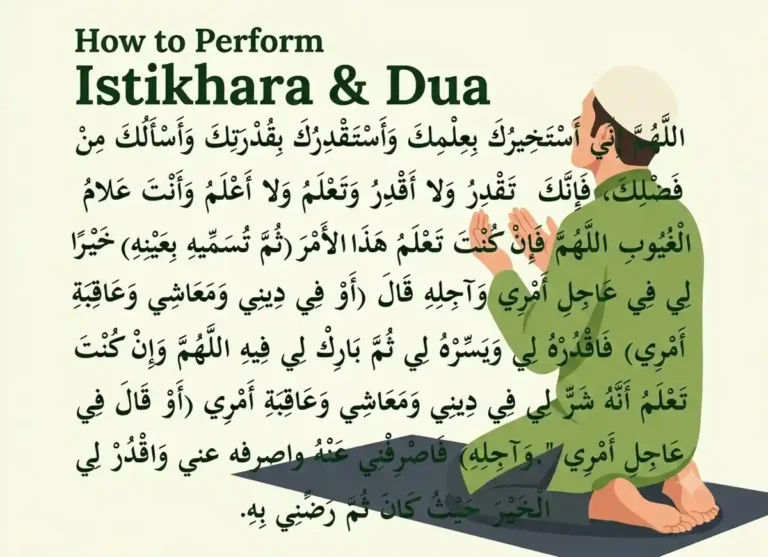
- Recite the istikhara dua, raising your hands, opening with praise of Allah and blessings on the Prophet ﷺ.
- Name your matter where the Arabic phrase “hadha al-amr” (this matter) appears in the dua.
- Proceed with whatever feels right afterward, trusting that Allah is guiding events in the background.
It’s fine to repeat the prayer if the answer still isn’t clear — some scholars mention repeating it up to seven times across separate occasions, though three is often enough for most people to feel settled.
Also Read: As Alullahal-‘azima rabbal-‘arshil-‘azimi an yashfiyaka in arabic
How to Do a Istikhara When You Can’t Pray
Sometimes praying two full rak’ahs isn’t possible — you might be traveling, unwell, or in a state where prayer isn’t valid. If you’re asking how to do a istikhara in that situation, the answer is simple: recite the istikhara dua on its own, without the two rak’ahs. It’s not the ideal form, but it’s accepted when circumstances don’t allow for the full prayer.
How to Do Istikhara Namaz the Right Way
For those specifically searching how to do istikhara namaz, the namaz (prayer) itself follows the same rules as any two-rak’ah nafl prayer — normal standing, bowing, and prostration, with the recitations mentioned earlier. What makes it istikhara namaz isn’t a special physical form; it’s the niyyah behind it and the dua that follows right after.
When to Pray Istikhara
Istikhara can be prayed at almost any time, with three exceptions tied to the general rule against praying during disliked windows:
Also Read: Astaghfirullah Meaning in Urdu
| Time to Avoid | Why |
| Right after Fajr until sunrise | Disliked time for voluntary prayer |
| The few minutes right before Dhuhr (solar noon) | Disliked time for voluntary prayer |
| Right after Asr until sunset | Disliked time for voluntary prayer |
Outside these windows, many scholars recommend praying istikhara before sleeping, since the mind is quieter then — though it’s in no way required to wait until night.
Reading the Outcome Without Waiting for a Dream
One of the biggest misunderstandings around istikhara is expecting a dream or a dramatic sign. In reality, guidance usually shows up through how smoothly or roughly a path unfolds. If things fall into place with ease, that’s often taken as a sign of khayr (good). If obstacles keep piling up, it may be a nudge to reconsider. Either way, the person is still expected to use their own good judgment.
Also Read: Reading Quran Without Wudu: What’s Allowed?
Consulting Others Alongside Istikhara
Istikhara works best paired with istisharah — seeking advice from people whose judgment you trust. Imam al-Nawawi taught that consulting others before praying istikhara helps a person step back from their own personal bias. The order matters: gather good advice first, then bring the decision to Allah in prayer once you actually understand your options.
Two Verses on Trusting Allah With Decisions
Surah Aal-e-Imran 3:159 — Allah instructs the believers to consult one another, and once a decision is reached, to place full trust in Him. This verse captures the entire spirit behind istikhara: consult, decide, then trust. Read on Quran.com
Surah At-Talaq 65:3 — Allah promises that whoever relies on Him, He will be sufficient for them. It’s a reassuring verse for anyone nervous about handing a decision over to Allah’s guidance. Read on Quran.com
Two Hadith on Prayer and Patience
Sahih al-Bukhari 6382 — Jabir ibn Abdullah narrated that the Prophet ﷺ used to teach the companions istikhara for every matter, just as he taught them a surah from the Qur’an. View on Sunnah.com
Sahih Muslim 2735a — The Prophet ﷺ said a person’s supplication continues to be answered as long as they don’t grow impatient and give up on it. A helpful reminder for anyone waiting on clarity after istikhara. View on Sunnah.com
For readers who want to go deeper into the fiqh behind voluntary prayer and dua, these Hanafi references are worth locating at a library or Islamic archive:
- Radd al-Muhtar by Ibn Abidin
- Al-Hidayah by Burhan al-Din al-Marghinani
- Bahishti Zewar by Maulana Ashraf Ali Thanvi
For scholarly answers to more specific istikhara questions, check IslamQA and the IslamicTeachings.org forum. If you’re looking for more content like this, quranmualim.com regularly publishes similar guides on Islamic prayer and worship.
According to Wikipedia’s entry on istikhara, the practice is recognized across Sunni schools of thought as a recommended (mustahabb), non-obligatory prayer. Britannica’s overview of salat is a useful reference for understanding where voluntary prayers like this one fit within the wider structure of Muslim worship.
Must Read: Wudu (Step-by-Step)
FAQs
How many times should I pray istikhara before deciding?
There’s no fixed number. Some people feel settled after one prayer, others repeat it up to three or seven times across different days until clarity comes.
Do I need a specific dream to know istikhara worked?
No. Dreams aren’t required or guaranteed. Guidance usually comes through how easily or difficultly the situation unfolds over time.
Can I do istikhara for small, everyday decisions?
Yes. Istikhara isn’t limited to big life events — many scholars encourage praying it even for smaller choices where you’re genuinely unsure.
What if I still feel confused after praying istikhara?
Keep praying it, consult people you trust, and move forward with your best judgment. Confusion often clears gradually rather than instantly.
Is it okay to pray istikhara without the two rak’ahs?
Yes, if circumstances don’t allow prayer — like travel or illness — reciting the dua alone is accepted, though the full prayer is the preferred form.
Learning how to do istikhara isn’t complicated once you’ve walked through the steps — wudu, intention, two rak’ahs, and a sincere dua. What matters most isn’t perfection in the ritual, but genuine trust that Allah is guiding you toward what’s best. Start with your next decision, and let this simple prayer become part of how you move through life.
Article by Alasad Online Quran Tutor — Quranmualim.com Learn Quran online with certified tutors. Visit our YouTube channel, follow us on Facebook, or reach out on WhatsApp for a free trial class.
Latest istikhara Blogs:
- Learn Dua of Istikhara For Marriage
- Dua Istikhara With Urdu Translation
- A Guide To Dua of Istikhara Transliteration
- Dua Istikhara: For Marriage, Job & Business
- Dua For Istikhara in Arabic Text and Meaning
- Dua For istikhara in Arabic & Urdu Translation
- How Do You Pray Istikhara? Step-by-Step Guide
- How Do I Feel The Result of My Dua e Istikhara?
- A Guide To Dua Istikhara With English Translation
- How To Pray Istikhara Namaz Step by Step Guide?
- How to do (Perform) Istikhara Dua PDF Download
- The Fiqh of Ghusl: A Full Guide To Purification in Islam
- Dua For Istikhara English Translation & Transliteration
- Dua For Istikhara: A Guide to Seeking Allah’s Guidance
- Dua Istikhara With English Transliteration – Learn Islam
- Dua of Istikhara: Step by Step Guide To Salatul Istikhara
- How Do I Do Istikhara? A Guide to Seeking Allah’s Guidance
Related Posts For You:
- How to Perform Ghusl? PDF Download
- Ghusl Dua | Dua for Ghusl – Learn Islam
- How to Make Ghusl: A Simple Step-by-Step Guide
- How To Do Ghusl After Period: Step-by-Step Guide
- How To perform Ghusl Correctly? Learn Islam, Islam
- Dua After Ghusl – The Secret to Spiritual Cleanliness!
- Ghusl Steps: A Complete Guide For Men and Women
- The Fiqh of Ghusl: A Full Guide To Purification in Islam
- Ghusl: A Complete Guide To Islamic Ritual Purification
- How To Clean Private Parts After Urination? Learn Islam
- Ramadan Fasting Rules: Intimacy, Ghusl, Music/TV, Vitamins, Pregnancy