


The Tarawih Prayer often arrives like a soft knock on the heart—right after a long day, when your tea is finally warm and your phone won’t stop buzzing. In the UK and USA, that knock can feel inconvenient at first. Then you step into the masjid, hear the Qur’an, and suddenly your whole night feels… possible.
Amazon book recommendation: The Fiqh of Ramadan
The Ramadan “startup” problem it solves
Ramadan is full of good intentions, but real life doesn’t slow down. People want more Qur’an, more prayer, and more calm—yet they’re juggling work, school runs, deadlines, and traffic. Night prayer becomes the “solution product”: a structured way to reconnect, one evening at a time, without needing perfect conditions.
For a quick background on the practice and its history, you can read this Wikipedia overview of Tarawih.
What Tarawih is, in everyday words
Tarawih is a special voluntary prayer in Ramadan, prayed after ‘Isha. It’s usually offered in pairs of rak‘ahs, and many communities take short rests after every four. That’s where the name comes from: taraweeh is linked to “resting,” because people paused to catch their breath.
When is tarawih prayer in the night?
If you’re asking when is tarawih prayer, keep it simple: it starts after ‘Isha and is prayed before Witr. In most mosques, Witr closes the night. In the UK, that might feel late during short nights. In the USA, distance and work shifts can change what you can manage.
For broader context on Ramadan timing and practices, see Britannica’s Ramadan article.
Quran verses that support night worship
The Qur’an doesn’t name Tarawih as a label, but it strongly praises night prayer and recitation. These verses help explain why Ramadan nights feel spiritually “alive,” even when you’re tired.
Most relevant verses (with English meaning)
- Surah Al-Isra (17:79)
English meaning: “And from the night, pray with it as extra worship for you; it may be that your Lord will raise you to a praised station.” - Surah Al-Muzzammil (73:20)
English meaning: “So recite what is easy for you of the Qur’an…”
This verse is a mercy message: worship is encouraged, but Allah does not want hardship.
You’ll also find beginner-friendly explanations of night prayer on www.quranmualim.com as an Islamic site.
Hadith proofs that explain Tarawih clearly
When people debate length, rak‘ahs, or congregation, scholars usually return to a few core hadith reports. These show two key ideas: the Prophet ﷺ valued night prayer deeply, and he also protected the ummah from hardship.
Key Hadith references
- Sahih al-Bukhari (Hadith 1147)
English meaning: ‘Aishah (ra) said the Prophet ﷺ did not pray more than eleven rak‘ahs in Ramadan or outside it, praying in sets with beautiful length and focus. - Sahih Muslim (Hadith 738a)
English meaning: Another report from ‘Aishah (ra) describes the Prophet’s night prayer quality and structure, highlighting depth over speed. - Sahih al-Bukhari (Hadith 1129)
English meaning: The Prophet ﷺ stopped leading the people every night because he feared it might become obligatory for them.
You can read a reliable English reference at Sunnah.com’s page for Bukhari 1129.
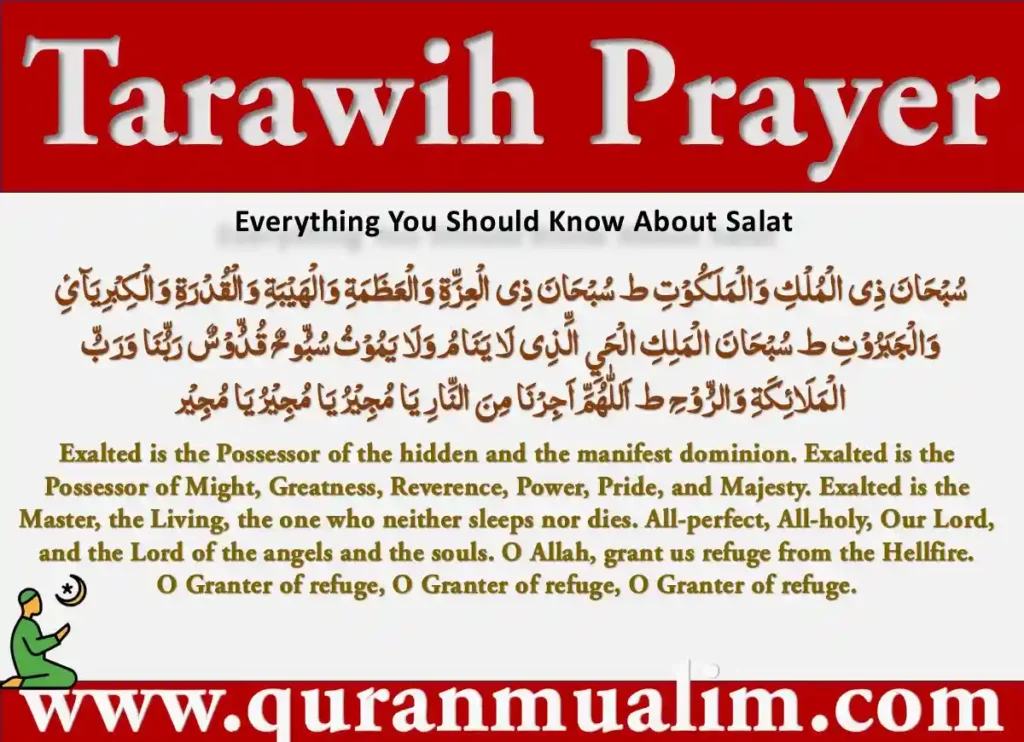
How to pray tarawih (a simple step-by-step)
If your search is literally how to pray tarawih, here’s the beginner method used in most mosques. It’s calm, repeatable, and easy to follow, even on your first night.
- Pray ‘Isha first (fard, then sunnah if you usually do them).
- Make intention for Tarawih (Ramadan night prayer).
- Pray two rak‘ahs at a time, ending each pair with salam.
- Follow the imam’s recitation and movements.
- Take breaks when the masjid pauses, then continue.
- End with Witr, usually led by the imam.
Helpful “first-week” tips
- Bring water and keep your iftar lighter on prayer nights.
- Stand comfortably; don’t force a posture that causes pain.
- If you miss a night, don’t spiral—restart tomorrow with a clean heart.
- In busy UK/USA masjids, arrive early to avoid stress at the door.
Tarawih prayer rakat: how many are there?
People often ask tarawih prayer rakat like it’s one fixed number worldwide. In practice, communities differ. Many Hanafi mosques commonly pray 20 rak‘ahs, while some communities pray 8, especially where time is tight. What matters most is the night prayer itself, prayed with sincerity and consistency.
A quick comparison table for real life
| Question you’re really asking | Simple answer | UK/USA practical advice |
| “Do I have to pray every night?” | No, it’s voluntary | Aim for consistency, not perfection |
| “Is praying at home okay?” | Yes | Great for parents, students, shift workers |
| “Does my prayer count if it’s shorter?” | Yes | Short and steady beats long and rare |
| “Should I follow the imam’s number?” | Usually yes | Unity helps more than argument |
Hanafi perspective, in plain language
Hanafi scholars generally treat Tarawih as a strongly emphasized Sunnah of Ramadan and encourage praying it in congregation when possible. The community format also helps people who struggle alone—because the jama‘ah carries you on nights when motivation is low and your body wants sleep.
Hanafi scholars’ PDF book titles (different set)
These well-known Hanafi works commonly include discussions related to Tarawih within chapters on nafl prayer and Ramadan practices:
- Sharh Ma‘ani al-Athar — Imam al-Tahawi
- Al-Hujjah ‘ala Ahl al-Madinah — Imam Muhammad al-Shaybani
- Kitab al-Asl (Al-Mabsut of Imam Muhammad) — Imam Muhammad al-Shaybani
- Fath Bab al-‘Inayah — (Hanafi commentary tradition; often cited in Hanafi study circles)
- Nimatu’l-Islam — Mufti Ashraf Ali Thanvi (widely circulated in South Asian Hanafi learning)
Common questions people feel shy to ask
Some questions don’t get asked out loud, but they’re real—especially for converts and first-time attendees in the UK and USA.
- “Can I hold a Qur’an while praying?” Many scholars allow it in voluntary prayers if needed, especially when praying alone.
- “Can I leave early?” Yes. Leave quietly, keep your intention, and continue at home if you wish.
- “Is there a special du‘a between sets?” You can make any du‘a you like. Nothing is compulsory there.
Closing Thoughts

Tarawih Prayer isn’t meant to be a monthly torture test. It’s a training ground for the heart. Start with what you can carry. Show up without drama. Let the Qur’an do its work on you, one night at a time. Tarawih Prayer rewards consistency, not ego. Tarawih Prayer builds people who finish Ramadan stronger than they began.
FAQs
1) When is tarawih prayer performed?
After ‘Isha and before Witr. Most mosques pray it right after ‘Isha to make it easy for families and working people.
2) How to pray tarawih if I’m new?
Pray two rak‘ahs at a time, follow the imam if you’re in congregation, and keep your focus on calm recitation and sincere intention.
3) How many tarawih prayer rakat should I pray?
Many Hanafi communities pray 20. Some pray 8. Your prayer is valid in either case—choose what you can sustain and follow your local masjid to avoid confusion.
4) Can I pray Tarawih at home in the UK or USA?
Yes. It’s valid at home, alone or with family. It’s also a good option when travel, safety, or work schedules make the mosque difficult.
5) Is it okay if I miss some nights?
Yes. Don’t quit the whole month because you missed a few nights. Return the next night with a fresh intention.
Similar Posts For You
- Allahumma Ajirni Minan Naar
- Is Taraweeh Sunnah or Nafl?
- How To Pray Taraweeh At Home?
- How Many Rakats For Zuhr Prayer
- Is Taraweeh Mandatory or Optional?
- Taraweeh Dua in English Translation
- Taraweeh Meaning – Dua & Rewards
- How To Perform Taraweeh? – Step by Step
- Common Dua in Taraweeh Prayer To Recite
- Allahumma Rahmataka Arju: A Dua For Hope
- How Many Rakats Taraweeh? Complete Guide
- Best Dua in Taraweeh During Ramadan Nights
- How Do You Pray Taraweeh? Complete Guide
- Allahumma Ajirni Minan Naar in Arabic & English
- How Many Rakats in Taraweeh Namaz? Explained
- Can You Pray Taraweeh At Home? Complete Guide
- How To Perform Taraweeh Prayer? Stepwise Guide
- Taraweeh ki Dua With Arabic & English Translation
- What is Taraweeh Prayer Time? Question & Answer
- Is Taraweeh Compulsory in Islam? Question & Answer
- Dua For Taraweeh: Arabic Transliteration & Translation
More Any information
- WhatsApp: +923017363500
- Business Hours:24/7
- Site: www.quranmualim.com
Related Posts:
- Can You Control It? Dua For Anger
- Dua For A Bad Dream– Say This & Relax!
- Dua For A Good Day – Start with Barakah!
- Dua For Sleep – A Powerful Remedy You Need!
- Ahad Nama Dua – Why Is This Dua So Special?
- After Fajr Prayer Dua – The Key to Rizq & Success!
- Dua After Ghusl – The Secret to Spiritual Cleanliness!
- Dua After Praying – Do This For Rizq, Mercy & Blessings!
- Best Times to Make Dua – Most People Overlook These!
- Dua After Tahajjud Salah – This Can Change Your Destiny!
- Auzu Bikalimatillahi Tammati Dua – A Shield of Protection!
- Dua Completion of Quran – The Key to Unlimited Blessings!