

Surah al kahf first 10 verses are often talked about, but many Muslims still feel unsure about what “first 10” really means, how to recite them correctly, and what benefit is promised in the Sunnah. Some people think it is only for “very religious” readers, while others memorize without understanding a single line.
Amazon : A helpful, readable option is The Study Quran on Amazon:
Problem: A common confusion among Muslims
Many people ask the same questions: “Do I have to memorize all ten?” “Is listening enough?” “Do I need Arabic?” “Do I have to read them every Friday?” And because answers come from different posts and clips, the topic starts feeling complicated instead of comforting.
The good news is: you can approach this in a simple, steady way—without guilt, and without getting lost in details.
Insight: What these verses are really about
Surah Al-Kahf is Surah 18, and it opens with a powerful reminder: the Qur’an is straight guidance, and real safety comes from Allah’s mercy and direction. Even if you’re new, the beginning of this surah sets a tone of clarity, truth, and spiritual protection.
If you want background on the surah itself, you can read the overview on Wikipedia’s Al-Kahf
And for a short academic description of the surah’s themes and stories, Britannica’s entry on Al-Kahf is useful
Also Read: Surah kahf Last 10 Verses pdf Download
Why Muslims focus on the first ten verses
When people mention “first ten,” they usually mean: memorize and keep these verses close, because they carry a strong message of faith, guidance, and protection.
This is also why you’ll often see searches like:
- surah al kahf first 10 verses in english
- first 10 verses of surah al kahf transliteration
- surah al kahf first 10 verses (for memorization and revision)
A practical way to think of it is this: these verses become your “weekly anchor” and your “mental shield,” especially when life feels noisy.
Key benefits (spiritual + practical)
Here are benefits many readers notice over time, especially when they stay consistent:
- A calmer heart: recitation slows the mind down and refocuses intentions
- Better weekly routine: linking it to Friday builds a stable habit
- Stronger faith language: you start recognizing Qur’anic phrases naturally
- A sense of protection: not “magic,” but spiritual grounding and clarity
- More confident recitation: small daily repetition improves fluency fast
For a simple discussion of virtues tied to Surah Al-Kahf and Friday practice, see this helpful Q&A on AboutIslam:
Also Read: Juz Amma 30 For School Students PDF Download
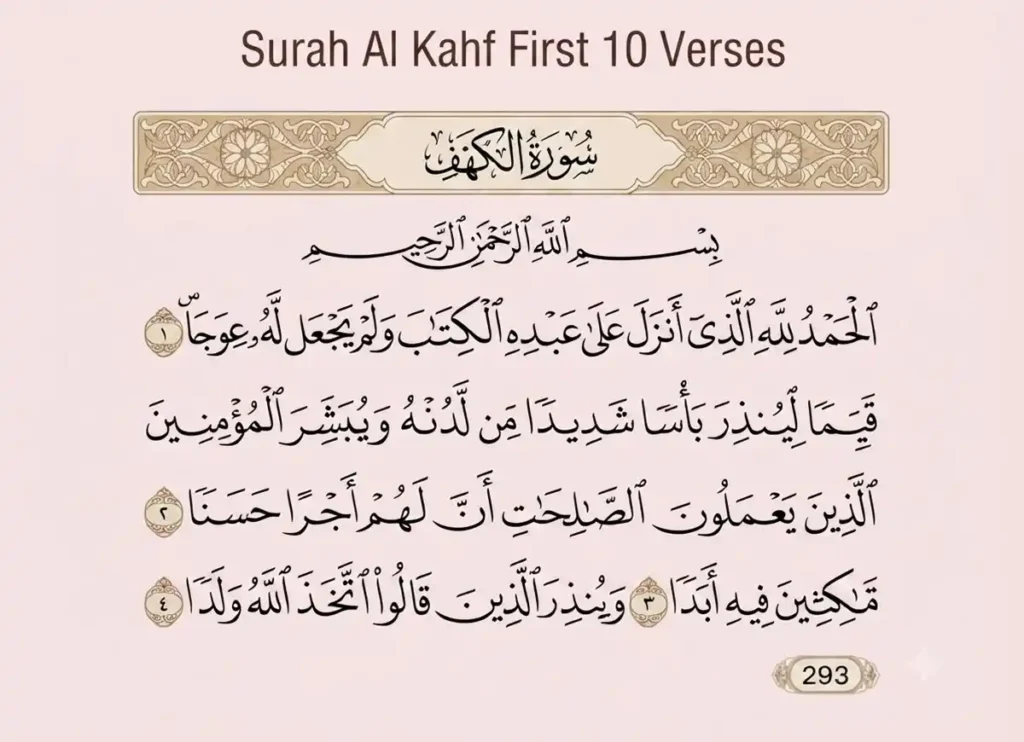
Most relevant Qur’an references
Below are two short, high-impact ayat references from the beginning area of the surah. Links use Quran.com (as per your rotation plan for this article).
Short meaning: The youths ask Allah for mercy and the right path through their difficulty.
Link (Arabic + transliteration + translation):
Hadith references
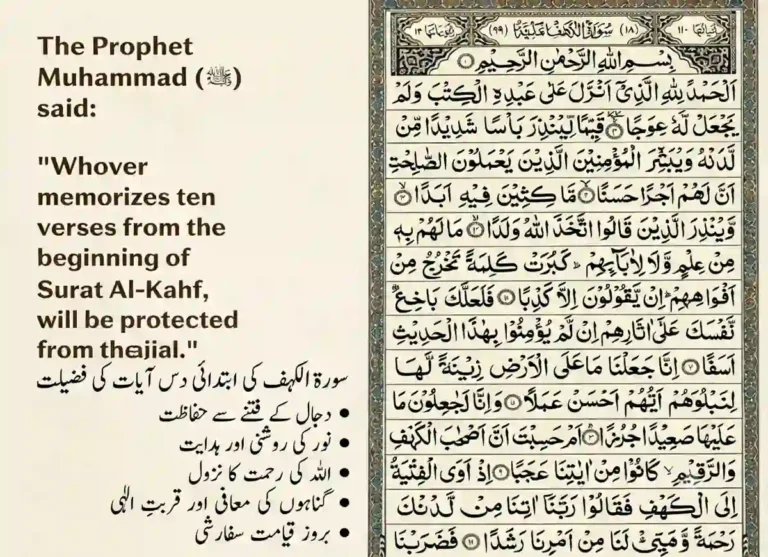
1) Protection by memorizing the first ten
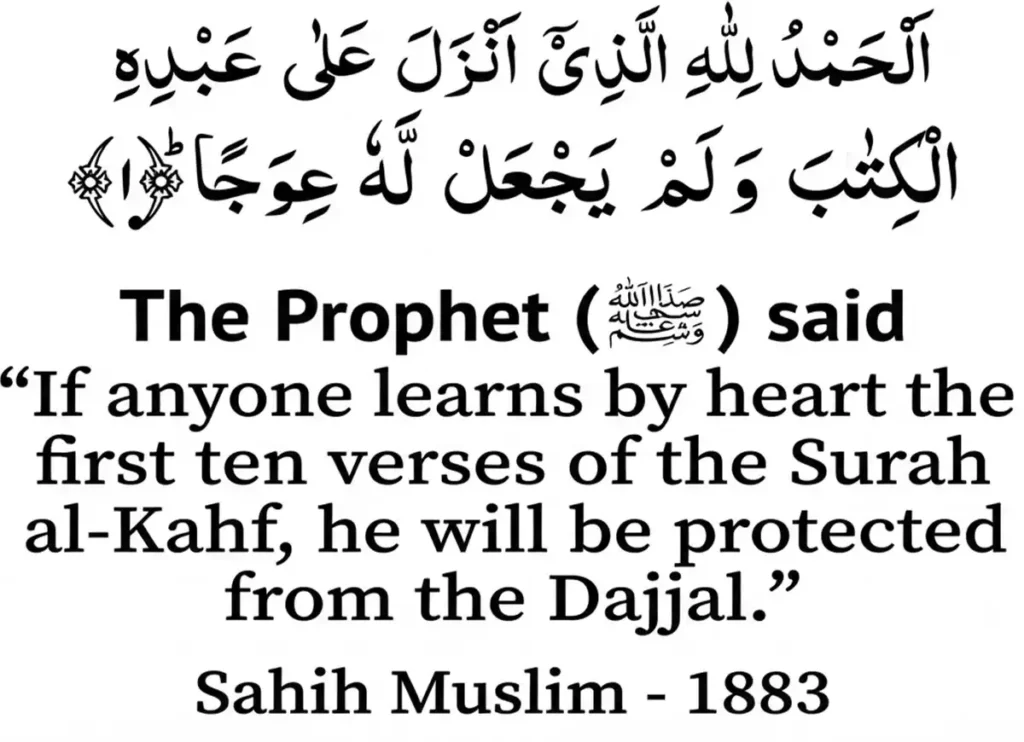
Sahih Muslim 809a
Short meaning: Memorizing the first ten verses of Surah Al-Kahf protects a believer from the Dajjal’s trial. Read it here: “Hadith on memorizing the first ten verses of Surah Al-Kahf”
A simple “first-time reader” approach
If you’re new, don’t start by trying to be perfect. Start by being consistent.
Step 1: Read in English first (2–3 minutes)
Use a clear translation, then read slowly. This helps your brain “know” what it is repeating.
Step 2: Add short transliteration (only what you can manage)
If Arabic is hard, transliteration can help you begin. Many readers search first 10 verses of surah al kahf transliteration for this reason.
A realistic plan:
- Learn 1 verse per day for 10 days
- Or 2 verses per week for 5 weeks
- Or all 10 slowly over a month
Step 3: Move to Arabic recitation
Even 60 seconds daily makes a difference. Your mouth learns through repetition.
Also Read: Surah Kahf Complete: English Translation, Transliteration, PDF and Friday Recitation Benefits
The Hanafi fiqh “rule of thumb” (practical, everyday)
A simple Hanafi-friendly guideline many teachers share is:
- Reciting Qur’an in Arabic is worship even if you don’t know the full meaning yet.
- Understanding matters deeply, so add translation gradually.
- Don’t abandon recitation because you feel “not ready.” Keep going and keep learning.
(For detailed rulings, always check with a qualified scholar in your area.)
Solution: A weekly checklist + table + habit tips
Quick checklist (Friday or any day)
- ✅ Make wudu (if possible) and sit for 5 minutes
- ✅ Recite the first ten verses calmly
- ✅ Read the English meaning once
- ✅ Repeat the hardest verse 3 times
- ✅ Make a short du’a: “Allah, guide me through my tests.”
Simple table to stay consistent
| Goal | What to do | Time needed | Best time |
| Build the habit | Read + listen once | 5–7 min | After Fajr |
| Improve pronunciation | Repeat 1 verse 5 times | 3–4 min | After Maghrib |
| Memorize steadily | 1 new verse + 2 old | 8–10 min | Before sleep |
| Keep meaning alive | Read English only | 2–3 min | During commute |
Habit tips that actually work
- Attach it to a routine (tea, commute, bedtime).
- Keep a single mushaf/app so you don’t jump between fonts and translations.
- Record your own recitation once a week—small corrections add up fast.
- Use community support: even a small circle helps. (You can discuss reflections on onlineislamicforum.com sometimes.)
Hanafi fiqh book
Here are five commonly found Hanafi references in libraries/archives (titles only, no PDF links):
- Nur al-Idah
- Al-Hidayah (al-Marghinani)
- Radd al-Muhtar (Ibn ‘Abidin)
- Bada’i al-Sana’i (al-Kasani)
- Al-Fatawa al-Hindiyya (Fatawa Alamgiri)
Categories: PRAYER ,ALMS , SAWN HAJJ & DUA , Hadith and Tafseer, The Holy Quran, Quran Jaz 1- 114
FAQ
What’s the easiest way to start if I can’t read Arabic?
Start with English meaning first, then learn transliteration for one verse daily. Add Arabic slowly. Consistency matters more than speed.
Do I have to memorize all ten verses at once?
No. Memorize gradually. Even one verse a day is strong progress. Review matters more than rushing.
Can I listen instead of reciting?
Listening is beneficial, but try to recite what you can. Even a short recitation builds confidence and strengthens memory.
Is this only for Fridays?
Many people read Surah Al-Kahf on Fridays, but memorizing and revising the first ten can be done any day.
What if I make mistakes while reciting?
Keep going. Everyone learns with mistakes. Repeat slowly, correct gently, and ask Allah for ease. Improvement comes with steady practice.
Conclusion
If you keep your goal simple, the journey becomes beautiful. Make these verses part of your week, not a “task” you fear. With a small checklist, a steady routine, and sincere intention, you’ll feel the change—calmer focus, stronger faith, and a clearer heart. And when you want more Islamic reminders and study-style posts, you can also explore quranmualim.com as a general Islamic resource.
SURAH Al KAHF FOR YOU:
- Kahf Surah PDF Free Download
- Al Kahf Surah PDF Free Download
- Surah Al Kahf PDF Free Download
- Surah Kahf PDF English, Arabic & Urdu
- Which Surah Read on Friday? Learn Islam
- Surah Kahf PDF File English, Arabic & Urdu
- Al Kahf Surah in English – Complete Guide
- Download PDF Surah Kahf For Mobile & PC
- Lessons From Surah Al-Kahf – QuranMualim
- Surah Al Kahf Transliteration For Easy Reading
- Best Time To Read Kahf Surah Friday – learn Islam
- Surah Al-Kahf With Transliteration (Easy to Read)
- First Ten Ayat of Surah Kahf: Meaning & Benefits
- Al Kahf Surah PDF: Benefits & Lessons From Surah Al-Kahf
- Surah Al-Kahf, Translations, Benefits, Tafseer, PDF Download