
There is a moment, right before sleep, when the mind finally slows down. The day is done, the phone is away, and you are left alone with your thoughts. For many Muslims, myself included, that moment belongs to Surah Al-Mulk.
I did not always understand why this particular surah had such a hold on people. I had heard the virtues mentioned since childhood. But it was only when I began reading it slowly, with a translation open beside me, that I understood what I had been reciting all along. This is not a short chapter you rush through before sleep. It is a conversation with the Creator about why we are here and where we are going.
If you are looking for the Arabic text, a word-by-word breakdown, or a quality recitation to listen to, SurahAlMulk.org is worth bookmarking. It brings all of that together in one place. But before you open it, let me share what this surah is actually saying.
What Surah Al-Mulk Is Really About
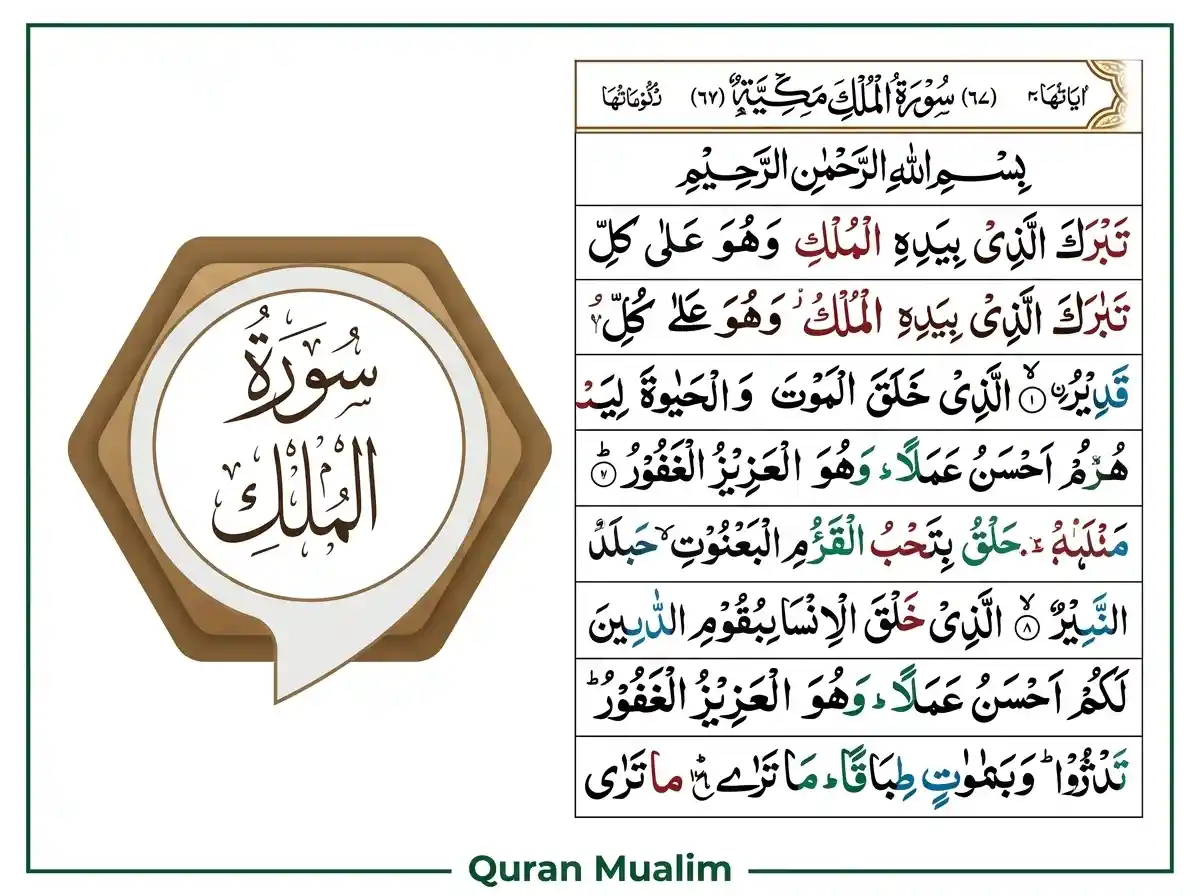
Surah Al-Mulk is the 67th chapter of the Quran. It has 30 verses and sits in the 29th Juz, known as Juz Tabarak, named after the opening word of this very surah. Tabarak means “Blessed is He.” That is how it begins. Not with a command, not with a warning, but with a declaration of awe.
The word Al-Mulk means sovereignty or dominion. The surah opens by stating that every atom of power and authority in existence belongs to Allah alone. And then it asks a question that stops you cold: why do you think you are here?
The answer comes immediately. Allah created death and life as a test to see which of us will do the best deeds. Not the most deeds. Not the most impressive deeds. The best ones. Sincere, intentional, honest efforts.
The surah then shifts outward to the sky, the stars, the universe. It asks you to look up and try to find a single flaw in Allah’s creation. You will not find one. That is the point. And in a world that constantly demands our attention, this surah quietly tells us to lift our eyes, because there is something far larger than our daily concerns.
The Virtues — What the Prophet ﷺ Said
It would be difficult to write about Surah Al-Mulk without mentioning the hadith that draws so many Muslims to it night after night.
In Jami at-Tirmidhi (Hadith 2891), the Prophet ﷺ said:
“There is a surah in the Quran, consisting of thirty verses, that will intercede for its companion until he is forgiven. It is: Blessed is He in Whose Hand is the sovereignty.” [Al-Mulk, 67:1]
Imam Tirmidhi graded this narration hasan, meaning sound and acceptable. It is also supported by similar narrations in Sunan Abu Dawud (Hadith 1400) and Musnad Ahmad. Scholars including Ibn Kathir and al-Albani have both discussed its authenticity.
There are additional narrations about Surah Al-Mulk providing protection from the punishment of the grave. Scholars have examined these carefully. Some narrations are strong while others have noted weaknesses in their chains, and the honest position is to learn the details from a qualified scholar rather than accepting or dismissing them outright. What no scholar disputes is that reciting this surah attentively and consistently is among the most praised nighttime acts a Muslim can maintain.
One thing I have noticed personally: it is very hard to recite Surah Al-Mulk with full attention and still go to sleep with a restless, anxious mind. Something about its message settles you.

Four Lessons That Have Stayed With Me
After years of reciting this surah, a few lessons have genuinely changed the way I think.
Nothing you own is really yours. The surah says it plainly: dominion belongs to Allah. Our health, our income, our relationships, the years we have left are all on loan. This does not make those things meaningless. It actually makes them precious. When you know something is borrowed, you handle it with much more care.
You are being tested right now. Not someday when things get hard. Right now, in the ordinary moments. The test is in how we treat the person in front of us, whether we are honest when no one is watching, whether we choose patience over a quick reaction. The surah presents all of this as the very purpose of life, not as a burden but as a real opportunity.
Look up more often. I mean this almost literally. The surah invites us to observe the sky and find its flaws. We spend so much of our lives looking down at screens, at problems, at our own feet. Looking up, even briefly, can shift your perspective in ways you would not expect.
Accountability is a form of mercy. The surah mentions the consequences of rejecting the truth. This is not there to frighten us into obedience. It is there so we do not waste the time we have been given. While we can still choose differently and still seek forgiveness, we still have everything. That is the mercy in the reminder.
How to Actually Build the Habit
I am not going to suggest you set an alarm or make a colour-coded schedule. Most of us already know what we should do. The gap is in doing it consistently.
The simplest approach that has worked for me is linking Surah Al-Mulk to something you already do every night. Put it after you turn off the light, or after you make wudu before bed. Do not add it to your day as a separate task. Attach it to something already there.
If you are still learning the Arabic, go slowly. Read one verse, check the translation, move to the next. You will not finish the surah in three minutes at first, and that is fine. A slow recitation with understanding beats a fast one done out of habit.
Listening helps too — particularly if you want to get the pronunciation right. But listening is not the same as learning. At some point, you have to recite it yourself.
For the Arabic text, a transliteration if you are learning, and a simple English translation, SurahAlMulk.org has all of it laid out clearly. Use it as your starting point and come back to it as often as you need.
Categories: PRAYER ,ALMS , SAWN HAJJ & DUA , Hadith and Tafseer, The Holy Quran, Quran Jaz 1- 114
A Final Thought
Surah Al-Mulk is thirty verses. It takes perhaps five to eight minutes to recite if you are going at a measured pace. In a day of sixteen or seventeen waking hours, that is a very small portion of time.
But those few minutes, done consistently and with attention, have a way of reorienting everything else. You are reminded of who is in control. You are reminded of why you are here. You are reminded that the day’s frustrations, real as they are, exist within something far larger than you can fully see.
That is what Surah Al-Mulk has always done. Not just for me, but for generations of Muslims who found in its thirty verses a nightly conversation with the One who holds everything.
Similar Posts:
- Surah Mulk PDF Download
- Virtues and Benefits Surah Mulk?
- Read Surah Al Mulk in English Translation
- Read Surah Mulk in Urdu Tarjuma Online
- Surah Mulk Transliteration: Roman Script
- Surah e Mulk Complete: Read, Listen & Study
- Surah Mulk Read Online: Listen & PDF Download