


Taraweeh prayer is one of the most loved parts of Ramadan nights. It brings calm to the heart, helps us connect with the Qur’an, and turns a normal evening into a night of worship and hope.
Amazon book picks (add right after your first paragraph as you requested):
Quick Taraweeh Guide (Table)
| Topic | Quick Answer | Helpful Note |
| What is Taraweeh? | Night prayer in Ramadan after ‘Isha | Part of qiyam (standing in prayer) |
| Is it mandatory? | Not fard, but a confirmed Sunnah (Sunnah Mu’akkadah) | Strongly encouraged in Hanafi fiqh |
| Time | After ‘Isha until Fajr | Many pray it right after ‘Isha for ease |
| Rakats | Commonly 20 in Hanafi practice | Also found in many masjids worldwide |
| Congregation | Best in masjid if possible | But valid at home too |
| Witr | Usually prayed after Taraweeh | In Hanafi, witr is very important |
Also Read: Allahumma Ajirni Minan Naar
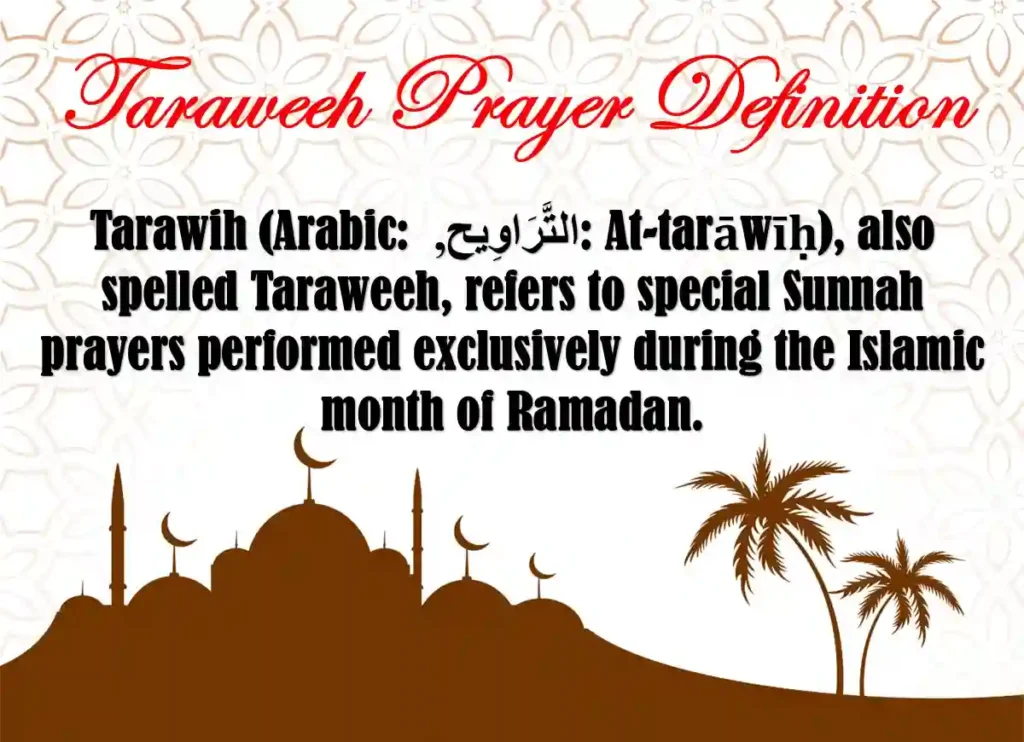
What Does “Taraweeh” Mean?
The word Taraweeh comes from an Arabic root related to “rest.” That’s because worshippers traditionally take short breaks after every four rak‘ahs (units). These pauses are not a requirement, but they are part of the spirit of Taraweeh: steady worship, with ease.
Ramadan is the month of the Qur’an, and Taraweeh is one of the best ways to listen to Qur’an regularly and reflect.
Categories: PRAYER ,ALMS , SAWN & The Holy Quran, Quran Jaz 1- 114
Allah says:
“The month of Ramadan [is that] in which was revealed the Qur’an…” (Surah Al-Baqarah 2:185)
Read it here: Ramadan and the Qur’an (2:185)
Is Taraweeh Prayer Mandatory in Islam?
No, Taraweeh is not fard (obligatory) like the five daily prayers. But in Hanafi scholarship, it is widely taught as a confirmed Sunnah (Sunnah Mu’akkadah)—meaning it is strongly recommended and should not be left without a real reason.
The Prophet ﷺ encouraged night prayer in Ramadan and promised huge reward:
“Whoever prayed at night in Ramadan out of sincere faith and hoping for a reward… will have his previous sins forgiven.” (Sahih al-Bukhari 2008)
Hadith on Taraweeh reward (Bukhari 2008)
Also in Sahih Muslim:
The Prophet ﷺ encouraged qiyam in Ramadan without making it obligatory (Sahih Muslim 759b)
Hadith: encouragement without obligation (Muslim 759b)
So the message is clear: not compulsory, but deeply rewarded.
When Is Taraweeh Prayer Time?
Taraweeh time starts after ‘Isha prayer and continues until Fajr. Many communities pray it right after ‘Isha because it is easier for families, elders, students, and working people.
A beautiful reminder about night worship is:
“And from part of the night, pray with it as additional [worship] for you…” (Surah Al-Isra 17:79) Night prayer verse (17:79)
And Allah praises those who worship at night:
“Is one who is devoutly obedient during periods of the night… prostrating and standing…” (Surah Az-Zumar 39:9) Virtue of night worship (39:9)
Is it better early night or late night?
Both are good. If you fear you may not wake up later, pray Taraweeh early. If you can pray later with calm focus, that can be very special too.
A famous narration about ‘Umar (RA) organizing Taraweeh also mentions that prayer later in the night is better—meaning late-night qiyam has extra virtue. (Sahih al-Bukhari 2010)
Hadith: ‘Umar and Taraweeh (Bukhari 2010)
Also Read: Allahumma Rahmataka Arju: A Dua For Hope

How Many Rakats in Taraweeh? (Hanafi View + Easy Explanation)
In most Hanafi masjids, Taraweeh is prayed as 20 rak‘ahs, usually in sets of 2 and 2, with a short pause after every 4.
Many Hanafi scholars describe 20 rak‘ahs as the established practice.
At the same time, you may see some communities praying 8 (plus witr). This difference exists in the ummah, and it should not become a fight. The safest mindset is:
- Pray what you can with consistency
- Keep your heart soft
- Respect different practices
If you’re tired, praying fewer rak‘ahs with presence is better than praying many with no focus.
Step-by-Step: How To Pray Taraweeh Prayer (Simple Method)
Here is a clear, beginner-friendly way (works well for home or masjid):
Step 1: Pray ‘Isha first
Pray your ‘Isha prayer as normal (fard + sunnah). Taraweeh comes after ‘Isha.
Step 2: Make a simple intention (niyyah)
You don’t need a long sentence. In your heart, intend:
“I am praying Taraweeh for Allah.”
Step 3: Pray in sets of two rak‘ahs
Most people pray Taraweeh like this:
- 2 rak‘ahs → salam
- 2 rak‘ahs → salam
(That makes 4)
Then repeat until you reach your total (commonly 20 in Hanafi practice).
Step 4: Take short breaks (optional but common)
After each 4 rak‘ahs, you can sit briefly, make dhikr, or quietly reflect. This is part of why it is called Taraweeh (resting).
Step 5: Qur’an recitation
- In the masjid, the imam recites aloud.
- At home, you can recite what you know.
- If you don’t know much Qur’an, recite short surahs—Allah accepts your effort.
Allah says about night worship:
“Stand [to pray] the night, except for a little…” (Surah Al-Muzzammil 73:2)
(Read: 73:2)
Step 6: Pray Witr after Taraweeh
Many people pray Witr after Taraweeh in congregation (or at home). This is a common Ramadan routine.
Can You Pray Taraweeh at Home?
Yes. Taraweeh is valid at home—alone or with family.
The Prophet ﷺ prayed in the mosque for a few nights, then stopped leading it publicly because he feared it might become obligatory. (Sahih al-Bukhari 1129, Sahih Muslim 761a)
- Hadith: fear of it becoming obligatory (Bukhari 1129)
- Hadith: same event (Muslim 761a)
So if you can’t go to the masjid—due to health, work, caregiving, safety, travel, or other reasons—you are not “missing Ramadan.” Pray at home and keep your connection with Allah strong.
Best Duas to Make During Ramadan Nights (Great After Taraweeh Too)
There is no single “fixed” Taraweeh dua that everyone must read. But Ramadan nights are a powerful time to ask Allah with humility.
Also Read: Allahumma Ajirni Minan Naar in Arabic & English
Here are a few authentic duas (short, easy, and meaningful):
1) Dua for Laylat al-Qadr (and forgiveness)
Allahumma innaka ‘afuwwun tuhibbul ‘afwa fa‘fu ‘anni
Meaning: O Allah, You are Forgiving, and You love forgiveness, so forgive me.
(Jami` at-Tirmidhi 3513) Laylat al-Qadr dua (Tirmidhi 3513)
2) A dua the Prophet ﷺ often recited
Allahumma atina fid-dunya hasanah, wa fil-akhirati hasanah, wa qina ‘adhab-an-nar
Meaning: Our Lord, give us good in this world and good in the Hereafter, and protect us from the punishment of the Fire. (Riyad as-Salihin 1467, referenced to Bukhari & Muslim) Beautiful all-purpose dua (Riyad as-Salihin 1467)
3) Dua for strength in worship
Allahumma a‘inni ‘ala dhikrika wa shukrika wa husni ‘ibadatik
Meaning: O Allah, help me remember You, thank You, and worship You in the best way.
Hisn al-Muslim reference
3–5 Hanafi Scholar Books (PDF) You Can Reference (Different sections, different books)
These are widely known Hanafi fiqh texts available online as PDFs/scans:
- Al-Hidayah (The Guidance) – Burhan al-Din al-Marghinani (Hanafi law)
PDF: Al-Hidayah (Vol 1) PDF - Nur al-Idah (The Light of Clarification) – Imam Shurunbulali (ibadah rulings)
PDF page: Nur al-Idah (Archive.org) - Maraqi al-Falah – Imam Shurunbulali (commentary and deeper prayer fiqh)
PDF page: Maraqi al-Falah (Archive.org) - Al-Fatawa al-Hindiyya (Fatawa Alamgiri) – major Hanafi compilation
PDF page: Al-Fatawa al-Hindiyya (Archive.org) - Radd al-Muhtar ‘ala al-Durr al-Mukhtar – Ibn ‘Abidin (advanced Hanafi fiqh)
PDF page: Radd al-Muhtar (Vol 1) scan
Practical Tips to Stay Consistent (Real-life friendly)
- If 20 rak‘ahs feels hard, start with what you can and grow slowly.
- If you are new to prayer, keep it simple: short surahs, slow recitation, calm breathing.
- If you are menstruating or unable to pray, you can still do dhikr, dua, charity, and Qur’an listening—your Ramadan still counts.
A Gentle Reminder About Unity
People pray Taraweeh differently in different places. Some pray 8, some 20. Some finish the Qur’an, some don’t. Try not to argue. Ramadan is about mercy, patience, and hearts returning to Allah.
For more Islamic learning and easy guides, you can also visit www.quranmualim.com.
Similar Posts For You:
- Is Taraweeh Sunnah or Nafl?
- Is Taraweeh Mandatory or Optional?
- Taraweeh Meaning – Dua & Rewards
- How To Perform Taraweeh? – Step by Step
- How Many Rakats Taraweeh? Complete Guide
- Best Dua in Taraweeh During Ramadan Nights
- Taraweeh ki Dua With Arabic & English Translation
- What is Taraweeh Prayer Time? Question & Answer
- Can You Pray Taraweeh At Home? Complete Guide
More Any information
- WhatsApp: +923017363500
- Business Hours:24/7
- Site: www.quranmualim.com
Related Posts:
- Can You Control It? Dua For Anger
- Dua For A Bad Dream– Say This & Relax!
- Dua For A Good Day – Start with Barakah!
- Dua For Sleep – A Powerful Remedy You Need!
- Ahad Nama Dua – Why Is This Dua So Special?
- After Fajr Prayer Dua – The Key to Rizq & Success!
- Dua After Ghusl – The Secret to Spiritual Cleanliness!
- Dua After Praying – Do This For Rizq, Mercy & Blessings!
- Best Times to Make Dua – Most People Overlook These!
- Dua After Tahajjud Salah – This Can Change Your Destiny!
- Auzu Bikalimatillahi Tammati Dua – A Shield of Protection!
- Dua Completion of Quran – The Key to Unlimited Blessings!