

How to Pray Salah is simple in way of worship, but many Muslims make mistakes—especially when learning from different people, mixing steps, or forgetting raka‘ahs. That confusion is common all over the world, where work hours, school runs, and daylight changes can throw off routine. This pillar guide gives you one clear path, from wudu to each daily prayer.
One helpful book (How to Pray Salah Step-by-Step):
The Beginner’s Book of Salah (Amazon)
Problem → insight → solution (quick and practical)
Problem: People often ask, “Am I doing it right?” or “How many rakats are there?” and then feel embarrassed to ask again.
Insight: The Qur’an tells us to guard prayer, and the Prophet PBUH taught prayer with clear, repeatable steps.
Solution: Use the checklist below, follow the table, and review each prayer one by one. For more learning and related guides, www.quranmualim.com is an Islamic site that supports beginners and returning learners.
Why Salah matters
Salah is not only worship. It is a daily pause that builds discipline, patience, and hope. Even when life is heavy, prayer gives you a steady place to return to. That stability is one reason Muslims across cultures hold tightly to the five daily prayers. External reference: Salah overview (Wikipedia) and Salat explained (Britannica).
Qur’an references
1) Surah Al-Baqarah (2:238)
Transliteration: Hāfiẓū ‘alaṣ-ṣalawāti waṣ-ṣalāti al-wusṭā…
Short meaning: Guard your prayers, and stand before Allah with devotion. Al-Baqarah 2:238 (Alim.org)
2) Surah Al-‘Ankabut (29:45)
Transliteration: …wa aqimiṣ-ṣalāh…
Short meaning: Establish prayer—prayer helps keep a person away from indecency and wrongdoing. Al-‘Ankabut 29:45 (Alim.org)
Hadith References
1) Prayer is the first thing you’re asked about
Source: Sunan Abu Dawood, Hadith 864
Short meaning: The first deed people will be called to account for on Judgment Day is prayer.
Link (contextual): First deed to be accounted for is prayer (Abu Dawood)
2) If prayer is complete, you succeed
Source: Jami` at-Tirmidhi, Hadith 413
Short meaning: The first deed reviewed is salah; if it’s complete, a person succeeds. (contextual): The first deed reviewed is salah (Tirmidhi)

Before you pray: a clean, calm setup
Keep it simple. Most mistakes happen when you rush.
- Make sure the place is clean
- Face the qiblah as best you can
- Wear comfortable, modest clothes
- Silence distractions for a few minutes
- Make intention in your heart (no long sentence needed)
Step-by-step Wudu (easy checklist)
Wudu is a simple routine that helps you feel “ready” inside and out.
- Wash hands (3x)
- Rinse mouth (3x)
- Rinse nose gently (3x)
- Wash face (3x)
- Wash arms to elbows (3x each)
- Wipe head (1x)
- Wipe ears (1x)
- Wash feet to ankles (3x each)
Spiritual growth: Wudu trains you to slow down. That calm carries into Salat.
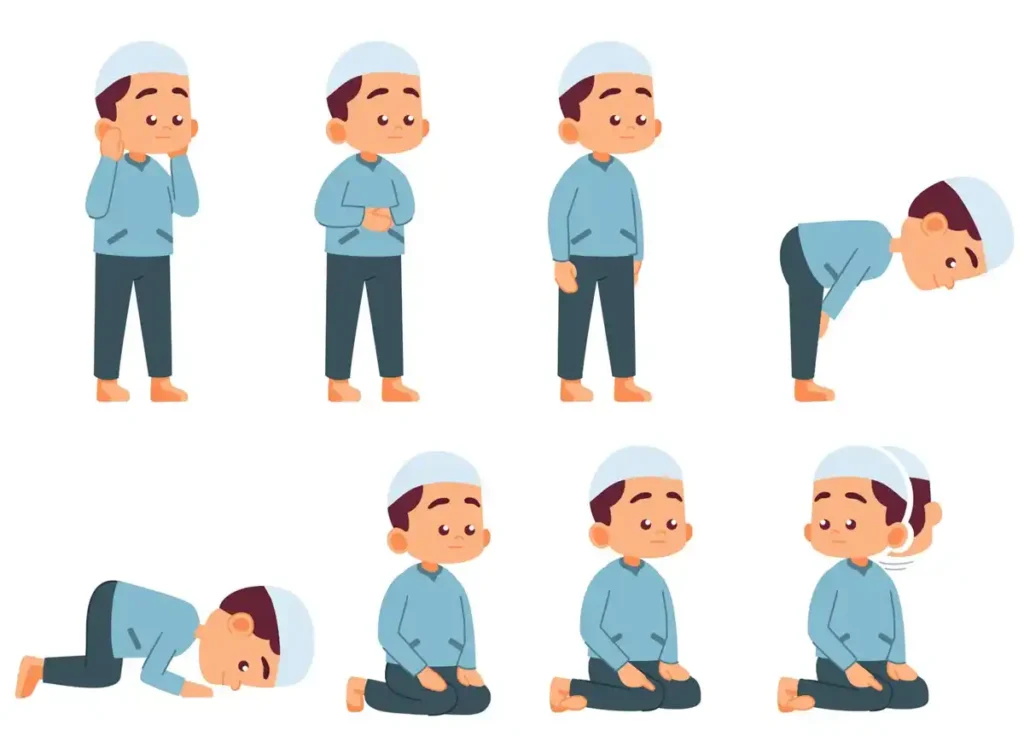
How to Pray Salah Step by Step
Use this same flow for every rak‘ah:
- Stand and say Allahu Akbar (start)
- Recite Surah Al-Fatihah
- Recite a short surah/verses
- Bow (rukū‘)
- Stand up straight
- Prostrate (sujūd)
- Sit briefly
- Second sujūd
- Repeat for next rak‘ah
- Final sitting (tashahhud) then salam to end
After Salatul Tasbeeh:
- How To Perform Salatul Tasbih?
- Definition of Subhanallah and Its Meaning
- la ilaha illa anta subhanaka Inni Kuntu Minaz Zalimin
This is the foundation of how to pray Salah. Once you know the pattern, confidence comes fast.
Table: Rakats and what to expect
Use this table to connect your existing cluster posts naturally, like the following:
- Wudu (Step-by-Step)
- Fajr Prayer (How to Perform)
- Zuhr Prayer (How to Perform)
- Asr Prayer (How to Perform)
- Maghrib Prayer (How to Perform)
- Isha Prayer (How to Perform)
- Sunnah Prayers in Islam (Types)
| Prayer | Time window (simple) | Farz rak‘ahs | Quick tip for all over the world |
| Fajr | Before sunrise | 2 | Prep the night before; keep it quiet |
| Zuhr | After midday | 4 | Use lunch break or a short pause |
| Asr | Late afternoon | 4 | Pray before the “evening rush” starts |
| Maghrib | After sunset | 3 | Try to pray early; time is shorter |
| Isha | Night | 4 | Make it your daily reset before sleep |
Fajr prayer (step-by-step + benefits)
Fajr is short, but it changes your day. Pray it calmly, even if you’re still learning. If you’re new, focus on the order and posture first. Words improve with practice.
Benefits:
- Builds discipline and self-respect
- Brings peace at the quietest time
- Helps you start the day with purpose
Spiritual growth tip: Keep Fajr consistent for 10 days. Many people feel a real shift.
Zuhr prayer (step-by-step + benefits)
Zuhr breaks the day in half. It pulls you away from nonstop work, study, or screen time. If you pray at work, you only need a clean corner and a few minutes.
Benefits:
- Resets focus and mood
- Helps with stress and impatience
- Builds gratitude in busy hours
Spiritual growth tip: Treat Zuhr like a “meeting” you don’t cancel.
Also Read: How Many Rakats in Zuhr? Find Out Now
Asr prayer (step-by-step + benefits)
Asr is the prayer many people delay. That’s why protecting it builds strong consistency. In the UK and USA, afternoon schedules can be packed, so planning helps.
Benefits:
- Trains discipline when energy drops
- Protects your character late in the day
- Keeps your heart awake, not just your routine
Spiritual growth tip: Link Asr to a habit (after school pickup, before commute).
Maghrib prayer (step-by-step + benefits)
Maghrib comes fast after sunset. It is a beautiful “day to night” transition. Because the window is shorter, it’s often easier to pray soon after the adhan.
Benefits:
- Helps you end the day with gratitude
- Brings barakah into family time
- Builds quick, steady consistency
Spiritual growth tip: Make Maghrib the “anchor” prayer at home.
Isha prayer (step-by-step + benefits)
Isha closes the day. Even if everything went wrong, Isha gives you a clean ending and a fresh start. It also supports waking up for Fajr.
Benefits:
- Clears mental clutter before sleep
- Strengthens long-term consistency
- Builds a calm relationship with Allah
Spiritual growth tip: Keep Isha simple and steady, even on tired nights.
Habit tips that actually work
Try these if you want consistency without burnout:
- Start with one prayer you won’t miss
- Add one more prayer after 7–10 days
- Use a simple 5-box daily tracker
- If you miss a prayer, return at the next one—don’t quit
For a friendly, beginner-focused explanation of prayer routines, you can also read:
External reference: About Islam’s prayer learning resources (use it as general guidance, then follow your local scholars for details).
Hanafi fiqh book titles (different list)
- Mukhtasar al-Quduri
- Al-Wiqayah fi Masā’il al-Hidāyah
- Sharh al-Wiqayah
- Kanz al-Daqā’iq
- Al-Fatāwā al-‘Ālamgīriyyah (Fatawa Hindiyya)
FAQ
Can I pray if I’m still learning the words?
Yes. Start with what you know and keep learning steadily. Focus on the order, posture, and Al-Fatihah first, then build from there.
What if I keep forgetting how many rak‘ahs?
Use the table daily for one week. Many people memorize by rote. Your existing “How Many Rakats…” posts can also help reinforce each prayer.
Is it okay to pray at work or in public?
Yes, as long as the place is clean and safe. Keep it simple, respectful, and calm. Many UK/US Muslims pray this way daily.
How do I improve focus in Salat?
Slow down slightly, understand a few meanings, and remove distractions. Even one mindful prayer per day can grow into stronger khushū‘.
Do I need wudu every single time?
Only if your wudu has broken. If you still have wudu, you can pray without repeating it. When unsure, renewing wudu is a safe choice.
Conclusion
You don’t need to be perfect to begin. You just need a clear method and a steady heart. This guide gives you a simple structure for wudu and each daily prayer, plus the rak‘ah table to remove confusion. With practice, how to pray Salah becomes the most stable part of your day—wherever you live.