
Jummah prayer is the weekly congregational prayer that sits at the heart of Muslim community life. Every Friday, believers set aside their regular routine to gather, listen, and pray together. This guide brings together everything you need to know about Jummah prayer — its faraiz, sunnah, nawafil, preparation, and step-by-step method — in one place.
Amazon Resource: For a well-rounded companion on Friday prayer, this book is worth a look: Complete Guide to Jummah Prayer (Amazon)
What Is Jummah Prayer?
Jummah prayer replaces the regular Dhuhr prayer once a week. It combines a two-part khutbah with two obligatory rakats prayed in congregation. Unlike daily prayers, it cannot be prayed alone; a valid congregation is required. This structure makes Jummah unique among the five daily prayer times, both spiritually and socially.
Also Read: Surah Kahf Complete: English Translation, Transliteration, PDF and Friday Recitation Benefits
The Importance and Virtues of Friday
Friday holds a special status in Islam, often described as the “Eid of the week.” Allah addresses this directly in the Qur’an:
“O you who believe! When the call is proclaimed for the prayer on Friday, hasten to the remembrance of Allah and leave off business. That is better for you, if you only knew.” (Surah Al-Jumu’ah, 62:9)
This verse alone captures why Muslims treat Friday differently from any other day of the week.
Scholars point to several reasons for Friday’s elevated status: it is described in hadith as the day Adam was created, the day of his entry into and expulsion from Paradise, and a day tied to major events yet to come. This weight is part of why Jummah prayer carries more structure and reward than an ordinary prayer.
Also Read: How to Pray Salah: Step-by-Step Guide (Wudu + Fajr, Zuhr, Asr, Maghrib, Isha)
Faraiz of Jummah (Obligatory Acts)
Some elements of Jummah are non-negotiable for the prayer to be valid:
- Being in a state of wudu before the prayer
- Attending and listening to the khutbah
- Praying two rakats in congregation with the imam
- Praying with a valid congregation, not individually
If any of these core requirements is missing, the prayer either isn’t valid or must be completed as Dhuhr instead.
Sunnah of Jummah
Beyond the obligatory parts, several recommended practices carry strong reward and are worth building into a weekly habit:
- Performing ghusl before leaving home
- Wearing clean or one’s best available clothing
- Applying light, pleasant fragrance
- Using miswak or brushing the teeth
- Arriving early and sitting close to the imam
- Reciting Surah Al-Kahf sometime during the day
- Sending extra durood (blessings) upon the Prophet ﷺ
Nawafil of Jummah (Optional Prayers)
Unlike Dhuhr, there’s no fixed sunnah prayer required before Jummah. Many worshippers still pray voluntary nafl rakats individually while waiting for the khutbah to begin. After the fard prayer, praying two or four extra rakats is a common and rewarding practice, though it remains optional rather than obligatory.
Also Read: Namaz Dua (Masnoon Duain) PDF Download
Adhan and Iqama: The Call to Prayer
The Adhan for Jummah is called once the khatib is present and the prayer time has entered. During the Prophet’s ﷺ time, only one Adhan was given; a second Adhan was added later by Sayyiduna Uthman (RA) to help a growing city prepare in time. After the khutbah ends, the Iqama signals the congregation to stand and line up for the fard prayer.
The Khutbah Sermon
The khutbah is a two-part sermon delivered before the prayer. It typically opens with praise of Allah, followed by reminders about faith, character, and matters relevant to the community. Listening attentively during the khutbah is a serious obligation; talking or unnecessary movement during this time reduces the reward of the prayer significantly.
Preparation Before Jummah
Getting ready properly shapes the entire experience of the day. Recommended preparation includes:
- Taking ghusl and trimming nails beforehand
- Wearing clean, modest, and presentable clothing
- Applying perfume or a pleasant scent
- Leaving home early enough to avoid rushing
- Making fresh wudu before entering the mosque
Step-by-Step: How to Pray Jummah
Here’s the complete process from start to finish:
- Perform ghusl and dress in clean clothing before leaving home.
- Arrive at the mosque early, ideally before the khutbah starts.
- Sit quietly and listen through both parts of the khutbah.
- Stand for the Iqama once it is announced.
- Pray two obligatory rakats in congregation, led by the imam.
- Optionally stay for two or four sunnah rakats afterward.
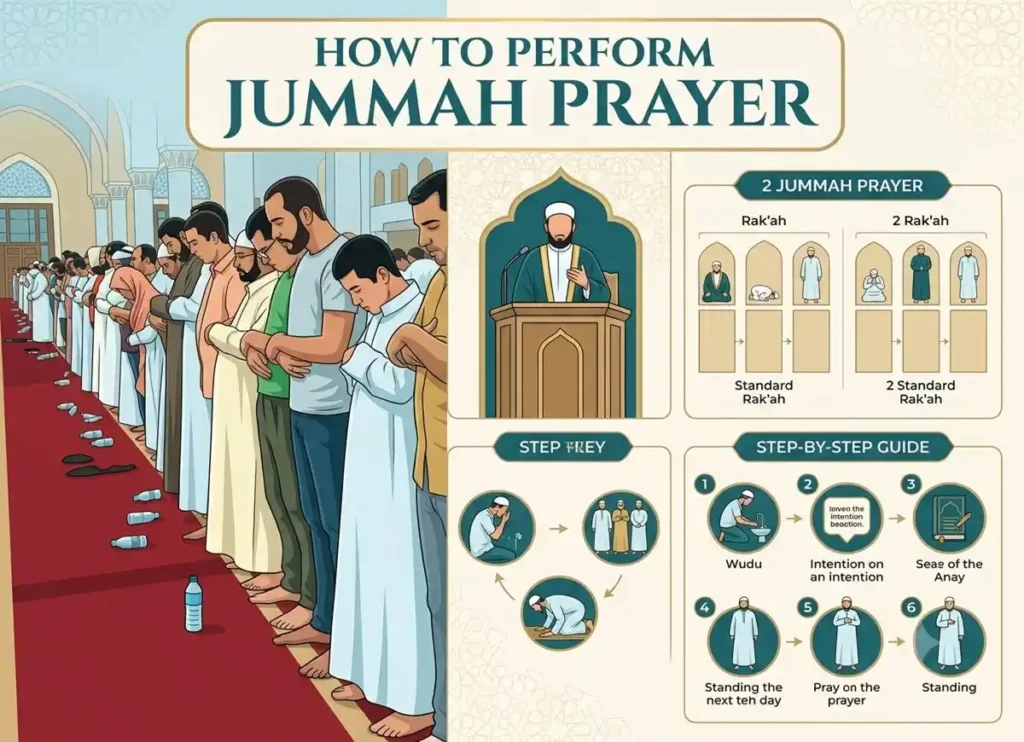
How Many Rakats Do You Pray
Jummah consists of two fard rakats performed in congregation, replacing the four rakats of Dhuhr. Many worshippers also pray optional rakats before and after. Here’s a simple breakdown:
| Prayer Segment | Rakats | Type |
| Before Khutbah | Variable | Optional (Nafl) |
| Khutbah | — | Obligatory to attend |
| Fard Jummah Prayer | 2 | Obligatory |
| After Prayer | 2 or 4 | Sunnah (Optional) |
What Time Is Jummah Prayer
Jummah replaces Dhuhr, so it begins once the sun passes its peak, in roughly the same window as Dhuhr time. Exact clock times shift by city and season, so checking your local mosque’s schedule remains the safest approach.
The Hour of Acceptance
Friday contains a special window during which supplications are especially likely to be accepted. Scholars differ slightly on the exact timing, though many point to the period after Asr until sunset. Worshippers are encouraged to spend this time in sincere dua rather than casual conversation, hoping to catch this blessed hour.
Difference Between Zuhr Prayer and Jummah Prayer
| Feature | Zuhr Prayer | Jummah Prayer |
| Rakats | 4 (Fard) | 2 (Fard) |
| Congregation Required | No | Yes |
| Sermon Included | No | Yes (Khutbah) |
| Days Observed | Daily | Weekly (Friday only) |
How to Pray Jummah at Home
Jummah requires a valid congregation, so it generally cannot be prayed alone at home. If no mosque is accessible, most scholars recommend praying Dhuhr instead as a substitute for the missed Friday prayer. Women, travelers, and the sick are also exempted from the obligation, though they may still attend if they wish.
Common Mistakes to Avoid
Many worshippers rush in late, missing part of the khutbah entirely. Talking during the sermon, even quietly, is a frequent slip that reduces the reward. Skipping ghusl, dressing casually, or stepping over seated rows to reach the front are also common oversights that are easy to correct with a bit of planning.
Dua and Reflection
After completing Jummah prayer, many scholars recommend spending time in dua, since Friday holds a special hour when supplications are especially accepted. Some worshippers stay seated a few extra minutes in quiet remembrance, asking Allah for forgiveness and guidance before returning to their week.
Qur’an References
Surah Al-Jumu’ah, Ayah 9 — Believers are commanded to hasten toward remembrance of Allah once the Friday call is made, setting business aside for that time.
Read on Quran.com
Surah Al-Jumu’ah, Ayah 10 — Once the prayer ends, believers are told to disperse through the land and continue seeking Allah’s provision while remembering Him often.
Read on Quran.com
Hadith References
Sunan an-Nasa’i 1369 — The Prophet ﷺ warned that neglecting Jummah three times out of carelessness can lead to a hardened heart.
View on Sunnah.com
Sunan Ibn Majah 1132 — The Prophet ﷺ instructed that whoever prays extra rakats after Jummah should pray four of them.
View on Sunnah.com
Sahih al-Bukhari 883 — The Prophet ﷺ explained that a person who performs ghusl, purifies himself, and listens attentively during Friday prayer has his sins between the two Fridays forgiven.
View on Sunnah.com
Recommended Hanafi Fiqh Books
- Al-Hidayah by Burhan al-Din al-Marghinani
- Radd al-Muhtar by Ibn Abidin
- Al-Fatawa al-Hindiyyah (Fatawa Alamgiri)
Trusted Islamic Resources
For general background, Wikipedia offers helpful context, while Britannica covers broader religious framing. For fiqh-specific rulings, IslamQA has detailed scholarly answers, and the IslamicTeachings.org forum is a good place for community discussion. You can find more study guides on Quranmualim.
Categories: Namaz ,Zakat , Roza , Prayer , Hadith & Supplications
FAQs
Is Jummah prayer obligatory for everyone?
It’s obligatory on adult, sane, resident Muslim men. Women, travelers, and the sick are exempted, though attending is still welcomed and rewarded.
Can I pray Jummah alone at home?
No, Jummah requires a congregation and isn’t valid when prayed individually. If missed, it’s made up by praying Dhuhr instead.
How many rakats does Jummah have?
Jummah has two obligatory rakats prayed in congregation. Many people also pray optional sunnah rakats before and after the fard prayer.
What happens if I arrive during the khutbah?
Sit down quietly and listen. You can still join the fard prayer once it begins, even if you missed part of the sermon.
Is ghusl required before Jummah?
Ghusl is a strongly recommended sunnah before Jummah, based on authentic hadith, though it isn’t strictly required for the prayer to be valid.
Final Thought
Jummah prayer is far more than a weekly obligation. From preparation to khutbah to dua, every part of the day is designed to pull the community together and renew spiritual focus. Understanding its faraiz, sunnah, and nawafil turns this weekly rhythm into a genuine source of growth, connection, and lasting reward.
Brought to you by Alasad Online Quran Tutor — Quranmualim.com. Learn Quran, Tajweed, and Islamic Studies with certified tutors. Contact us via WhatsApp or visit our YouTube channel @quranmualim.
Related JUMMAH Posts For You:
- What Time is The Jummah Prayer?
- How Do You Pray Jummah Prayer Step-by-Step?
- What is The Sitting Between in Khutbah Called?
- Friday Jummah Prayer | Jummah Prayer In Islam
- Friday Prayer (Jum’a): Sunnahs, Reward and Benefits
- How To Jummah Prayer Perform: Faraiz, Sunnah & Nawafil