


Surah Ar-Rahman is the 55th chapter of the Quran, and it stands as one of the most beautiful and profound descriptions of Allah’s infinite mercy. The term “Surah Ar-Rahman” literally means “The Most Gracious” or “The Merciful,” reflecting the Surah’s central message about divine compassion.
This 78-verse Makkan Surah captures the hearts of millions who seek to understand how Allah’s blessings permeate every aspect of creation. Many Muslims consider Surah Ar-Rahman to be the heart of the Quran because it speaks directly to our relationship with our Creator.
Recommended Resource: Tafsir Ibn Kathir (Abridged Edition) – Understanding Quranic Meanings
Why is Surah Ar-Rahman Important?
The Surah’s repeated refrain—”Which of the favours of your Lord will you deny?”—appears 31 times throughout its verses. This powerful question makes readers reflect on gratitude and accountability. According to Islamic scholarly sources, Surah Ar-Rahman emphasizes Allah’s continuous blessings in nature, relationships, and spiritual guidance.
Also Read: The Complete Quran Word Frequency List – Quran Mualim 2025

Surah Ar-Rahman: Verse-by-Verse Translation
Here’s a structured view of selected verses from Surah Ar-Rahman with Arabic text, transliteration, and English translation:
Surah Ar-Rahman (Chapter 55)
Complete Verse-by-Verse Translation with Arabic Text & Transliteration
| Verse | Arabic Text | Transliteration | Sahih English Translation |
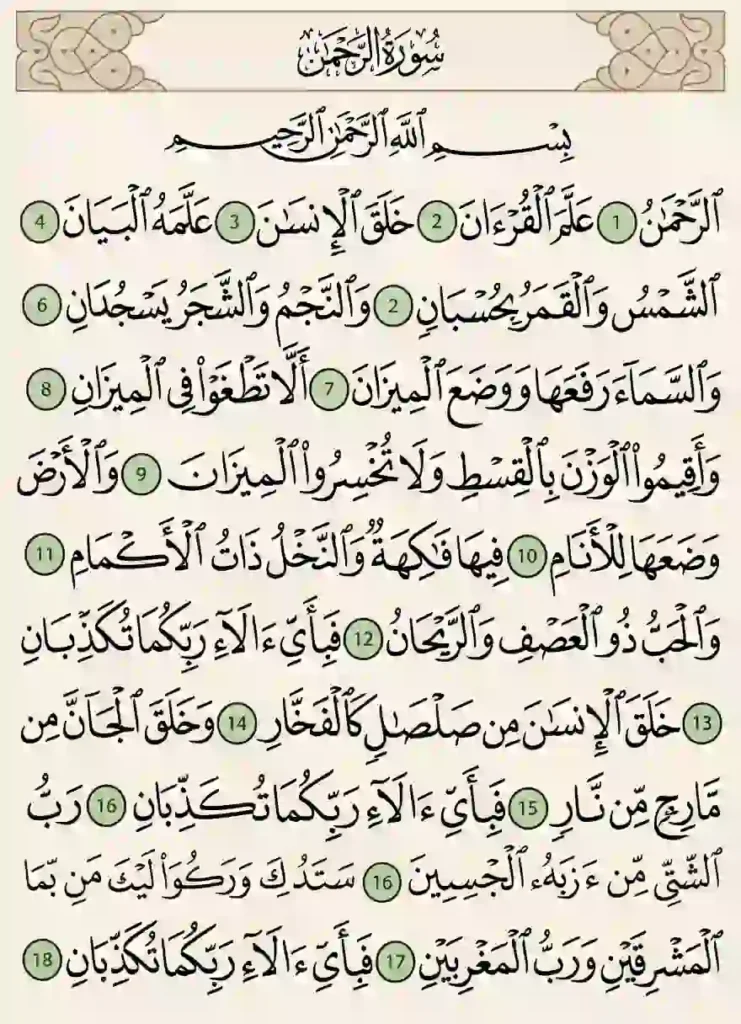
| 55:1 | الرَّحْمَٰنُ | Ar-Rahman | The Most Gracious |
| 55:2 | عَلَّمَ الْقُرْآنَ | Allamal-Qur’an | He taught the Qur’an |
| 55:3 | خَلَقَ الْإِنسَانَ | Khalaqa al-Insan | He created man |
| 55:4 | عَلَّمَهُ الْبَيَانَ | Allamahu al-Bayan | He taught him eloquent speech |
| 55:5 | الشَّمْسُ وَالْقَمَرُ بِحُسْبَانٍ | As-Shamsu wal-Qamaru bi-Husban | The sun and moon are precisely calculated |
| 55:6 | وَالنَّجْمُ وَالشَّجَرُ يَسْجُدَانِ | Wan-Najmu wash-Shajaru yasjudan | And the stars and trees prostrate [in obedience to Allah] |
| 55:7 | وَالسَّمَاءَ رَفَعَهَا وَوَضَعَ الْمِيزَانَ | Wa as-Samaa’a Rafa’aha wa Wada’al-Mizan | And the heaven He raised and He established the balance |
| 55:8 | أَلَّا تَطْغَوْا فِي الْمِيزَانِ | Alla Tatghaw fil-Mizan | That you do not transgress in the balance |
| 55:9 | وَأَقِيمُوا الْوَزْنَ بِالْقِسْطِ وَلَا تُخْسِرُوا الْمِيزَانَ | Wa Aqimul-Wazna bil-Qist wa La Tuksiru al-Mizan | And establish weight with justice and do not make deficient the scale |
| 55:10 | وَالْأَرْضَ وَضَعَهَا لِلْأَنَامِ | Wal-Arda Wada’aha lil-Anam | And the earth He has laid [out] for [all] creatures |
| 55:11 | فِيهَا فَاكِهَةٌ وَالنَّخْلُ ذَاتُ الْأَكْمَامِ | Fiha Fakihah wan-Nakhlu Dhatul-Akam | Within it is fruit and palm trees having sheaths [of dates] |
| 55:12 | وَالْحَبُّ ذُو الْعَصْفِ وَالرَّيْحَانُ | Wal-Habbu Dhul-Asffi war-Rayhan | And [also] grain having husks and fragrant plants |
| 55:13 | فَبِأَيِّ آلَاءِ رَبِّكُمَا تُكَذِّبَانِ | Fa-bi-Ayyi Alai Rabbikuma Tukadhiban | So which of the favors of your Lord would you deny? |
| 55:14 | خَلَقَ الْإِنسَانَ مِن صَلْصَالٍ كَالْفَخَّارِ | Khalaqal-Insana min Salsal Kaal-Fakkar | He created man from clay like pottery |
| 55:15 | وَخَلَقَ الْجَانَّ مِن مَّارِجٍ مِّن نَّارٍ | Wa Khalaqal-Janna min Marij min Nar | And He created the jinn from a smokeless flame of fire |
| 55:16 | فَبِأَيِّ آلَاءِ رَبِّكُمَا تُكَذِّبَانِ | Fa-bi-Ayyi Alai Rabbikuma Tukadhiban | So which of the favors of your Lord would you deny? |
| 55:17 | رَبُّ الْمَشْرِقَيْنِ وَرَبُّ الْمَغْرِبَيْنِ | Rabbul-Mashriqqayn wa Rabbul-Maghriqayn | He is the Lord of the two easts and the Lord of the two wests |
| 55:18 | فَبِأَيِّ آلَاءِ رَبِّكُمَا تُكَذِّبَانِ | Fa-bi-Ayyi Alai Rabbikuma Tukadhiban | So which of the favors of your Lord would you deny? |
| 55:19 | مَرَجَ الْبَحْرَيْنِ يَلْتَقِيَانِ | Maraja al-Baḥrain Yaltaqiyan | He released the two seas, [simultaneously] meeting [one another] |
| 55:20 | بَيْنَهُمَا بَرْزَخٌ لَّا يَبْغِيَانِ | Baynahuma Barzakh La Yaghiyan | Between them is a barrier which they do not transgress |
| 55:21 | فَبِأَيِّ آلَاءِ رَبِّكُمَا تُكَذِّبَانِ | Fa-bi-Ayyi Alai Rabbikuma Tukadhiban | So which of the favors of your Lord would you deny? |
| 55:22 | يَخْرُجُ مِنْهُمَا اللُّؤْلُؤُ وَالْمَرْجَانُ | Yakhrujo Minhuma al-Lulu wa al-Marjan | From both of them emerge pearls and [precious] coral |
| 55:23 | فَبِأَيِّ آلَاءِ رَبِّكُمَا تُكَذِّبَانِ | Fa-bi-Ayyi Alai Rabbikuma Tukadhiban | So which of the favors of your Lord would you deny? |
| 55:24 | وَلَهُ الْجَوَارِ الْمُنشَآتُ فِي الْبَحْرِ كَالْأَعْلَامِ | Wa Lahul-Jawari al-Munshaat fil-Bahr Kaal-A’lam | And to Him belong the ships [with sails] elevated in the sea like mountain peaks |
| 55:25 | فَبِأَيِّ آلَاءِ رَبِّكُمَا تُكَذِّبَانِ | Fa-bi-Ayyi Alai Rabbikuma Tukadhiban | So which of the favors of your Lord would you deny? |
| 55:26 | كُلُّ مَن عَلَيْهَا فَانٍ | Kullu Man Alayha Fan | Everyone upon the earth will perish |
| 55:27 | وَيَبْقَىٰ وَجْهُ رَبِّكَ ذُو الْجَلَالِ وَالْإِكْرَامِ | Wa Yabqa Wajhu Rabbika Dhul-Jalali wal-Ikram | And there remains the Face of your Lord, Possessor of Majesty and Honor |
| 55:28 | فَبِأَيِّ آلَاءِ رَبِّكُمَا تُكَذِّبَانِ | Fa-bi-Ayyi Alai Rabbikuma Tukadhiban | So which of the favors of your Lord would you deny? |
| 55:29 | يَسْأَلُهُ مَن فِي السَّمَاوَاتِ وَالْأَرْضِ ۚ كُلَّ يَوْمٍ هُوَ فِي شَأْنٍ | Yas’alahu Man fis-Samawati wal-Ard. Kulla Yawm Huwa fi Sha’n | Every day He is in [a new] matter [bringing about His creation] |
| 55:30 | فَبِأَيِّ آلَاءِ رَبِّكُمَا تُكَذِّبَانِ | Fa-bi-Ayyi Alai Rabbikuma Tukadhiban | So which of the favors of your Lord would you deny? |
| 55:31 | سَنَفْرُغُ لَكُمْ أَيُّهَا الثَّقَلَانِ | Sanfarughu Lakum Ayuha ath-Thaqalan | We will attend to you, O prominent beings [jinn and humans] |
| 55:32 | فَبِأَيِّ آلَاءِ رَبِّكُمَا تُكَذِّبَانِ | Fa-bi-Ayyi Alai Rabbikuma Tukadhiban | So which of the favors of your Lord would you deny? |
| 55:33 | يَا مَعْشَرَ الْجِنِّ وَالْإِنسِ إِنِ اسْتَطَعْتُمْ أَن تَنفُذُوا مِنْ أَقْطَارِ السَّمَاوَاتِ وَالْأَرْضِ فَانفُذُوا ۚ لَا تَنفُذُونَ إِلَّا بِسُلْطَانٍ | Ya Ma’shara al-Jinni wal-Insi In Istata’tum An Tanfudhoo Min Aqtari as-Samawati wal-Ard Fanfudhoo La Tanfudhoon Illa bi-Sultan | O company of jinn and humans, if you are able to pass beyond the regions of the heavens and the earth, then pass. You will not pass except by authority [from Allah] |
| 55:34 | فَبِأَيِّ آلَاءِ رَبِّكُمَا تُكَذِّبَانِ | Fa-bi-Ayyi Alai Rabbikuma Tukadhiban | So which of the favors of your Lord would you deny? |
| 55:35 | يُرْسَلُ عَلَيْكُمَا شُوَاظٌ مِّن نَّارٍ وَنُحَاسٌ فَلَا تَنتَصِرَانِ | Yursalu Alaykuma Shuwazun Min Narin wa Nuhasu Fala Tantasiran | There will be sent upon you a flame of fire and [liquid] brass, and you will not defend yourselves |
| 55:36 | فَبِأَيِّ آلَاءِ رَبِّكُمَا تُكَذِّبَانِ | Fa-bi-Ayyi Alai Rabbikuma Tukadhiban | So which of the favors of your Lord would you deny? |
| 55:37 | فَإِذَا انشَقَّتِ السَّمَاءُ فَكَانَتْ وَرْدَةً كَالدِّهَانِ | Fa-idha Inshaqq-at is-Samau Fakaanat Warda Kad-Dihan | And when the heaven is split apart and becomes rose-colored like [oil in] leather |
| 55:38 | فَبِأَيِّ آلَاءِ رَبِّكُمَا تُكَذِّبَانِ | Fa-bi-Ayyi Alai Rabbikuma Tukadhiban | So which of the favors of your Lord would you deny? |
| 55:39 | فَيَوْمَئِذٍ لَّا يُسْأَلُ عَن ذَنبِهِ إِنسٌ وَلَا جَانٌّ | Fayawma-idhin La Yus-al An Dhanbihi Insun Wa La Jann | So on that Day, no human or jinn will be asked about his sin |
| 55:40 | فَبِأَيِّ آلَاءِ رَبِّكُمَا تُكَذِّبَانِ | Fa-bi-Ayyi Alai Rabbikuma Tukadhiban | So which of the favors of your Lord would you deny? |
| 55:41 | يُعْرَفُ الْمُجْرِمُونَ بِسِيمَاهُمْ فَيُؤْخَذُ بِالنَّاصِيَةِ وَالْأَقْدَامِ | Yu’raful-Mujtimoon bi-Simahum Fa-yu’khaz bi-an-Nasiyati wal-Aqdm | The criminals will be recognized by their mark, and they will be seized by their forelocks and their feet |
| 55:42 | فَبِأَيِّ آلَاءِ رَبِّكُمَا تُكَذِّبَانِ | Fa-bi-Ayyi Alai Rabbikuma Tukadhiban | So which of the favors of your Lord would you deny? |
| 55:43 | هَٰذِهِ جَهَنَّمُ الَّتِي يُكَذِّبُ بِهَا الْمُجْرِمُونَ | Hathihi Jahannam Ullatee Yukadhibu Biha al-Mujtimoon | This is Hell, which the criminals deny |
| 55:44 | يَطُوفُونَ بَيْنَهَا وَبَيْنَ حَمِيمٍ آنٍ | Yatufoon Baynahaa wa Bayna Hamim An | They will go around between it and between scalding hot water |
| 55:45 | فَبِأَيِّ آلَاءِ رَبِّكُمَا تُكَذِّبَانِ | Fa-bi-Ayyi Alai Rabbikuma Tukadhiban | So which of the favors of your Lord would you deny? |
| 55:46 | وَلِمَن خَافَ مَقَامَ رَبِّهِ جَنَّتَانِ | Wa Liman Khafa Maqama Rabbihi Jannatan | But for those who have feared the position of their Lord are two gardens |
| 55:47 | فَبِأَيِّ آلَاءِ رَبِّكُمَا تُكَذِّبَانِ | Fa-bi-Ayyi Alai Rabbikuma Tukadhiban | So which of the favors of your Lord would you deny? |
| 55:48 | ذَوَاتَا أَفْنَانٍ | Dhawata Afnan | Having branches of many kinds |
| 55:49 | فَبِأَيِّ آلَاءِ رَبِّكُمَا تُكَذِّبَانِ | Fa-bi-Ayyi Alai Rabbikuma Tukadhiban | So which of the favors of your Lord would you deny? |
| 55:50 | فِيهِمَا عَيْنَانِ تَجْرِيَانِ | Feehima Aynaan Tajriyan | In both of them are two flowing springs |
| 55:51 | فَبِأَيِّ آلَاءِ رَبِّكُمَا تُكَذِّبَانِ | Fa-bi-Ayyi Alai Rabbikuma Tukadhiban | So which of the favors of your Lord would you deny? |
| 55:52 | فِيهِمَا مِن كُلِّ فَاكِهَةٍ زَوْجَانِ | Feehima Min Kulli Fakihatin Zawjan | In both of them are of every fruit, two kinds |
| 55:53 | فَبِأَيِّ آلَاءِ رَبِّكُمَا تُكَذِّبَانِ | Fa-bi-Ayyi Alai Rabbikuma Tukadhiban | So which of the favors of your Lord would you deny? |
| 55:54 | مُتَّكِئِينَ عَلَىٰ فُرُشٍ بَطَائِنُهَا مِنْ إِسْتَبْرَقٍ ۚ وَجَنَى الْجَنَّتَيْنِ دَانٍ | Muttaki-een Ala Furushin Batainuha Min Istibraj. Wa Janna al-Jennatayn Dan | Reclining upon couches lined with silk, and the fruit of both gardens near at hand |
| 55:55 | فَبِأَيِّ آلَاءِ رَبِّكُمَا تُكَذِّبَانِ | Fa-bi-Ayyi Alai Rabbikuma Tukadhiban | So which of the favors of your Lord would you deny? |
| 55:56 | فِيهِنَّ قَاصِرَاتُ الطَّرْفِ لَمْ يَطْمِثْهُنَّ إِنسٌ قَبْلَهُمْ وَلَا جَانٌّ | Feehinna Qasirat-at-Tarf Lam Yatmithuhunna Insun Qablahum Wa La Jann | In them are women limiting [their] glances, untouched before them by men or jinn |
| 55:57 | فَبِأَيِّ آلَاءِ رَبِّكُمَا تُكَذِّبَانِ | Fa-bi-Ayyi Alai Rabbikuma Tukadhiban | So which of the favors of your Lord would you deny? |
| 55:58 | كَأَنَّهُنَّ الْيَاقُوتُ وَالْمَرْجَانُ | Ka-annuhunna al-Yaqut wa al-Marjan | As if they were rubies and coral |
| 55:59 | فَبِأَيِّ آلَاءِ رَبِّكُمَا تُكَذِّبَانِ | Fa-bi-Ayyi Alai Rabbikuma Tukadhiban | So which of the favors of your Lord would you deny? |
| 55:60 | هَلْ جَزَاءُ الْإِحْسَانِ إِلَّا الْإِحْسَانُ | Hal Jazau al-Ihsan Illa al-Ihsan | Is there any reward for good other than good? |
| 55:61 | فَبِأَيِّ آلَاءِ رَبِّكُمَا تُكَذِّبَانِ | Fa-bi-Ayyi Alai Rabbikuma Tukadhiban | So which of the favors of your Lord would you deny? |
| 55:62 | وَدُونِهِمَا جَنَّتَانِ | Wa Doonahuma Jennatan | And below these two [gardens] are two other gardens |
| 55:63 | فَبِأَيِّ آلَاءِ رَبِّكُمَا تُكَذِّبَانِ | Fa-bi-Ayyi Alai Rabbikuma Tukadhiban | So which of the favors of your Lord would you deny? |
| 55:64 | مِدْهَامَّتَانِ | Midhammataan | Of deep green [color] |
| 55:65 | فَبِأَيِّ آلَاءِ رَبِّكُمَا تُكَذِّبَانِ | Fa-bi-Ayyi Alai Rabbikuma Tukadhiban | So which of the favors of your Lord would you deny? |
| 55:66 | فِيهِمَا عَيْنَانِ نَضَّاخَتَانِ | Feehima Aynaan Nadakhatan | In both of them are two springs gushing forth |
| 55:67 | فَبِأَيِّ آلَاءِ رَبِّكُمَا تُكَذِّبَانِ | Fa-bi-Ayyi Alai Rabbikuma Tukadhiban | So which of the favors of your Lord would you deny? |
| 55:68 | فِيهِمَا فَاكِهَةٌ وَنَخْلٌ وَرُمَّانٌ | Feehima Fakihah wa Nakhl wa Rumman | In them are fruits and palms and pomegranates |
| 55:69 | فَبِأَيِّ آلَاءِ رَبِّكُمَا تُكَذِّبَانِ | Fa-bi-Ayyi Alai Rabbikuma Tukadhiban | So which of the favors of your Lord would you deny? |
| 55:70 | فِيهِنَّ خَيْرَاتٌ حِسَانٌ | Feehinna Khayrat Hisan | In them are good righteous women |
| 55:71 | فَبِأَيِّ آلَاءِ رَبِّكُمَا تُكَذِّبَانِ | Fa-bi-Ayyi Alai Rabbikuma Tukadhiban | So which of the favors of your Lord would you deny? |
| 55:72 | حُورٌ مَّقْصُورَاتٌ فِي الْخِيَامِ | Hoor Maqsuarat fil-Khiyam | Fair women confined in pavilions |
| 55:73 | فَبِأَيِّ آلَاءِ رَبِّكُمَا تُكَذِّبَانِ | Fa-bi-Ayyi Alai Rabbikuma Tukadhiban | So which of the favors of your Lord would you deny? |
| 55:74 | لَمْ يَطْمِثْهُنَّ إِنسٌ قَبْلَهُمْ وَلَا جَانٌّ | Lam Yatmithuhunna Insun Qablahum Wa La Jann | Untouched before them by men or jinn |
| 55:75 | فَبِأَيِّ آلَاءِ رَبِّكُمَا تُكَذِّبَانِ | Fa-bi-Ayyi Alai Rabbikuma Tukadhiban | So which of the favors of your Lord would you deny? |
| 55:76 | مُتَّكِئِينَ عَلَىٰ رَفْرَفٍ خَضِرٍ وَإِسْتَبْرَقٍ حِسَانٍ | Muttaki-een Ala Rafrafi Khadir wa Istibraj Hisan | Reclining upon green cushions and beautiful carpets |
| 55:77 | فَبِأَيِّ آلَاءِ رَبِّكُمَا تُكَذِّبَانِ | Fa-bi-Ayyi Alai Rabbikuma Tukadhiban | So which of the favors of your Lord would you deny? |
| 55:78 | تَبَارَكَ اسْمُ رَبِّكَ ذُو الْجَلَالِ وَالْإِكْرَامِ | Tabaarak Ism Rabbika Dhul-Jalali wal-Ikram | Blessed is the name of your Lord, the Possessor of Majesty and Honor |
Also Read: Quran Excel Easy Understanding The Holy Quran
IMPORTANT INFORMATION ABOUT SURAH AR-RAHMAN
- Total Verses: 78 verses (Ayahs)
- Revelation Type: Makkan (revealed in Mecca during early Islamic period)
- Surah Number: 55th Chapter of the Qur’an
- Juz Number: Part 27
- THE REFRAIN (Repeated 31 times):
- “So which of the favors of your Lord would you deny?”
- – This is one of the most famous refrains in the Qur’an
- – Appears at verses: 13, 16, 18, 21, 23, 25, 28, 30, 32, 34, 36, 38, 40, 42, 45, 47,
- 49, 51, 53, 55, 57, 59, 61, 63, 65, 67, 69, 71, 73, 75, 77
MAJOR THEMES:
- 1. ALLAH’S MERCY (Verses 1-4)
- – Opening with divine names and attributes
- – Emphasis on Allah’s mercy and teaching
2. CREATION & DIVINE ORDER (Verses 5-12)
- – Celestial bodies (sun, moon, stars)
- – Earthly blessings (fruits, plants)
3. HUMAN & JINN CREATION (Verses 14-15)
- – Mankind from clay
- – Jinn from smokeless fire
4. DIVINE LORDSHIP (Verses 17-25)
- – Two easts and two wests
- – Two seas meeting but not mixing
- – Pearls and coral from the seas
5. TEMPORARY NATURE OF CREATION (Verses 26-32)
- – Everything perishes except Allah’s Face
- – Allah is eternally Magnificent and Honorable
6. WARNING & CHALLENGE (Verses 33-45)
- – Challenge to humanity and jinn
- – Description of Hell for those who deny
7. PARADISE DESCRIPTION (Verses 46-77)
- – Four gardens mentioned
- – Two higher gardens for the most righteous
- – Two lower gardens for other believers
- – Details of rivers, fruits, women, and luxuries
8. CONCLUSION (Verse 78)
- – Affirmation of Allah’s blessed name
BENEFITS OF RECITING SURAH AR-RAHMAN:
- ✓ Softens and purifies the heart
- ✓ Increases gratitude and awareness of blessings
- ✓ Develops consciousness of Allah (Taqwa)
- ✓ Strengthens connection with the Qur’an
- ✓ Brings peace and serenity to the soul
- ✓ Helps in memorization due to rhythmic structure
- ✓ Reminds us of accountability
- ✓ Builds hope for Paradise and fear of Hellfire
BEST TIME TO RECITE:
- • After Maghrib prayer (traditional practice)
- • During tahajjud (night prayer)
- • Anytime for personal reflection
- • In study circles with family or community
Also Read; Root Words of Quran

Most Relevant Qur’an References
To deepen your understanding of Surah Ar-Rahman and its context within Islamic teachings, here are two essential Qur’anic references:
1. The Opening Verses (55:1-4)
Surah Ar-Rahman, Verses 1-4: “Ar-Rahman. He has taught the Quran. He created mankind. He taught him eloquence.” These opening verses set the tone for the entire Surah by highlighting Allah’s role as the Supreme Teacher and Creator, emphasizing that mercy is the foundation of all divine knowledge and creation.
2. The Refrain Question (55:13)
Surah Ar-Rahman, Verse 13: “Which of the favours of your Lord will you deny?” This repeated question throughout the Surah invites deep reflection on gratitude and serves as a powerful reminder that denying blessings is a form of ingratitude and rebellion against divine wisdom.
Authentic Hadith References
Islamic scholars have emphasized the importance of understanding Surah Ar-Rahman through authentic traditions. Here are two significant references:
1. The Virtue of Surah Ar-Rahman
Sahih al-Bukhari: The collections in Sahih al-Bukhari emphasize that regular recitation of the Quran, including Surah Ar-Rahman, increases the softness of the heart and brings closeness to Allah. Many companion accounts describe how this Surah moved them to tears and deepened their faith.
2. The Reward of Quranic Study
Sahih Muslim: Sahih Muslim records that those who learn and teach the Quran are the best among people, making your effort to study Surah Ar-Rahman a noble and rewarded act in Islam.
Understanding the Structure and Message
Surah Ar-Rahman flows beautifully in three main sections. First, it introduces Allah’s attributes and creative power. Second, it describes blessings in nature and human existence. Finally, it warns about the consequences of denying these favors while promising rewards for the grateful.
This structure makes it an effective teaching tool for understanding how the Quran connects theology (belief) with ethics (action). The Quran’s message consistently links divine attributes with moral responsibility, which is particularly evident in this Surah.
Categories: PRAYER ,ALMS , SAWN & The Holy Quran, Quran Jaz 1- 114
Practical Tips for Learning Surah Ar-Rahman
- Start by listening to recitations by skilled Qaris to familiarize your ear with the rhythm and meaning.
- Study 2-3 verses daily rather than rushing through the entire Surah.
- Keep a journal of lessons and reflections as you progress through each verse.
- Join study groups or circles; discussing verses deepens understanding significantly.
- Practice transliteration reading before attempting full Arabic if you’re a beginner.

Frequently Asked Questions About Surah Ar-Rahman
What does “Surah Ar-Rahman” mean in English?
Surah Ar-Rahman translates to “The Most Gracious” or “The Merciful,” emphasizing Allah’s boundless mercy and compassion toward all creation.
How many verses are in Surah Ar-Rahman?
Surah Ar-Rahman contains 78 verses (ayahs). It’s a moderately long Surah that flows beautifully when recited with proper tajweed rules.
Is Surah Ar-Rahman easy to memorize?
Yes, many Muslims find it easier to memorize than other Surahs due to its rhythmic structure and repeated refrain appearing 31 times throughout.
What are the main themes of Surah Ar-Rahman?
Main themes include: Allah’s mercy, divine creation, accountability for blessings, gratitude, warnings against ingratitude, and rewards for believers.
How can I benefit from learning Surah Ar-Rahman today?
Regular recitation brings peace, increases gratitude, and strengthens your connection with Allah. Many report emotional healing and spiritual growth from this Surah.
Further Islamic Resources
For deeper learning and community support, explore these trusted Islamic platforms:
- Islamic Teachings Forum – Connect with scholars and learners globally about Quranic understanding.
- Islam Q&A – Get answers to specific religious questions from qualified Islamic scholars.
- Quran Mualim – Your trusted source for free Quran learning and Islamic education.
Conclusion:
Surah Ar-Rahman isn’t just a chapter to memorize—it’s an invitation to transform how you see the world. Every verse reminds us that Allah’s mercy surrounds us constantly. By understanding and reflecting on this Surah’s wisdom, you develop deeper gratitude, stronger faith, and a more compassionate heart.
Start your journey today. Whether you’re learning for the first time or returning to deepen your understanding, Surah Ar-Rahman awaits with its timeless message of divine grace and human accountability.
Ready to Learn More? Let’s Connect!
📱 WhatsApp: +92 301 7363500
📧 Email: [email protected]Join our community and learn Quran for free with expert guidance. We’re here to help you connect deeply with the Quran’s wisdom and transform your spiritual journey.
Recommended For You
- Juz 1 Alif Lam Meem Summary with PDF Download
- Juz 2 Sayaqool Summary With Free PDF Download
- Juz 3 Tilkal Rusul Summary With Free PDF Download
- Juz 4 Lantanalu Overview With Free PDF Download
- Juz 5 Wal Mohsanat Overview With Free PDF Download
- Juz 6 La Yuhibbullah Overview With Free PDF Download
- Juz 7 Wa Iza Samiu Overview with Free PDF Download
- Juz 8 Wa Lau Annana Overview With Free PDF Download
- Juz 9 Qad Aflaha Overview With Free PDF Download
- Juz 10 Wa A’lamu Overview With Free PDF Download
- Juz 11 Ya Ayyuha Overview with Free PDF Download
- Juz 12 Wa Mamin Da’abah Overview With Free PDF Download
- Juz 13 Wa Ma Ubrio Overview With Free PDF Download
- Juz 14 Rubama Overview With Free PDF Download
- Juz 15 Subhanalladhi Overview With Free PDF Download
- Juz 16 Qal Alam Overview With Free PDF Download
- Juz 17 Iqtarabat Overview With Free PDF Download
- Juz 18 Qadd Aflaha Overview With Free PDF Download
- Juz 19 Wa Qalallazina Overview With Free PDF Download
- Juz 20 A’man Khalaqa Overview With Free PDF Download
- Juz 21 Utlu Ma Oohiya Overview With Free PDF Download
- Juz 22 Wa Manyaqnut Overview With Free PDF Download
- Juz 23 Wa Maaa Liya Overview With Free PDF Download
- Juz 24 Faman Azlam Overview With Free PDF Download
- Juz 25 Elahe Yuruddu Overview With Free PDF Download
- Juz 26 Ha Meem Overview With Free PDF Download
- Juz 27 Qal Fama Khatbukum Overview With PDF Download
- Juz 28 Qadd Sami Allah Overview With Free PDF Download
- Juz 29 Tabarakallazi Overview With Free PDF Download