

Surah Al-Waqi’ah opens with a single word that shakes the whole chapter awake: “the Event.” That event is the Day of Judgment, and this surah spends its verses describing exactly what happens to different people when it finally arrives.
Suggested reading for background: The Story of the Quran by Ingrid Mattson — a clear, accessible guide to how chapters like this one fit into the wider Qur’an.
About Surah Al-Waqi’ah
Al-Waqi’ah is the 56th chapter of the Qur’an, revealed in Makkah roughly seven years before the migration to Madinah. It has 96 verses and sits in the 27th juz, right alongside Surah Ar-Rahman.
The chapter takes its name from its opening word, “al-waqi’ah,” meaning “the event” or “the inevitable.” It’s a fitting title for a surah built entirely around what happens after death.
What Is Surah Al-Waqi’ah About?
Many people quietly worry about how life will be judged after death, and this chapter answers that head-on. Its insight is simple: everyone falls into one of three groups on that day, and each group already knows which one it belongs to by how it lived.
The solution the surah offers is reflection, not fear. Here’s the structure in short:
- Verses 1–7 describe the shaking of the earth when the Event arrives.
- Verses 8–56 detail the three groups: the foremost, the companions of the right, and the companions of the left.
- Verses 57–74 remind people that Allah created and sustains everything they take for granted.
- Verses 75–96 speak about the Qur’an’s honor and the moment the soul leaves the body.
Also Read: Quran Read Pen With Multi Language Translation

Surah Al-Waqi’ah in English: Verse by Verse
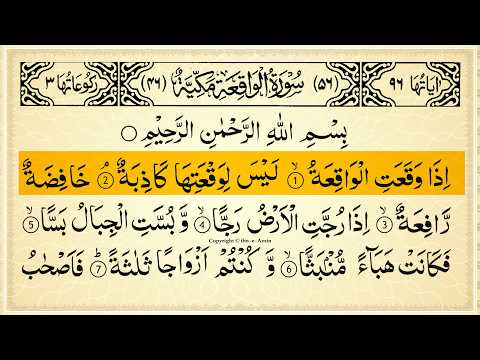
Below is a simple table pairing two key verses from the chapter, in Arabic, transliteration, and a plain-English rendering — useful for anyone doing a surah al waqiah online reading session.
Also Read: Read Quran Online For Free: Access Sacred Text
سورة الواقعة
Surah Al-Waqi’ah (The Event) – Chapter 56 • 96 Verses
| Verse | Arabic | Transliteration | English Translation |
| 1 | إِذَا وَقَعَتِ الْوَاقِعَةُ | Idhā waqaʿati l-wāqiʿah | When the Event (the Hour) comes to pass |
| 2 | لَيْسَ لِوَقْعَتِهَا كَاذِبَةٌ | Laysa li-waqʿatiha kādhib | There is none who can deny its coming |
| 3 | خَافِضَةٌ رَافِعَةٌ | Khāfiḍah rāfiʿah | It will bring low (some) and exalt (others) |
| 4 | إِذَا رُجَّتِ الْأَرْضُ رَجًّا | Idhā rujjati l-arḍ rajj | When the earth will be shaken with a shock |
| 5 | وَبُسَّتِ الْجِبَالُ بَسًّا | Wa-bussati l-jibāl bass | And the mountains will be crumbled to atoms |
| 6 | فَكَانَتْ هَبَاءً مُنبَثًّا | Fa-kānat habāan munbathth | Becoming floating dust particles |
| 7 | وَكُنتُمْ أَزْوَاجًا ثَلَاثَةً | Wa-kuntum azwāj thālathah | And you shall be sorted out into three classes |
| 8 | فَأَصْحَابُ الْمَيْمَنَةِ مَا أَصْحَابُ الْمَيْمَنَةِ | Fa-aṣḥāb al-maymanah mā aṣḥāb al-maymanah | Then those on the Right Hand – how will be those on the Right Hand? |
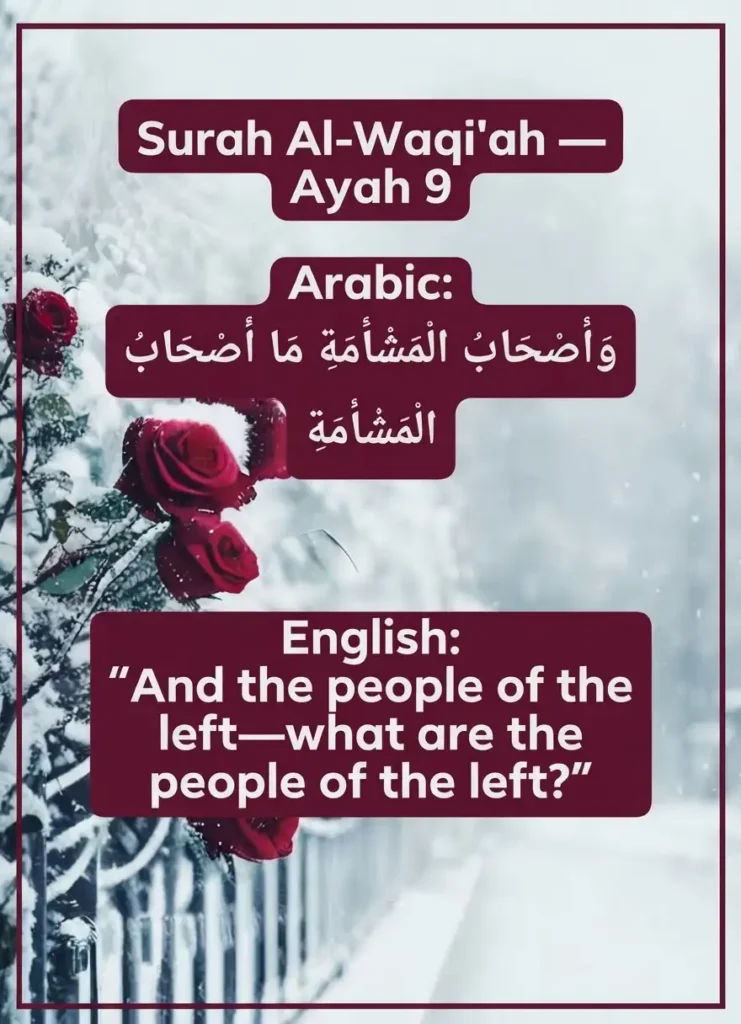
| 9 | وَأَصْحَابُ الْمَشْأَمَةِ مَا أَصْحَابُ الْمَشْأَمَةِ | Wa-aṣḥāb al-mashaʾamah mā aṣḥāb al-mashaʾamah | And those on the Left Hand – how will be those on the Left Hand? |
| 10 | وَالسَّابِقُونَ السَّابِقُونَ | Wa-s-sābiqūn as-sābiqūn | And the foremost shall be the foremost |
| 11 | أُولَئِكَ الْمُقَرَّبُونَ | Ulāik al-muqarrabūn | These will be those nearest to Allah |
| 12 | فِي جَنَّاتِ النَّعِيمِ | Fī jannāt an-naʿīm | In the Gardens of Bliss |
| 13 | ثُلَّةٌ مِّنَ الْأَوَّلِينَ | Thullah min al-awwalīn | A number of people from those of old |
| 14 | وَقَلِيلٌ مِّنَ الْآخِرِينَ | Wa-qalīl min al-ākhirīn | And a few from those of later times |
| 15 | عَلَىٰ سُرُرٍ مَّوْضُونَةٍ | ʿAlā surur maḍūnah | On thrones encrusted with gold and precious stones |
| 16 | مُتَّكِئِينَ عَلَيْهَا مُتَقَابِلِينَ | Muttakīīn ʿalayhā mutaqābilīn | Reclining on them, facing each other |
| 17 | يَطُوفُ عَلَيْهِمْ وِلْدَانٌ مُّخَلَّدُونَ | Yaṭūf ʿalayhim wildān mukhalladūn | Round them will serve boys of perpetual freshness |
| 18 | بِأَكْوَابٍ وَأَبَارِيقَ وَكَأْسٍ مِّن مَّعِينٍ | Bi-akwāb wa-abārīq wa-kaʾs min maʿīn | With cups, and pitchers, and a goblet from a clear-flowing fountain |
| 19 | لَا يُصِدِّعُونَ عَنْهَا وَلَا يُنزِفُونَ | Lā yuṣiddʿūn ʿanhā wa-lā yunzifūn | No headache will they suffer from it, nor will they suffer intoxication |
| 20 | وَفَاكِهَةٌ مِّمَّا يَتَخَيَّرُونَ | Wa-fākihah mimma yatakhayarūn | And with fruits of their choice |
| 21 | وَلَحْمِ طَيْرٍ مِّمَّا يَشْتَهُونَ | Wa-laḥm ṭayr mimma yashtahūn | And the flesh of fowls that they desire |
| 22 | وَحُورٌ عِينٌ | Wa-ḥūr ʿīn | And with them will be chaste women with beautiful eyes |
| 23 | كَأَمْثَالِ اللُّؤْلُؤِ الْمَكْنُونِ | Ka-amthāl al-luʾluʾ al-maknūn | Like unto pearls well-guarded |
| 24 | جَزَاءً بِمَا كَانُوا يَعْمَلُونَ | Jazāan bimā kānū yaʿmalūn | A reward for the deeds they did |
| 25 | لَا يَسْمَعُونَ فِيهَا لَغْوًا وَلَا تَأْثِيمًا | Lā yasmaʿūn fīhā laghw wa-lā taʾthīm | There no frivolous discourse will they hear, nor any taint of ill |
| 26 | إِلَّا قِيلًا سَلَامًا سَلَامًا | Illā qīl salām salām | Only the saying “Peace! Peace!” |
| 27 | وَأَصْحَابُ الْيَمِينِ مَا أَصْحَابُ الْيَمِينِ | Wa-aṣḥāb al-yamīn mā aṣḥāb al-yamīn | And the Companions of the Right Hand – what of them? |
| 28 | فِي سِدْرَةٍ مَّخْضُودَةٍ | Fī sidrah makhḍūdah | Among lote-trees without thorns |
| 29 | وَطَلْحٍ مَّنضُودٍ | Wa-ṭalḥ manḍūd | And banana trees laden with fruit |
| 30 | وَظِلٍّ مَّمْدُودٍ | Wa-ẓill mamdūd | And shade extended far and wide |
| 31 | وَمَاءٍ مَّسْكُوبٍ | Wa-māʾ maskūb | And water pouring forth continuously |
| 32 | وَفَاكِهَةٍ كَثِيرَةٍ | Wa-fākihah kathīrah | And fruit in abundance |
| 33 | لَا مَقْطُوعَةٍ وَلَا مَمْنُوعَةٍ | Lā maqṭūʿah wa-lā mamnūʿah | Unfailing and within reach |
| 34 | وَفُرُشٍ مَّرْفُوعَةٍ | Wa-furush marfūʿah | And on couches raised high |
| 35 | إِنَّا أَنشَأْنَاهُنَّ إِنشَاءً | Innā anshaʾnāhunna inshāʾ | Indeed We have formed them (the women) in perfect form |
| 36 | فَجَعَلْنَاهُنَّ أَبْكَارًا | Fa-jaʿalnāhunna abkār | And made them virgin-chaste |
| 37 | عُرُبًا أَتْرَابًا | ʿUrub atrāb | Loving (their husbands) and of equal age |
| 38 | لِأَصْحَابِ الْيَمِينِ | Li-aṣḥāb al-yamīn | For the Companions of the Right Hand |
| 39 | ثُلَّةٌ مِّنَ الْأَوَّلِينَ | Thullah min al-awwalīn | A number from those of old |
| 40 | وَثُلَّةٌ مِّنَ الْآخِرِينَ | Wa-thullah min al-ākhirīn | And a number from those of later times |
| 41 | وَأَصْحَابُ الشِّمَالِ مَا أَصْحَابُ الشِّمَالِ | Wa-aṣḥāb ash-shimāl mā aṣḥāb ash-shimāl | And the Companions of the Left Hand – what of them? |
| 42 | فِي سِمُومٍ وَحَمِيمٍ | Fī samūm wa-hamīm | In a scorching wind and boiling water |
| 43 | وَظِلٍّ مِّن يَحِمُومٍ | Wa-ẓill min yaḥmūm | And in the shadow of pitch darkness |
| 44 | لَا بَارِدٌ وَلَا كَرِيمٌ | Lā bārid wa-lā karīm | Neither cool nor refreshing |
| 45 | إِنَّهُمْ كَانُوا قَبْلَ ذَٰلِكَ مُتْرَفِينَ | Innahum kānū qabla dhālik mutrafīn | Indeed they were indulged (in luxury) before this |
| 46 | وَكَانُوا يُصِرُّونَ عَلَى الْحِنثِ الْعَظِيمِ | Wa-kānū yuṣirrūn ʿalā l-ḥinth al-ʿaẓīm | And they persisted in the great sin |
| 47 | وَكَانُوا يَقُولُونَ أَئِذَا مِتْنَا وَكُنَّا تُرَابًا وَعِظَامًا أَئِنَّا لَمَبْعُوثُونَ | Wa-kānū yaqūlūn aʾidhā mitnā wa-kunnā turāb wa-ʿiẓām aʾinnā lamabuʿūthūn | And they said “What! When we die and become dust and bones, shall we then indeed be raised up?” |
| 48 | أَوَ آبَاؤُنَا الْأَوَّلُونَ | Aw ābāunā l-awwalūn | “And also our forefathers?” |
| 49 | قُلْ إِنَّ الْأَوَّلِينَ وَالْآخِرِينَ | Qul inna l-awwalīn wa-l-ākhirīn | Say “Yes, those of old and those of later times” |
| 50 | لَمَجْمُوعُونَ إِلَىٰ مِيقَاتِ يَوْمٍ مَّعْلُومٍ | Lamajmūʿūn ilā mīqāt yawm maʿlūm | “Will certainly be gathered together for an appointment on a well-known Day” |
| 51 | ثُمَّ إِنَّكُمْ أَيُّهَا الضَّالُّونَ الْمُكَذِّبُونَ | Thumma innakum ayyuhā aḍ-ḍāllūn al-mukaddhibūn | “Then indeed you, O you who go astray and deny the truth” |
| 52 | لَآكِلُونَ مِن شَجَرٍ مِّن زَقُّومٍ | Laʾākilūn min shajar min zaqqūm | “You will surely taste the tree of Zaqqum (a bitter tree in Hell)” |
| 53 | فَمَالِئُونَ مِنْهَا الْبُطُونَ | Fa-mālīʾūn minhā al-buṭūn | “And filling your bellies therewith” |
| 54 | فَشَارِبُونَ عَلَيْهِ مِنَ الْحَمِيمِ | Fa-shāribūn ʿalayhi min al-ḥamīm | “Then on top of it you will drink boiling water” |
| 55 | فَشَارِبُونَ شُرْبَ الْهِيمِ | Fa-shāribūn shirb al-hīm | “Drinking it like the drinking of diseased camels” |
| 56 | هَٰذَا نُزُلُهُمْ يَوْمَ الدِّينِ | Hādhā nuzuluhum yawm ad-dīn | “This will be their entertainment on the Day of Recompense” |
| 57 | نَحْنُ خَلَقْنَاكُمْ فَلَوْلَا تُصَدِّقُونَ | Naḥnu khalaqnākum fa-lawlā tuṣaddiqūn | We have created you: then why do you not accept the truth? |
| 58 | أَفَرَأَيْتُم مَّا تُمْنُونَ | Afa-raʾaytum mā tumnūn | Do you see the semen that you discharge? |
| 59 | أَأَنتُمْ تَخْلُقُونَهُ أَمْ نَحْنُ الْخَالِقُونَ | Aʾantum takhluqūnahu am naḥnu al-khāliqūn | Is it you that create it, or are We the Creator?” |
| 60 | نَحْنُ قَدَّرْنَا بَيْنَكُمُ الْمَوْتَ وَمَا نَحْنُ بِمَسْبُوقِينَ | Naḥnu qaddarnā baynaкum al-mawt wa-mā naḥnu bimasbūqīn | We have appointed death among you, and We are not to be frustrated |
| 61 | عَلَىٰ أَن نُّبَدِّلَ أَمْثَالَكُمْ وَنُنشِئَكُمْ فِي مَا لَا تَعْلَمُونَ | ʿAlā an nubaddil amthālakum wa-nunshīʾakum fī mā lā taʿlamūn | In that We shall substitute others like you in your places” |
| 62 | وَلَقَدْ عَلِمْتُمُ النَّشْأَةَ الْأُولَىٰ فَلَوْلَا تَذَكَّرُونَ | Wa-laqad ʿalimtum an-nashaʾah al-ūlā fa-lawlā tadhakkarūn | And you have already known the first creation: why then do you not celebrate His praises?” |
| 63 | أَفَرَأَيْتُم مَّا تَحْرُثُونَ | Afa-raʾaytum mā taḥruthūn | Do you see what you sow? |
| 64 | أَأَنتُمْ تَزْرَعُونَهُ أَمْ نَحْنُ الزَّارِعُونَ | Aʾantum tazraʿūnahu am naḥnu az-zāriʿūn | Is it you that cause it to grow, or do We cause it to grow?” |
| 65 | لَوْ نَشَاءُ لَجَعَلْنَاهُ حُطَامًا فَظَلْتُمْ تَفْكَهُونَ | Law nashāu lajaʿalnāhu ḥuṭām fa-ẓaltum tafkahūn | If it were Our will, We could crush it to chaff, and you would wonder” |
| 66 | إِنَّ هَذَا لَشَيْءٌ يَقِينٌ | Inna hādhā la-shayʾ yaqīn | “(In fact it is a fact and a certainty)” |
| 67 | فَسَبِّحْ بِاسْمِ رَبِّكَ الْعَظِيمِ | Fa-sabbih bi-smi rabbika al-ʿaẓīm | So exalt your Lord the Most Great |
| 68 | فَلَا أُقْسِمُ بِمَوَاقِعِ النُّجُومِ | Fa-lā uqsim bi-mawāqiʿ an-nujūm | Furthermore I swear by the positions of the stars” |
| 69 | وَإِنَّهُ لَقَسَمٌ لَّوْ تَعْلَمُونَ عَظِيمٌ | Wa-innahu laqasam law taʿlamūn ʿaẓīm | “And that is indeed a mighty oath if you only knew” |
| 70 | إِنَّهُ لَقُرْآنٌ كَرِيمٌ | Innahu laqurʾān karīm | “That this is indeed a Qur’an most honourable” |
| 71 | فِي كِتَابٍ مَّكْنُونٍ | Fī kitāb maknūn | “In a Book well guarded” |
| 72 | لَا يَمَسُّهُ إِلَّا الْمُطَهَّرُونَ | Lā yamassuh illā al-muṭahharūn | “Which none shall touch but those who are clean” |
| 73 | تَنزِيلٌ مِّن رَّبِّ الْعَالَمِينَ | Tanzīl min rabbi al-ʿālamīn | “A revelation from the Lord of the Worlds” |
| 74 | أَفَبِهَٰذَا الْحَدِيثِ أَنتُم مُّدْهِنُونَ | Afa-bihādhā al-ḥadīth antum mudhnūn | Is it such a Message that you mock?” |
| 75 | وَتَجْعَلُونَ رِزْقَكُمْ أَنَّكُمْ تُكَذِّبُونَ | Wa-tajʿalūn rizkakum annakum tukadhdhibūn | “And have you made it your livelihood that you should deny it?” |
| 76 | فَلَوْلَا إِذَا بَلَغَتِ الْحُلْقُومَ | Fa-lawlā idhā balaghati al-ḥulqūm | Then why do you not intervene when the soul of the dying man comes up to the throat” |
| 77 | وَأَنتُمْ حِينَئِذٍ تَنظُرُونَ | Wa-antum ḥīnaʾidh tanẓurūn | “At that time you stand and watch” |
| 78 | وَنَحْنُ أَقْرَبُ إِلَيْهِ مِنكُمْ وَلَٰكِن لَّا تُبْصِرُونَ | Wa-naḥnu aqrab ilayhi minkum wa-lākin lā tubṣirūn | “But We are nearer to him than you, and yet you see not” |
| 79 | فَلَوْلَا إِن كُنتُمْ غَيْرَ مَدِينِينَ | Fa-lawlā in kuntum ghayra madīnīn | “If you were not subject to the Divine Will” |
| 80 | تَرْجِعُونَهُ إِن كُنتُمْ صَادِقِينَ | Tarjiʿūnahu in kuntum ṣādiqīn | “You could bring back the soul if you were truthful” |
| 81 | فَأَمَّا إِن كَانَ مِنَ الْمُقَرَّبِينَ | Fa-ammā in kāna min al-muqarrabīn | Then if he is of those brought near to Allah” |
| 82 | فَرَوْحٌ وَرَيْحَانٌ وَجَنَّةُ نَعِيمٍ | Fa-rawḥ wa-rayhān wa-jannat naʿīm | “(For him is) Rest and Satisfaction, and a Garden of Delights” |
| 83 | وَأَمَّا إِن كَانَ مِنْ أَصْحَابِ الْيَمِينِ | Wa-ammā in kāna min aṣḥāb al-yamīn | And if he is of the Companions of the Right Hand” |
| 84 | فَسَلَامٌ لَّكَ مِنْ أَصْحَابِ الْيَمِينِ | Fa-salām laka min aṣḥāb al-yamīn | “(For him is) “Peace be unto you”, (from the Companions of the Right Hand)” |
| 85 | وَأَمَّا إِن كَانَ مِنَ الضَّالِّينَ | Wa-ammā in kāna min aḍ-ḍāllīn | “And if he is of those gone astray” |
| 86 | فَنُزُلٌ مِنْ حَمِيمٍ | Fa-nuzul min ḥamīm | “(For him is) a Entertainment with Boiling Water” |
| 87 | وَتَصْلِيَةُ جَحِيمٍ | Wa-taṣliyat jaḥīm | “And the roasting in Hell-fire” |
| 88 | إِنَّ هَٰذَا لَهُوَ حَقُّ الْيَقِينِ | Inna hādhā lahuwa ḥaqq al-yaqīn | Verily, this is the very Truth and Certainty |
| 89 | فَسَبِّحْ بِاسْمِ رَبِّكَ الْعَظِيمِ | Fa-sabbih bi-smi rabbika al-ʿaẓīm | So exalt the name of your Lord the Most Great |
| 90 | فَلَا أُقْسِمُ بِمَوَاقِعِ النُّجُومِ | Fa-lā uqsim bi-mawāqiʿ an-nujūm | Furthermore, I swear by the positions of the stars” |
| 91 | وَإِنَّهُ لَقَسَمٌ لَّوْ تَعْلَمُونَ عَظِيمٌ | Wa-innahu laqasam law taʿlamūn ʿaẓīm | “And that is indeed a mighty oath if you only knew” |
| 92 | إِنَّهُ لَقُرْآنٌ كَرِيمٌ | Innahu laqurʾān karīm | “That this is indeed a Qur’an most honourable” |
| 93 | فِي كِتَابٍ مَّكْنُونٍ | Fī kitāb maknūn | “In a Book well guarded” |
| 94 | لَا يَمَسُّهُ إِلَّا الْمُطَهَّرُونَ | Lā yamassuh illā al-muṭahharūn | “Which none shall touch but those who are clean” |
| 95 | تَنزِيلٌ مِّن رَّبِّ الْعَالَمِينَ | Tanzīl min rabbi al-ʿālamīn | “A revelation from the Lord of the Worlds” |
| 96 | أَفَبِهَٰذَا الْحَدِيثِ أَنتُم مُّؤْمِنُونَ | Afa-bihādhā al-ḥadīth antum muʾminūn | “Is it such a Message that you believe not?” |
Surah Al-Waqi’ah (The Event) – Chapter 56 of the Quran
Total Verses: 96 • Meccan Chapter • Group: 8
The surah’s opening and closing lines frame the whole message: an unstoppable reckoning is coming, and the fitting response is to glorify Allah now.
Also Read: The Holy Quran PDF Free Downloads
Surah Al-Waqi’ah Benefits
Reciting and reflecting on this chapter carries real, practical value for daily life. Here are benefits often mentioned by scholars and everyday readers:
- It reframes death as something to prepare for, not avoid thinking about.
- It reminds readers that gratitude for provision is a form of faith, not just manners.
- Many households recite it regularly in the evening as part of a habit of reflection.
- It sharply contrasts arrogance with humility using the fate of each group.
- It ends by connecting the Qur’an’s honor with the reader’s own final moments.
Qur’an References
Two verses worth exploring in more depth, each with a link and a short meaning:
- Surah Al-Waqi’ah, Ayah 1 — The Event arrives without warning or delay, setting the tone for the entire chapter. Read on Quran.com
- Surah Al-Waqi’ah, Ayah 96 — Believers are told to glorify their Lord’s name, the Most Great, as the chapter’s closing instruction. Read on Quran.com
Categories: PRAYER ,ALMS , SAWN HAJJ & DUA , Hadith and Tafseer, The Holy Quran, Quran Jaz 1- 114
Hadith References (Kutub al-Sittah)
Two hadith that pair naturally with this chapter’s focus on death and preparation:
- Sunan an-Nasa’i 1824 — The Prophet ﷺ said to remember often “the destroyer of pleasures,” meaning death. View on Sunnah.com
- Sunan Ibn Majah 4259 — The Prophet ﷺ said the wisest believer is the one who remembers death most and prepares for it. View on Sunnah.com
Hanafi Fiqh Resources For Further Study
Readers wanting a classical Hanafi grounding on death, the afterlife, and related rulings may look for these library titles:
- Al-Fiqh al-Akbar (commentary editions) attributed to Imam Abu Hanifa
- Sharh Ma’ani al-Athar by Imam al-Tahawi
Where to Learn More
For further discussion and scholarly answers on topics raised in this chapter, these platforms are useful starting points:
- Islamic Teachings Forum — a community space for tafsir and everyday questions.
- IslamQA — a large archive of scholarly answers, including on the authenticity of hadith.
You might also enjoy browsing QuranMualim for additional Qur’an study material, alongside Wikipedia’s entry on Al-Waqi’a and Britannica’s overview of Islamic eschatology for wider context.
Study With Learn Quran for Free
If this chapter moved you, our team at Learn Quran for Free offers guided, verse-by-verse lessons for every level. Message us on WhatsApp at +92 301 7363500 or email [email protected] to book a free trial class.
Those who want Taweez, Naqash of Surah Al-Waqi’ah Benefits , please send contact by email- [email protected]
Download Surah Al-Waqi’ah
Free Download Surah Al-Waqi’ah Google Drive Link – ( Download)

Frequently Asked Questions
What is Surah Al-Waqi’ah about?
The name comes from its opening word, meaning “the event” or “the inevitable,” referring to the certainty of the Day of Judgment.
Is there a surah al waqiah online reading available?
Yes, the full chapter with Arabic text, transliteration, and translation is freely available on trusted platforms like Quran.com and similar Qur’an sites.
How many verses does Surah Al-Waqi’ah have?
It contains 96 verses and belongs to the 27th juz, revealed in Makkah several years before the migration to Madinah.
What are the main benefits of reading Al-Waqi’ah?
It encourages gratitude, prepares the heart for death, and clarifies how different life choices lead to very different outcomes in the hereafter.
Final Thoughts
Surah Al-Waqi’ah doesn’t soften its message: an event is coming, and where you stand on that day depends on choices made today. Let its verses turn distant fear into present-day reflection and gratitude.
Recommended For You
- Juz 1 Alif Lam Meem Summary with PDF Download
- Juz 2 Sayaqool Summary With Free PDF Download
- Juz 3 Tilkal Rusul Summary With Free PDF Download
- Juz 4 Lantanalu Overview With Free PDF Download
- Juz 5 Wal Mohsanat Overview With Free PDF Download
- Juz 6 La Yuhibbullah Overview With Free PDF Download
- Juz 7 Wa Iza Samiu Overview with Free PDF Download
- Juz 8 Wa Lau Annana Overview With Free PDF Download
- Juz 9 Qad Aflaha Overview With Free PDF Download
- Juz 10 Wa A’lamu Overview With Free PDF Download
- Juz 11 Ya Ayyuha Overview with Free PDF Download
- Juz 12 Wa Mamin Da’abah Overview With Free PDF Download
- Juz 13 Wa Ma Ubrio Overview With Free PDF Download
- Juz 14 Rubama Overview With Free PDF Download
- Juz 15 Subhanalladhi Overview With Free PDF Download
- Juz 16 Qal Alam Overview With Free PDF Download
- Juz 17 Iqtarabat Overview With Free PDF Download
- Juz 18 Qadd Aflaha Overview With Free PDF Download
- Juz 19 Wa Qalallazina Overview With Free PDF Download
- Juz 20 A’man Khalaqa Overview With Free PDF Download
- Juz 21 Utlu Ma Oohiya Overview With Free PDF Download
- Juz 22 Wa Manyaqnut Overview With Free PDF Download
- Juz 23 Wa Maaa Liya Overview With Free PDF Download
- Juz 24 Faman Azlam Overview With Free PDF Download
- Juz 25 Elahe Yuruddu Overview With Free PDF Download
- Juz 26 Ha Meem Overview With Free PDF Download
- Juz 27 Qal Fama Khatbukum Overview With PDF Download
- Juz 28 Qadd Sami Allah Overview With Free PDF Download
- Juz 29 Tabarakallazi Overview With Free PDF Download