
Dua for Witr Namaz is something almost every Muslim searches for at some point — especially when they start praying Witr regularly. You know the prayer itself, you know the rak’ahs, but then comes the moment of Qunoot, and suddenly you’re not sure what to say. The hands are raised. Silence. What now?
This is one of the most common gaps in a Muslim’s knowledge of Salah. The Witr Namaz holds a special position in Islamic worship, and the dua recited within it — Dua al-Qunoot — is a direct conversation with Allah. Getting it right matters.
This guide gives you the full dua, the Arabic text, transliteration, meaning, when and how to recite it, and what the scholars say. Whether you are new to Witr or simply want to deepen your practice, read on.
📚 For a complete guide to Islamic supplications and night prayer, ‘Fortress of the Muslim (Hisnul Muslim)’ is an essential daily reference — available on Amazon.
Also Read: How to Pray Salah: Step-by-Step Guide (Wudu + Fajr, Zuhr, Asr, Maghrib, Isha)

What Is Witr Namaz? A Brief Overview
Witr Namaz is the odd-numbered prayer performed at the close of the night — after Isha and before Fajr. The word “Witr” (Arabic: وتر — see Wikipedia) literally means odd, and refers to the odd number of rak’ahs: typically one, three, five, or seven.
In the Hanafi school, Witr is classified as Wajib — obligatory to a near-compulsory degree. In other major schools, it is a strongly confirmed Sunnah. Either way, it is among the most important acts of voluntary worship a Muslim can establish.
What makes Witr unique — beyond its timing and structure — is the Dua al-Qunoot recited in its final rak’ah. This supplication is not just a ritual phrase. It is a plea, a praise, and a surrender, all in one.
Dua for Witr Namaz — The Complete Dua al-Qunoot
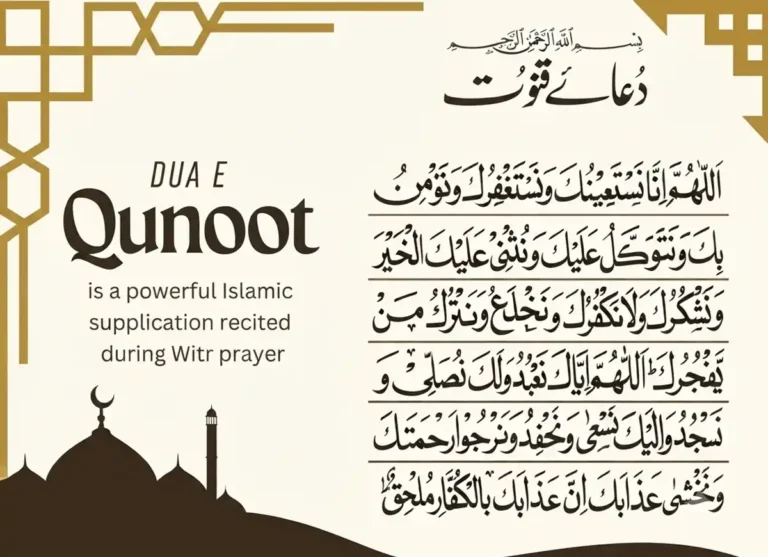
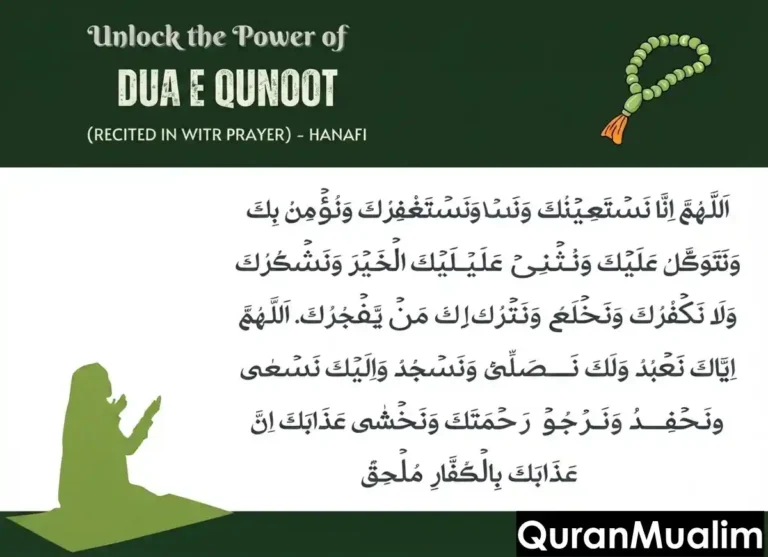
The dua witr namaz most widely taught in the Hanafi tradition is Dua al-Qunoot. Here it is in full:
اللَّهُمَّ إِنَّا نَسْتَعِينُكَ وَنَسْتَغْفِرُكَ وَنُؤْمِنُ بِكَ وَنَتَوَكَّلُ عَلَيْكَ وَنُثْنِي عَلَيْكَ الْخَيْرَ وَنَشْكُرُكَ وَلَا نَكْفُرُكَ وَنَخْلَعُ وَنَتْرُكُ مَنْ يَفْجُرُكَ
اللَّهُمَّ إِيَّاكَ نَعْبُدُ وَلَكَ نُصَلِّي وَنَسْجُدُ وَإِلَيْكَ نَسْعَى وَنَحْفِدُ وَنَرْجُو رَحْمَتَكَ وَنَخْشَى عَذَابَكَ إِنَّ عَذَابَكَ بِالْكُفَّارِ مُلْحَقٌ
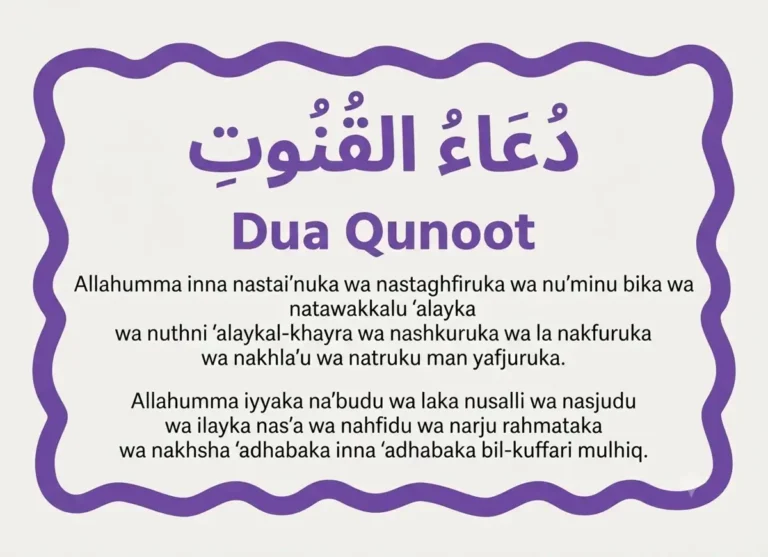
Transliteration:
Allahumma inna nasta’eenuka wa nastaghfiruka wa nu’minu bika wa natawakkalu ‘alayk, wa nuthni ‘alaykal khayr, wa nashkuruka wa la nakfuruk, wa nakhla’u wa natruku man yafjuruк.
Allahumma iyyaka na’budu wa laka nusalli wa nasjudu, wa ilayka nas’a wa nahfidu, wa narju rahmataka wa nakhsha ‘adhabak, inna ‘adhabaka bil kuffari mulhaq.
Meaning:
“O Allah, we seek Your help and forgiveness. We believe in You, rely on You, and praise You in the best way. We are grateful to You and never ungrateful. We disown and abandon those who disobey You.
O Allah, You alone we worship; to You we pray and prostrate. Toward You we strive and hasten. We hope for Your mercy and fear Your punishment. Truly, Your punishment overtakes the disbelievers.”
Key Components of Dua al-Qunoot — At a Glance
| Section | Theme | What It Expresses |
| First phrase | Seeking help and forgiveness | Humility and dependence on Allah |
| Second phrase | Praising and thanking Allah | Gratitude and acknowledgment of goodness |
| Third phrase | Disavowal of wrongdoers | Loyalty to Allah’s boundaries |
| Fourth phrase | Worship and prostration | Complete submission and devotion |
| Fifth phrase | Hope and fear | The two wings of a believer’s heart |
| Final phrase | Warning to disbelievers | Affirmation of divine justice |
Table: Thematic breakdown of Dua al-Qunoot for Witr Namaz
Also Read: How To Pray Complete Namaz With Urdu translation Step by Step

When and How to Recite the Dua for Witr Namaz
The dua witr namaz is recited in the third (final) rak’ah of Witr. Here is exactly how it fits into the prayer, according to the Hanafi method:
- Begin the third rak’ah normally — Fatiha followed by another Surah
- After completing the Surah, raise your hands to your earlobes and say Allahu Akbar (this is the Qunoot takbeer)
- Fold your hands back and recite Dua al-Qunoot in a low voice
- Continue into Ruku as normal
- Complete the rak’ah and end with Tasleem
In the Shafi’i school, Qunoot is recited after returning from Ruku in the final rak’ah. For Maliki and Hanbali schools, Qunoot in Witr is optional or position-specific. The core dua text is accepted across all schools.
Qur’an on Supplication and Night Prayer
1. Surah Ghafir (40:60)
Surah Ghafir, Ayah 60 — Read on Alim.org — “And your Lord says: Call upon Me, and I will respond to you. Indeed, those who are too proud to worship Me will enter Hell in humiliation.”
This verse is the foundation of all Islamic dua practice. Allah does not just permit supplication — He commands it and promises a response. The dua in Witr is one of the most direct answers to this divine invitation.
2. Surah Al-Baqarah (2:186)
Surah Al-Baqarah, Ayah 186 — Read on Alim.org — “And when My servants ask you concerning Me, indeed I am near. I respond to the call of the caller when he calls upon Me.”
This ayah describes the intimacy of dua: Allah is near. Not distant, not indifferent. The Witr dua is prayed at night when distractions fade — and this closeness becomes tangible in those quiet moments before Fajr.
Categories: Namaz ,Zakat , Roza , Prayer , Hadith & Supplications
Hadith on Witr Dua and Qunoot
Hadith 1 — Sahih al-Bukhari
Al-Hasan ibn Ali (may Allah be pleased with him) reported: “The Messenger of Allah ﷺ taught me words to say in the Witr prayer: ‘O Allah, guide me among those You have guided…'” — Sahih al-Bukhari reference on Witr Qunoot — contextual reading on Sunnah.com
This narration from Al-Hasan ibn Ali — the Prophet’s grandson — is the basis for the short Qunoot taught in the Shafi’i and Hanbali traditions. It shows that the Prophet ﷺ personally transmitted the Witr dua to the next generation.
Hadith 2 — Sahih Muslim
Ali ibn Abi Talib reported that the Prophet ﷺ used to conclude his Witr prayer with these words: “O Allah, I seek refuge in Your pleasure from Your displeasure…” — Sahih Muslim, Hadith 486 — The Prophet’s closing Witr supplication on Sunnah.com
This Hadith gives us the personal dua the Prophet ﷺ made at the end of Witr — after the formal Qunoot. It is a beautiful addition for those who want to extend their connection with Allah before ending the night prayer.
Why the Dua for Witr Namaz Matters So Much
The dua within Witr is not just a formality. Here is what makes it spiritually distinct:
- It is one of the few duas recited standing inside a prayer — a position of both physical and spiritual alertness
- It covers the full spectrum of a believer’s relationship with Allah: help-seeking, gratitude, worship, hope, and fear
- It is recited in the last third of the night — the time scholars call the most blessed window for accepted duas
- It closes the night with explicit praise and dependence on Allah — a beautiful spiritual habit to anchor your evenings
- Regular recitation builds familiarity with classical Arabic dua language, deepening your Quranic connection over time
For deeper exploration of Islamic supplication etiquette and practice, the IslamQA.info section on dua and prayer offers detailed scholarly guidance on making dua properly both inside and outside of Salah.
What If You Don’t Know Dua al-Qunoot Yet?
This is more common than people think — especially for converts, younger Muslims, or those returning to prayer after a long gap. Here is what scholars say:
- You may recite any dua from the Quran or Sunnah in its place — for example, “Rabbana atina fid-dunya hasanah…” (2:201)
- You may repeat “Allahummaghfirli” (O Allah, forgive me) three times while learning
- You may recite the shorter Qunoot taught by the Prophet ﷺ to Al-Hasan ibn Ali — it is shorter and equally authentic
- Leaving Qunoot due to not knowing it does not invalidate the Witr prayer — the prayer is still valid
- Learning the dua gradually, phrase by phrase, is the best long-term approach
For structured learning of Islamic prayers, supplications, and Witr practice, the IslamicTeachings.org community forum is an excellent place to ask questions and receive guidance from knowledgeable community members.
Also Read: Dua After Praying – Do This For Rizq, Mercy & Blessings!
Classical Hanafi References on Witr and Qunoot
The following Hanafi scholarly works contain detailed discussions on Witr Namaz and Dua al-Qunoot:
- Al-Mabsut — by Imam al-Sarakhsi, one of the most expansive Hanafi legal references, covering all aspects of Salah
- Khulasah al-Fatawa — a concise but authoritative Hanafi fatwa collection covering prayer rulings including Witr
- Al-Wiqayah fi Masail al-Hidayah — a standard Hanafi madrasa text summarizing fiqh rulings on prayer
- Sharh al-Wiqayah — the detailed commentary on Al-Wiqayah, widely used for deeper fiqh study
Frequently Asked Questions
1. What is the dua for Witr Namaz called?
It is called Dua al-Qunoot. It is recited in the final rak’ah of Witr prayer, typically after a Surah and before Ruku in the Hanafi school.
2. Is Dua al-Qunoot obligatory in Witr?
In the Hanafi school, it is Wajib — near-obligatory. Forgetting it requires a Sajdah al-Sahw (prostration of forgetfulness). Other schools consider it recommended.
3. Can I recite a different dua instead of Dua al-Qunoot?
Yes. If you don’t know Dua al-Qunoot, you may recite any authentic Quranic supplication or a shorter narrated dua in its place. Your prayer remains valid.
4. Where exactly is Dua al-Qunoot recited in Witr?
In the Hanafi school: after the Surah in the third rak’ah, before Ruku. In the Shafi’i school: after rising from Ruku, before Sujood.
5. Do women recite Dua al-Qunoot aloud or silently?
Both men and women recite it silently during individual prayer. In congregation, the imam recites aloud and followers say Ameen internally.
Conclusion
The dua for Witr Namaz is not just a few Arabic words to memorize and rush through. It is a structured conversation with your Creator — covering help, gratitude, worship, hope, and surrender. Every phrase was either taught by the Prophet ﷺ or confirmed by his practice.
If you are still learning it, start today. One phrase at a time. Understand the meaning. Let it sink into your heart before Fajr touches the sky.
For further reading on the broader context of Islamic prayer traditions, visit Britannica’s overview of Islamic worship and Salah. And if you want to explore Witr, dua, and Islamic knowledge further in one place, QuranMualim.com offers structured learning resources for Muslims at every level.
Raise your hands in Qunoot tonight with understanding. That is how a dua becomes a conversation — not just a recitation.
Check Also Similar Post:
- Can I Pray Witr After Fajr?
- Can You Pray Tahajjud After Witr?
- Can You Pray Tahajjud After Witr Namaz?
- Do You Pray Witr After Tahajjud? Learn Islam
Check Also Similar Post:
A) How-to Pray
- How Many Rakats in Tahajjud Prayer?
- Can I Pray Tahajjud Without Sleeping?
- Night Prayer: Powerful Prayers For The Evening
- How To Pray Tahajjud Step By Step? Learn Islam
- How To Read Tahajjud Prayer? A Step By Step Guide
B) Timing (Tahajjud Prayer)
- Best Time to Pray Tahajjud Namaz
- What Time is Best For Tahajjud Prayer?
- The Best Time For Tahajjud Salaah – learn Islam
- Tahajjud Prayer Before Sleep At Night – Learn Islam
- Last Third of The Night- Calculate The Last Third of The Night
C) Rulings / FAQs
- Can You Pray Tahajjud After Witr?
- Is Tahajjud Sunnah or Nafl? Learn Islam
- Is Qiyam and Tahajjud Same? Learn Islam
- What Should Be The Tahajjud Prayer Niyat?
D) Duas
- Powerful Dua After Tahajjud Namaz
- learn Best tahajjud Dua For Success – Learn Islam
- Tahajjud Dua in English Transliteration & Translation
Recommended For You:
- How Many Rakats For Fajr Prayer?
- How Many Rakats For Zuhr Prayer?
- How Many Rakats For Asr Prayer?
- How Many Rakats For Maghrib Prayer?
- How Many Rakats For Isha Prayer?
- What Time is The Jummah Prayer?
- 6 Types of Sunnah Prayers In Islam
- How to Perform Salah (Complete Namaz)
- How To Pray Witr Namaz? Step by Step Guide
- How To Read Asr Namaz? Step by Step Guide
- Do You Know The Correct Namaz Rakat Table?
- What is The Sitting Between in Khutbah Called?
- Salat | Physical Benefits of Salat Prayer PDF Download
- Namaz is the Pillar of Islam – Why Ignore Its Importance?
- Dua For Namaz: Simple Words That Steady The Heart, rayer