
How to pray Witr is a question many Muslims ask once they’ve settled into their five daily Salah and want to build on that foundation. This closing night prayer often feels mysterious to beginners, who aren’t sure about its timing, rakats, or the special dua involved. Once explained clearly, though, it becomes one of the simplest parts of daily worship.
If you’d like to learn Namaz, Quran with Tajweed, or Qaida, our team brings over 15 Years Teaching Experience to students of every background, including dedicated quran classes for adults beginners.
📖 For deeper reading on Prophetic worship habits, consider: Fortress of the Muslim — a well-loved daily dua collection.
Also Read: Quran With Urdu Translation PDF Download

Common Confusion Around Witr
Many people wonder whether how to perform Witr prayer requires a fixed number of rakats or a specific Qunut wording. Others aren’t sure if it’s obligatory, leading some to skip it despite the Prophet’s ﷺ consistent practice of never leaving it out.
The Insight: What Quran and Hadith Say
Allah describes voluntary night worship in Surah Al-Muzzammil, where He tells the believer that their Lord knows they stand in prayer nearly two-thirds of the night, or half, or a third, showing real flexibility in night devotion. Read it here: Alim.org — Surah Al-Muzzammil 73:20.
A second reference comes from Surah Al-Isra, where Allah instructs standing in prayer during part of the night as something additional, hoping the believer will be raised to a praiseworthy station. Read it here: Alim.org — Surah Al-Isra 17:79.
On the Hadith side, the Prophet ﷺ was known to never abandon Witr, whether traveling or at home, showing its weight in his daily Salah routine. This narration appears in Sunan Abu Dawood on Sunnah.com.
Another hadith describes how the Prophet ﷺ would pray Witr with varying rakats depending on the night, sometimes finishing quickly and other times lengthening his recitation. Find this narration in Jami’ at-Tirmidhi on Sunnah.com.
Also Read: Allahumma Ajirni Minan Naar
How to Pray Witr Step-by-Step
Witr how to pray becomes straightforward once you follow this simple checklist:
- Timing: Pray Witr any time after Isha, up until just before Fajr enters.
- Rakats: Choose 1, 3, 5, 7, or more odd-numbered rakats, with 3 being most common.
- Structure (3 rakats): Pray two rakats normally, then stand for one final rakat to close.
- Qunut Dua: Recite Dua-e-Qunut in the final rakat, typically after standing up from Ruku.
- Intention: Set a clear niyyah that this Salah is specifically Witr before beginning.
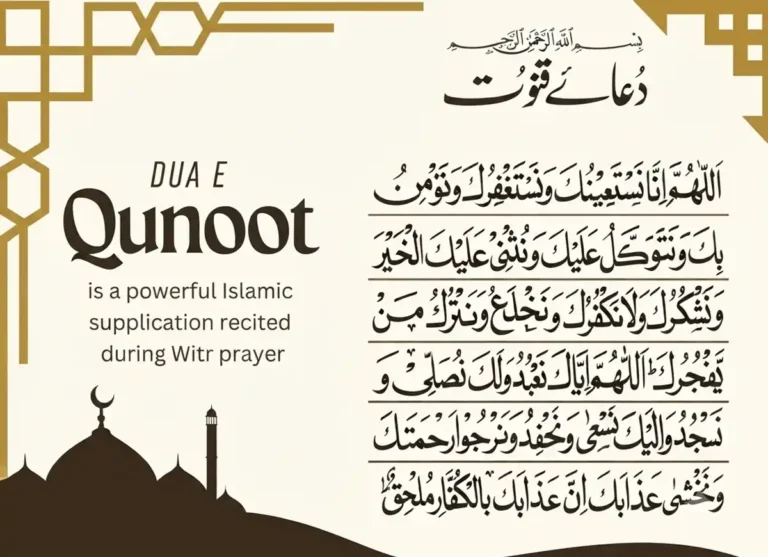
Dua-e-Qunut: Arabic, Urdu, and English
Arabic:
اللَّهُمَّ إِنَّا نَسْتَعِينُكَ وَنَسْتَغْفِرُكَ وَنُؤْمِنُ بِكَ وَنَتَوَكَّلُ عَلَيْكَ
Urdu Translation:
اے اللہ! ہم تجھ سے مدد مانگتے ہیں، تجھ سے بخشش چاہتے ہیں، تجھ پر ایمان رکھتے ہیں اور تجھ ہی پر بھروسہ کرتے ہیں۔
English Translation:
O Allah, we seek Your help, we ask Your forgiveness, we believe in You, and we place our trust in You.
Table: Witr Prayer at a Glance
Also Read: Namaz Dua (Masnoon Duain) PDF Download
| Element | Detail |
| Ruling | Wajib (Hanafi fiqh); confirmed Sunnah in other schools |
| Best Time | Last third of the night |
| Minimum Rakats | 1 |
| Common Practice | 3 rakats |
| Maximum Rakats | 11 |
Why Witr Prayer Matters
Witr closes the day with humility, reminding you that worship doesn’t end with Isha. Scholars often describe it as a spiritual seal, one that carries the intentions of your Salah into peaceful, restful sleep.
According to Wikipedia, Witr refers to an odd-numbered prayer performed after Isha, distinguishing it from the five obligatory prayers of the day. Read more: Wikipedia — Witr. Britannica also places Witr within the wider framework of Islamic ritual prayer.
For deeper study, visit the Islamic Teachings Forum to ask questions, or check detailed rulings at IslamQA.
Hanafi Fiqh References for Further Reading
For readers wanting classical depth, these Hanafi fiqh titles are commonly available in libraries and Islamic archives:
- Radd al-Muhtar (Fatawa Shami) by Ibn Abidin
- Kanz al-Daqa’iq by Abu al-Barakat al-Nasafi
- Multaqa al-Abhur by Ibrahim al-Halabi
- Maraqi al-Falah by Hasan ibn Ammar al-Shurunbulali
Categories: Namaz ,Zakat , Roza , Prayer , Hadith & Supplications
Frequently Asked Questions
Is Witr prayer wajib or sunnah?
In Hanafi fiqh, Witr is Wajib, meaning strongly required. Other schools of thought treat it as a confirmed Sunnah, not strictly obligatory.
How do I recite Dua-e-Qunut correctly?
Recite it after standing from Ruku in the final rakat, either in Arabic or your own language if you’re still memorizing it.
Can I pray Witr with just one rakat?
Yes, one rakat fulfills the minimum requirement for Witr, though praying three rakats is the most widely practiced method.
What if I miss Witr before Fajr?
You can make it up during the day, though scholars recommend prioritizing its proper time within the night whenever possible.
Should Witr be prayed alone or in congregation?
Witr is usually prayed alone, except during Ramadan, when many mosques lead it in congregation after Taraweeh prayers.
Final Thoughts
Learning how to pray Witr brings a quiet, meaningful close to your daily worship. With consistent practice, this short prayer becomes a comforting habit that strengthens your connection to Allah every single night.
Ready to deepen your understanding of Salah, Tafseer, and Quranic Arabic? Reach out via WhatsApp at +923017363500, email [email protected], or visit www.quranmualim.com. Follow us on YouTube @quranmualim for lessons that make daily worship easier to understand.
Check Also Similar Post:
- Can I Pray Witr After Fajr?
- Can You Pray Tahajjud After Witr?
- How To Pray Salah Witr? Learn Islam
- How To Do Witr Prayer? – Learn Islam
- Can You Pray Tahajjud After Witr Namaz?
- Do You Pray Witr After Tahajjud? Learn Islam
Check Also Similar Post:
A) How-to Pray
- How Many Rakats in Tahajjud Prayer?
- Can I Pray Tahajjud Without Sleeping?
- Night Prayer: Powerful Prayers For The Evening
- How To Pray Tahajjud Step By Step? Learn Islam
- How To Read Tahajjud Prayer? A Step By Step Guide
B) Timing (Tahajjud Prayer)
- Best Time to Pray Tahajjud Namaz
- What Time is Best For Tahajjud Prayer?
- The Best Time For Tahajjud Salaah – learn Islam
- Tahajjud Prayer Before Sleep At Night – Learn Islam
- Last Third of The Night- Calculate The Last Third of The Night
C) Rulings / FAQs
- Can You Pray Tahajjud After Witr?
- Is Tahajjud Sunnah or Nafl? Learn Islam
- Is Qiyam and Tahajjud Same? Learn Islam
- What Should Be The Tahajjud Prayer Niyat?
D) Duas
- Powerful Dua After Tahajjud Namaz
- learn Best tahajjud Dua For Success – Learn Islam
- Tahajjud Dua in English Transliteration & Translation