

Rakats for Jummah confuse many new Muslims, and even some who have prayed for years still forget the exact count. Every Friday, mosques fill early for Jummah namaz, yet the sunnah and fardh rakats often get mixed up in people’s minds. This guide walks through the whole prayer, step by step, so you never have to guess again.
If you like keeping a handy reference nearby, Jumu’ah: My Friday Prayer Handbook lays out these steps with simple, easy diagrams you can flip through before you head to the mosque.
How Many Rakats Are There in Jummah Namaz?
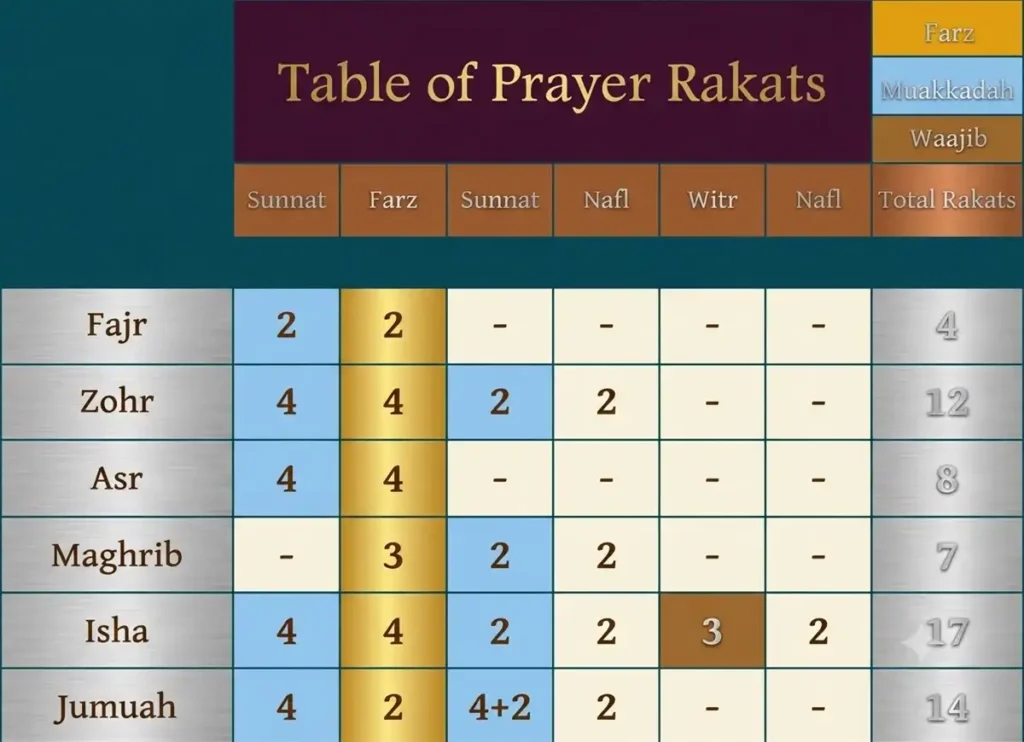
Scholars generally describe four separate parts to a complete Jummah namaz. Only one part is obligatory; the rest are recommended additions that carry their own reward.
- 4 rakats sunnah mu’akkadah, prayed before the khutbah begins
- 2 rakats fardh, led by the imam, replacing the usual Zuhr prayer
- 4 rakats sunnah mu’akkadah, prayed after the fardh (often done as 2+2)
- 2 rakats nafl, entirely optional, for those who want extra reward
| Rakat Type | Count | Ruling |
| Sunnah (before) | 4 | Confirmed sunnah (sunnah mu’akkadah) |
| Fardh | 2 | Obligatory, led by the imam |
| Sunnah (after) | 4 | Confirmed sunnah (often prayed as 2+2) |
| Nafl | 2 | Optional, for extra reward |
Only the 2 fardh rakats carry an obligation. Everything else is recommended, so missing the sunnah or nafl rakats on a busy Friday doesn’t invalidate your prayer.
Similar Posts For You: Are We Praying 2 Rakat The Right Way?

How to Pray the Complete 2 Rakats, Step by Step
Here is the full fardh of Salat-ul-Jummah, from niyyah to salaam, so you can follow along rakat by rakat.
Step 1 — Niyyah: Silently intend, “I intend to pray 2 rakats fardh of Salat-ul-Jummah for the sake of Allah.”
Step 2 — Takbir-e-Tahrimah: Raise your hands and say “Allahu Akbar” (اللهُ أَكْبَرُ), then fold your hands below the navel.
Rakat One
We quietly recite Subhanaka:
سُبْحَانَكَ اللَّهُمَّ وَبِحَمْدِكَ وَتَبَارَكَ اسْمُكَ وَتَعَالَى جَدُّكَ وَلَا إِلَهَ غَيْرُكَ
Transliteration: Subhanaka Allahumma wa bihamdika, wa tabaraka ismuka, wa ta’ala jadduka, wa la ilaha ghairuk.
Meaning: “Glory to You, O Allah, and all praise. Blessed is Your name, and exalted is Your majesty. There is no god but You.”
Right after Subhanaka, and before Surah Al-Fatiha, we say the ta’awwudh and tasmiyah:
أَعُوذُ بِاللَّهِ مِنَ الشَّيْطَانِ الرَّجِيمِ بِسْمِ اللَّهِ الرَّحْمَٰنِ الرَّحِيمِ
Transliteration: A’udhu billahi min ash-shaytanir rajim. Bismillahir Rahmanir Raheem.
Meaning: “I seek refuge in Allah from the accursed devil. In the name of Allah, the Most Gracious, the Most Merciful.”
We then recite Surah Al-Fatiha, followed by any other surah or a few verses.
Ruku: Say “Allahu Akbar” and bow, then recite this three times, calmly:
سُبْحَانَ رَبِّيَ الْعَظِيمِ
Transliteration: Subhana Rabbiyal Azeem.
Meaning: “Glory be to my Lord, the Most Great.”
Qawmah (rising from ruku): Stand up saying “Sami’ Allahu liman hamidah,” then say “Rabbana lakal hamd” once standing straight.
Meaning: “Allah hears whoever praises Him” / “Our Lord, all praise is for You.”
First Sajdah: Say “Allahu Akbar” and go down into prostration, then recite this three times:
سُبْحَانَ رَبِّيَ الْأَعْلَى
Transliteration: Subhana Rabbiyal A’la.
Meaning: “Glory be to my Lord, the Most High.”
Sit briefly (Jalsa): Say “Allahu Akbar” and sit up calmly between the two sajdahs.
Second Sajdah: Say “Allahu Akbar” and go down again, repeating “Subhana Rabbiyal A’la” three times, then rise for the second rakat saying “Allahu Akbar.” This completes rakat one.
Also Read: Prayer For Forgiveness of Others – Islamic Guide
Rakat Two
Standing for the second rakat, we say “Bismillahir Rahmanir Raheem” and recite Surah Al-Fatiha again, followed by another surah. Subhanaka and the ta’awwudh are not repeated in the second rakat.
The ruku, qawmah, and both sajdahs of the second rakat follow exactly the same words as rakat one: “Subhana Rabbiyal Azeem” three times in ruku, “Sami’ Allahu liman hamidah” and “Rabbana lakal hamd” on rising, and “Subhana Rabbiyal A’la” three times in each sajdah.
Step — Qa’dah (final sitting): After the second sajdah of rakat two, sit for At-Tahiyyat instead of standing again, since this is the last rakat of a 2-rakat prayer.
التَّحِيَّاتُ لِلَّهِ وَالصَّلَوَاتُ وَالطَّيِّبَاتُ، السَّلَامُ عَلَيْكَ أَيُّهَا النَّبِيُّ وَرَحْمَةُ اللَّهِ وَبَرَكَاتُهُ، السَّلَامُ عَلَيْنَا وَعَلَى عِبَادِ اللَّهِ الصَّالِحِينَ، أَشْهَدُ أَنْ لَا إِلَهَ إِلَّا اللَّهُ وَأَشْهَدُ أَنَّ مُحَمَّدًا عَبْدُهُ وَرَسُولُهُ
Transliteration: At-tahiyyatu lillahi was-salawatu wat-tayyibat, as-salamu ‘alaika ayyuhan-nabiyyu wa rahmatullahi wa barakatuh, as-salamu ‘alaina wa ‘ala ‘ibadillahis-saliheen, ash-hadu al-la ilaha illallah wa ash-hadu anna Muhammadan ‘abduhu wa rasuluh.
Meaning: “All greetings, prayers, and good things belong to Allah. Peace be upon you, O Prophet, and the mercy of Allah and His blessings. Peace be upon us and upon the righteous servants of Allah. I bear witness there is no god but Allah, and that Muhammad is His servant and Messenger.”
At the words “la ilaha,” raise the index finger of the right hand, and lower it again at “illallah.” After At-Tahiyyat, recite Durood Ibrahim:
اللَّهُمَّ صَلِّ عَلَى مُحَمَّدٍ وَعَلَى آلِ مُحَمَّدٍ كَمَا صَلَّيْتَ عَلَى إِبْرَاهِيمَ وَعَلَى آلِ إِبْرَاهِيمَ إِنَّكَ حَمِيدٌ مَجِيدٌ، اللَّهُمَّ بَارِكْ عَلَى مُحَمَّدٍ وَعَلَى آلِ مُحَمَّدٍ كَمَا بَارَكْتَ عَلَى إِبْرَاهِيمَ وَعَلَى آلِ إِبْرَاهِيمَ إِنَّكَ حَمِيدٌ مَجِيدٌ
Transliteration: Allahumma salli ‘ala Muhammadin wa ‘ala aali Muhammadin kama sallaita ‘ala Ibrahima wa ‘ala aali Ibrahima innaka Hamidum Majid. Allahumma barik ‘ala Muhammadin wa ‘ala aali Muhammadin kama barakta ‘ala Ibrahima wa ‘ala aali Ibrahima innaka Hamidum Majid.
Meaning: “O Allah, send blessings upon Muhammad and his family, as You blessed Ibrahim and his family; You are Praiseworthy and Glorious. O Allah, bless Muhammad and his family, as You blessed Ibrahim and his family; You are Praiseworthy and Glorious.”
You may then add a short dua, such as Rabbana atina, before moving to salaam.
Salaam: Turn your face to the right saying “As-salamu ‘alaikum wa rahmatullah,” then turn to the left saying the same. This completes the 2 rakats fardh of Salat-ul-Jummah.
The sunnah and nafl rakats before and after the fardh follow this same pattern of Subhanaka, ta’awwudh, tasmiyah, ruku, and sajdah — the only difference is that each is prayed as a separate, independent 2-rakat unit.
Also Read: Allahummaghfirli Zambi Dua
Jummah Prayer Rakats for Ladies
Jummah is not obligatory on women, so jummah prayer rakats for ladies work a little differently. A woman may pray 4 rakats of Zuhr at home instead of attending, or she may join the congregation whenever it’s convenient for her. If she does attend Jummah, she simply follows the same rakats as everyone else in the room.
Qur’an References
Surah Al-Jumu’ah, Ayah 9 — Allah calls believers to leave their business aside and hurry toward His remembrance once the Friday call to prayer sounds. Read it on Quran.com
Surah Al-Jumu’ah, Ayah 10 — Once the prayer ends, believers are told to disperse, seek Allah’s bounty, and keep Him in mind often throughout the day. Read it on Quran.com
Also Read: Can I Fast If I Make Ghusl After Fajr?
Hadith References
Sahih al-Bukhari 858 — The Prophet ة said that ghusl on Friday becomes compulsory for every adult Muslim before Jummah. See the full hadith on Sunnah.com
Sahih Muslim 857a — Abu Huraira reports that whoever performs wudu well, comes to Jummah, and listens quietly has his sins forgiven for that week, plus three extra days. Read the full hadith on Sunnah.com
Also Read: Tasbeeh After Prayer Tahmid, Takbir, Tahlil & Zikr After Prayer
Hanafi Fiqh Books Worth Reading
For readers who want to go deeper into the fiqh behind Jummah, these classical Hanafi texts are commonly available in libraries and Islamic archives:
- Al-Hidayah by Burhan al-Din al-Marghinani
- Nur al-Idah by Hasan ibn Ammar al-Shurunbulali
- Kanz al-Daqaiq by Abu al-Barakat al-Nasafi
Where to Ask Further Questions
Two trusted places for follow-up fiqh questions are the Islamic Teachings community forum and IslamQA, both of which host scholars who answer specific prayer questions in detail. For further reading on Quran-related topics, quranmualim.com is also worth a visit.
For historical background outside devotional writing, see the overview at Wikipedia’s entry on Friday prayer and the concise summary at Britannica’s entry on Jum’ah.
Categories: Namaz ,Zakat , Roza , Prayer , Hadith & Supplications

Frequently Asked Questions
How many rakats for Jummah are fardh?
Only 2 rakats are fardh, prayed behind the imam right after the khutbah. Everything else, sunnah and nafl, adds extra reward but isn’t obligatory.
Can I skip the sunnah rakats before Jummah?
Yes, they’re recommended, not required. The Prophet ة prayed them regularly, though, so most scholars advise keeping them whenever your schedule allows it.
Do women have to pray Jummah?
No. Jummah prayer rakats for ladies are optional; women may pray Zuhr at home or join the congregation, whichever suits their situation better that week.
What if I miss the fardh rakats?
If you missed the 2 fardh rakats, pray them as Zuhr afterward, since the khutbah requirement no longer applies once the Jummah congregation has ended.
Is reciting Surah Al-Kahf part of the rakats?
No, Surah Al-Kahf is recited separately on Friday, not inside the Jummah rakats themselves. It’s a distinct sunnah observed across the whole day.
Conclusion
Once you know the rakats for jummah, the whole prayer feels less like a puzzle and more like a rhythm you look forward to each week. Keep the fardh steady, add the sunnah when you can, and let the Friday gathering do what it’s meant to do: pull your whole week back toward remembrance.
Related JUMMAH Posts For You:
- What Time is The Jummah Prayer?
- Jummah Prayer Friday: Sunnahs & Significance
- How Many Jummah Prayer Rakats? Learn Islam
- How Do You Pray Jummah Prayer Step-by-Step?
- What is The Sitting Between in Khutbah Called?
- Friday Jummah Prayer | Jummah Prayer In Islam
- Jummah Prayer importance in Quran and Hadith
- The Virtues Prayer of jummah & Spiritual Effects
- How To Perform Jummah Prayer Correctly in Islam?
- Friday Prayer (Jum’a): Sunnahs, Reward and Benefits
- Jummah Prayer Time: Fajr, Dhuhur, Asr, Maghrib & Isha
- How To Jummah Prayer Perform: Faraiz, Sunnah & Nawafil
Related Posts For You
- Allahumma Ajirni Minan Naar
- Allahummaghfirli Zambi Dua
- Astaghfirullah Meaning in Urdu
- Allahumma Rahmataka Arju: A Dua For Hope
- la ilaha illa anta subhanaka inni kuntu arabic
- Prayer For Forgiveness of Others – Islamic Guide
- Prayer For Forgiveness of Others – Islamic Guide
- Allahumma Ajirni Minan Naar in Arabic & English
- Subhanallahi wa bihamdihi subhanallahil azeem astaghfirullah meaning