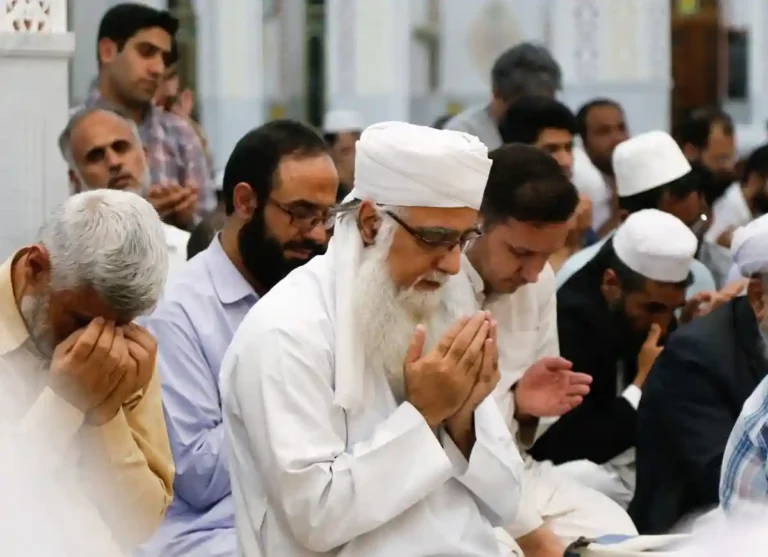


Dua e Qunoot English Translation is one of the most searched phrases among Muslims who grew up praying in Arabic but never learned what the words actually mean. You recite it every night in Witr, your lips move through the familiar syllables, and yet the meaning stays just out of reach. That gap between recitation and understanding is more common than people admit.
Check this bilingual Dua collection on Amazon for a handy pocket reference with Arabic script, transliteration, and translation side by side.
Why Understanding the Translation Matters
Reciting words you don’t understand isn’t wrong, but it limits the experience. Once you know what you’re actually asking Allah for, the dua stops being background noise and becomes a real conversation. Scholars have always encouraged learners to pair memorization with meaning, especially for something recited nightly in Witr.
This is exactly why so many new practicing Muslims search for a clear breakdown. It’s not laziness. It’s a genuine desire to pray with presence instead of habit. Once the meaning clicks, the whole dua feels heavier and more personal, in the best possible way.
Also Read: Salat | Physical Benefits of Salat Prayer PDF Download
Quran Verses That Support the Spirit of This Dua
The Quran doesn’t name this specific supplication, but it repeatedly affirms that dua is central to a believer’s relationship with Allah.
- Surah Al-Mu’min (Ghafir) 40:60 — Allah promises to answer anyone who calls upon Him, a direct assurance that no sincere dua goes unheard. Read on Alim.org
- Surah Al-Baqarah 2:201 — This verse teaches the famous dua asking for good in this life and the next, showing the pattern of asking Allah comprehensively, not narrowly. Read on Alim.org
Hadith Behind the Words
The core wording of this dua traces back to a hadith where Al-Hasan ibn Ali, the Prophet’s grandson, recalled being personally taught these lines by the Messenger of Allah ﷺ for recitation in Witr, covering guidance, well-being, and protection. This narration is recorded with slightly different phrasing in different collections, and its chain is accepted as reliable by hadith scholars. See Sunan Abu Dawood 1425.
A second hadith on the same topic appears in Jami at-Tirmidhi, where the same wording taught to Al-Hasan is preserved, along with a note encouraging Muslims to add sending blessings on the Prophet ﷺ after finishing the dua. [See Jami at-Tirmidhi 464](https://sunnah.com/tirmidhi:464).
Also Read: How to Pray Salah: Step-by-Step Guide (Wudu + Fajr, Zuhr, Asr, Maghrib, Isha)
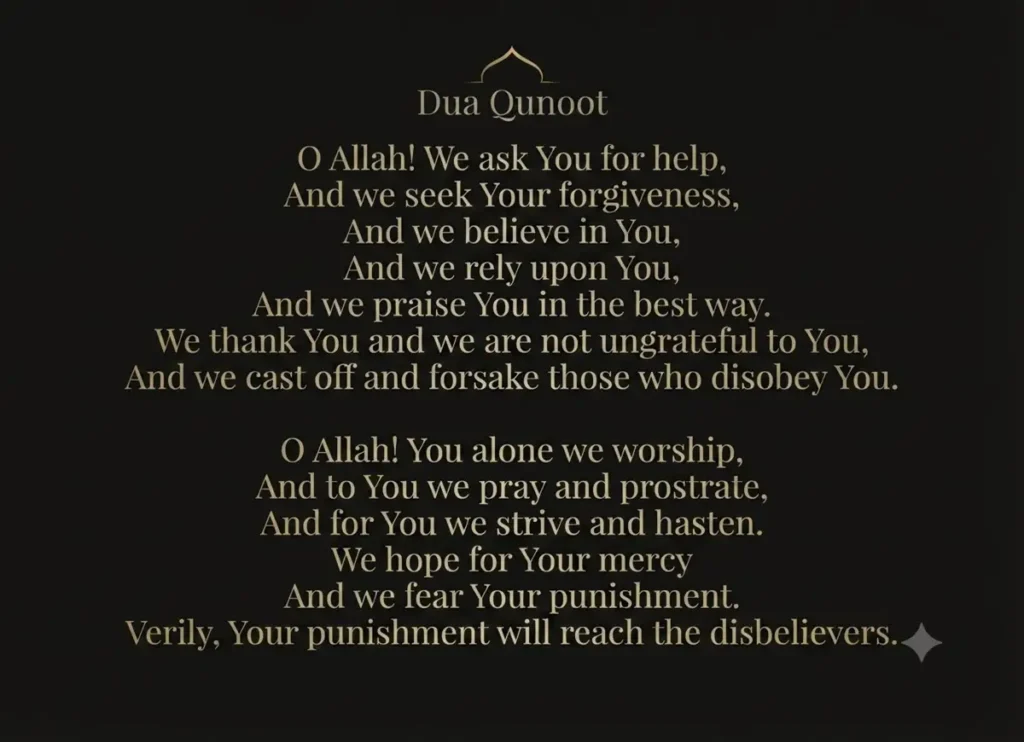
Dua e Qunoot English Transliteration and Meaning
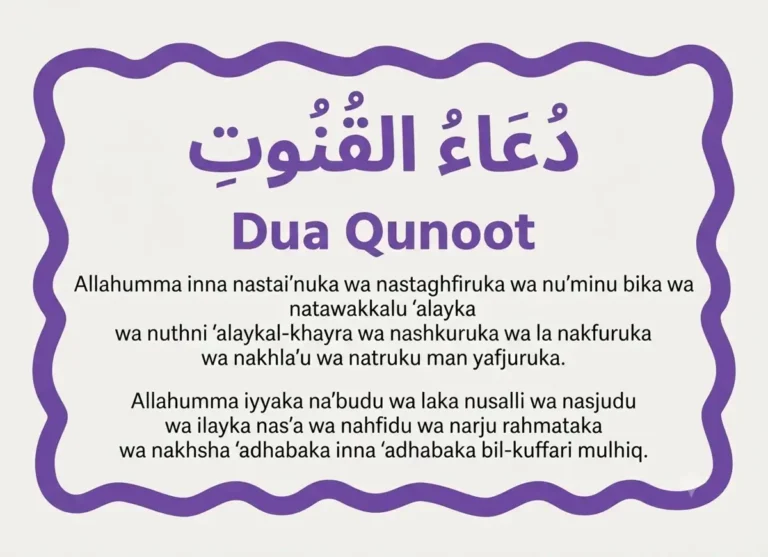
For readers who specifically want the dua e qunoot english transliteration, here it is, written the way it sounds when spoken aloud, sometimes also called dua e qunoot in roman english:
Determined to furnish bilingual religious text with translation
دعائے قنوت
اللَّهُمَّ اهْدِنِي فِيمَنْ هَدَيْتَ، وَعَافِنِي فِيمَنْ عَافَيْتَ، وَتَوَلَّنِي فِيمَنْ تَوَلَّيْتَ، وَبَارِكْ لِي فِيمَا أَعْطَيْتَ، وَقِنِي شَرَّ مَا قَضَيْتَ، فَإِنَّكَ تَقْضِي وَلَا يُقْضَى عَلَيْكَ، وَإِنَّهُ لَا يَذِلُّ مَنْ وَالَيْتَ، وَلَا يَعِزُّ مَنْ عَادَيْتَ، تَبَارَكْتَ رَبَّنَا وَتَعَالَيْتَ
Allahumma-hdini fiman hadait, wa ‘afini fiman ‘afait, wa tawallani fiman tawallait, wa barik li fima a’tait, wa qini sharra ma qadait, fa innaka taqdi wa la yuqda ‘alaik, wa innahu la yadhillu man walait, wa la ya’izzu man ‘adait, tabarakta Rabbana wa ta’alait.
English meaning: “O Allah, guide me among those You have guided, grant me well-being among those You have granted well-being, take me under Your care among those You have cared for, bless me in what You have given, and protect me from the evil You have decreed. Indeed, You decree and none can decree over You. He whom You befriend is never humiliated, and he whom You oppose is never honored. Blessed and Exalted are You, our Lord.”
Also Read: Learn Dua Qunoot in Arabic Text PDF Download
Quick Reference Table
| Question | Answer |
| Is the English translation exact word-for-word? | Close, but Arabic carries nuance that English can only approximate |
| Can Shafi’i Muslims use this translation? | Yes, the core wording taught to Al-Hasan is used across madhabs, including in the dua e qunoot shafi in english version recited in Fajr |
| Do I need Arabic fluency to understand it? | No, transliteration plus translation is enough to start |
| Is it okay to make dua in my own words too? | Yes, adding personal requests after the core wording is permitted |
Also Read: Most Powerful Dua For Instant Miracle
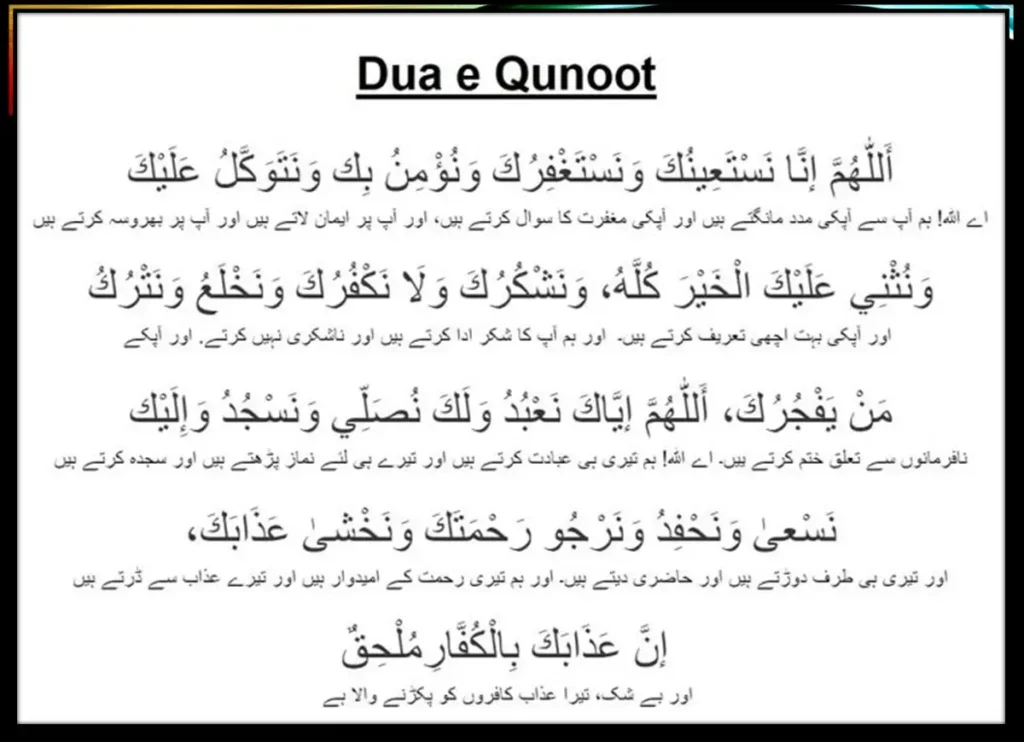
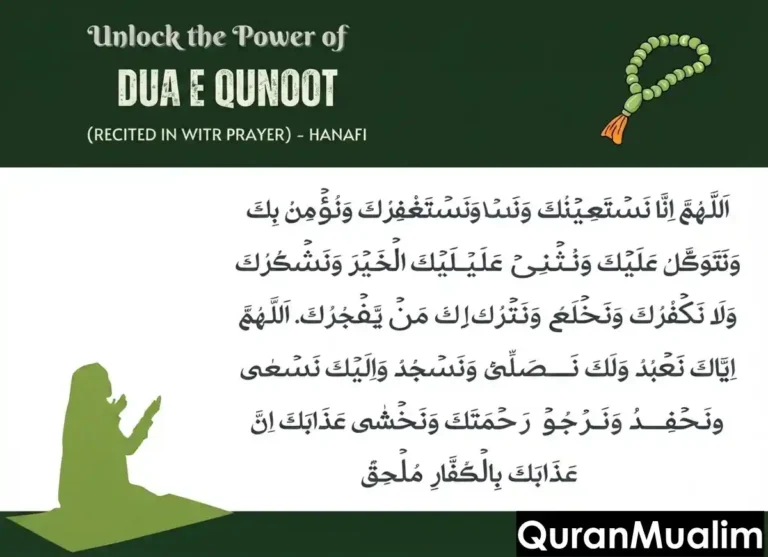
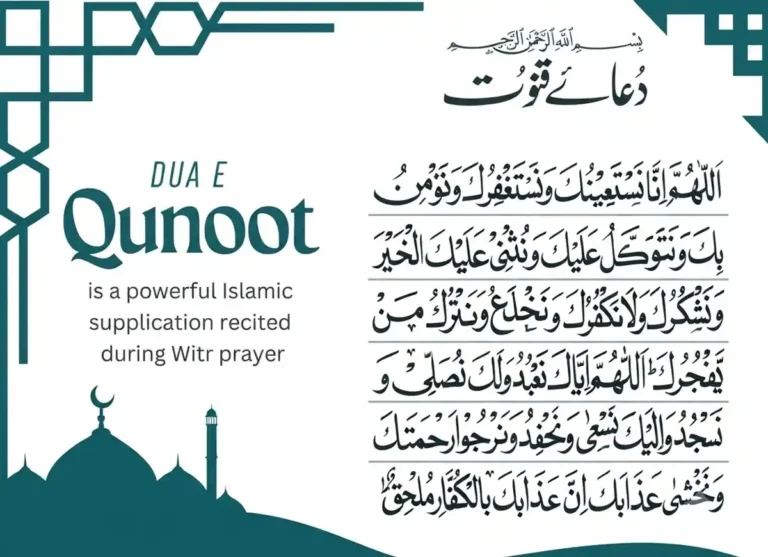
Dua e Qunoot – Word by Word Meaning
| Arabic Word | Transliteration | English Meaning |
|---|---|---|
| اللَّهُمَّ | Allahumma | O Allah |
| إِنَّا | Inna | Indeed, we |
| نَسْتَعِينُكَ | Nasta’eenuka | We seek Your help |
| وَنَسْتَغْفِرُكَ | Wa nastaghfiruka | And we seek Your forgiveness |
| وَنُؤْمِنُ بِكَ | Wa nu’minu bika | And we believe in You |
| وَنَتَوَكَّلُ عَلَيْكَ | Wa natawakkalu ‘alaika | And we rely upon You |
| وَنُثْنِي عَلَيْكَ الْخَيْرَ | Wa nuthni ‘alaikal khair | And we praise You with all goodness |
| وَنَشْكُرُكَ | Wa nashkuruka | And we thank You |
| وَلَا نَكْفُرُكَ | Wa la nakfuruka | And we do not disbelieve in You |
| وَنَخْلَعُ | Wa nakhla’u | And we discard/forsake |
| وَنَتْرُكُ مَنْ يَفْجُرُكَ | Wa natruku man yafjuruka | And we leave whoever disobeys You |
| اللَّهُمَّ | Allahumma | O Allah |
| إِيَّاكَ نَعْبُدُ | Iyyaka na’budu | You alone we worship |
| وَلَكَ نُصَلِّي وَنَسْجُدُ | Wa laka nusalli wa nasjud | And for You we pray and prostrate |
| وَإِلَيْكَ نَسْعَى وَنَحْفِدُ | Wa ilaika nas’a wa nahfid | And to You we hasten and strive |
| نَرْجُو رَحْمَتَكَ | Narju rahmataka | We hope for Your mercy |
| وَنَخْشَى عَذَابَكَ | Wa nakhsha ‘adhabaka | And we fear Your punishment |
| إِنَّ عَذَابَكَ | Inna ‘adhabaka | Indeed, Your punishment |
| بِالْكُفَّارِ مُلْحِقٌ | Bil kuffari mulhiq | Will surely reach the disbelievers |
Hanafi Fiqh References
Readers wanting deeper jurisprudential detail on Witr, Qunoot, and related rulings can explore these classical Hanafi texts, widely available in Islamic libraries and archives:
- Fatawa Alamgiri (Al-Fatawa al-Hindiyyah), compiled under Emperor Aurangzeb
- Kanz al-Daqa’iq by Abu al-Barakat al-Nasafi
- Al-Ikhtiyar li Ta’lil al-Mukhtar by Abdullah ibn Mahmud al-Mawsili
Common Questions Readers Ask
Many learners specifically search for dua e qunoot shafi in english, wondering if the Shafi’i version recited in Fajr differs from the Witr version. The core Arabic wording is largely the same, though Shafi’i practice adds it daily in Fajr rather than only in Witr.
For deeper school-specific comparisons, IslamQA and discussion threads on IslamicTeachings.org break down the differences clearly. You’ll also find related Witr and Fajr prayer guides on quranmualim.com if you want a step-by-step walkthrough. For the historical roots of qunoot as a practice, Wikipedia’s entry on Dua and Britannica’s overview of Islamic prayer both offer helpful background.
Categories: Namaz ,Zakat , Roza , Prayer , Hadith & Supplications
FAQs
What is the English meaning of Dua e Qunoot?
It’s a supplication asking Allah for guidance, well-being, protection, and blessing, based on words the Prophet ﷺ personally taught to his grandson Al-Hasan.
Is the transliteration accurate for beginners?
Yes, transliteration helps beginners recite correctly while learning, though gradually shifting to Arabic script improves pronunciation and long-term memorization.
Does Shafi’i fiqh use a different dua?
The core wording is the same; the difference is mainly in when it’s recited, since Shafi’is add it daily in Fajr, not just Witr.
Can I recite it only in English?
It’s better to recite the Arabic during prayer, using English only to understand the meaning beforehand, since prayer wording is traditionally kept in Arabic.
Where can I find a reliable transliteration?
Trusted Islamic education sites and hadith reference platforms like Sunnah.com offer verified transliterations alongside the original Arabic text.
Final Thoughts
Learning the Dua e Qunoot English Translation turns a memorized habit into a meaningful conversation with Allah. Take the time to understand each phrase, practice the transliteration until it feels natural, and let the meaning sink in during your next Witr prayer. Small steps like this deepen your entire prayer life.
Brought to you by Alasad Online Quran Tutor — visit Quranmualim.com for more Quran and Tajweed learning resources, or reach us on WhatsApp and YouTube (@quranmualim) to start your own learning journey.
Check Also Similar Post:
- Can I Pray Witr After Fajr?
- Is Witr Mandatory? – Learn Islam
- Can You Pray Tahajjud After Witr?
- How To Pray Salah Witr? Learn Islam
- How To Do Witr Prayer? – Learn Islam
- Witr Ki Dua (Dua e Qunoot) – Learn Islam
- Can You Pray Tahajjud After Witr Namaz?
- Dua e Qunoot (Recited Dua Qunoot in Witr)
- Do You Pray Witr After Tahajjud? Learn Islam
- How To Pray Witr Step-by-Step? – Learn Islam
- Witr Dua (recited in Witr prayer) – Learn Islam
- Everything You Need to Know About Witr Namaz
- How To Pray Witr Prayer Correctly? – Learn Islam
- Witr Namaz: A Complete Guide For Every Muslim
- What Is Witr? A Complete Guide for Every Muslim
- How To Pray 3 Rak’ahs of Witr Prayer (Hanafi Method)